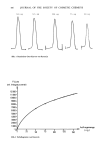
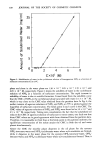
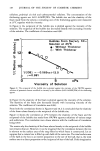
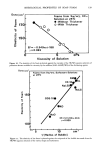
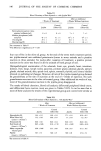
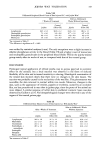
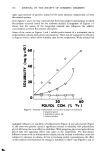
140 JOURNAL OF THE SOCIETY OF COSMETIC CHEMISTS is valid, the foam elasticity can be associated to the dynamic surface tension of the soap solution. CONCLUSION The addition of fatty acids changed the dissolved state of the model soap consisting of sodium laurate, sodium palmitate and sodium oleate to lower the transition tempera- ture except in the case of palmitic acid. There was a close relationship among the bubble size, the elasticity of the foam and the viscosity of the soap solution. The elasticity of the foam and the reciprocal of the bubble size decreased With increasing viscosity of the solution. The correlation between the elasticity of the foam and the reciprocal of the bubble size was a linear relation having a minus coefficient. REFERENCES (1) B. Derjaguin, Die elastischen Eigenshaften der Sch iume, Kolloid-z., 64, 1 (1933). (2) B. Derjaguin and E. Obuchov, Untersuchungen iiber die mechanischen Eigenshaften disperser Systeme und Oberfliichenschichten. II. Die elastischen Eigenshaften und Dispersit}it der Schiiume, Kolloid-z., 68, 243 (1934). (3) J. O. Sibree, The viscosity of froth, Trans. Faraday Soc., 30, 325 (1934). (4) G. V. Scott and W. E. Thompson, Measurement of foam consistency,J. Amer. Oil Chem. Soc., 29, 386 (1952). (5) H. G. Wenzel, R.J. Brungraber and T. E. Stelson, The viscosity of high expansion foam,J. Mater., 5, 396 (1970). (6) J.j. Bikerman, "Foam," Springer-Verlag, New York (1973). (7) H. Komatsu, H. Yamada and S. Fukushima, Rheological properties of soap foam. I. Apparatus for viscoelastic measurement on foam,J. Soc. Cosmet. ½hem., 29, 237 (1978). (8) H. Yamada, H. Komatsu and M. Tanaka, A study on the improvement in the foam characteristics of soap foam by the addition of super-ratting agents, submitted toJ. Amer. Oil Chem. Soc.

j. $oc. Cosmet. Chem., 33, 141-148 (May/June 1982) Physiological toleration of jojoba wax in laboratory animals A. YARON, A. BENZIONI, Research and Development Authority Ben-Gurion University of the Negev, P.O. Box I025, Beer-Sheva 84110, Israel, I. MORE, D. MAHLER, Department of Plastic Surgery, Soroka Medical Center and Faculty of Medical Sciences, Ben-Gurion University of the Negev, Beer-Sheva, Israel, A. MESHORER, The 1Veizmann Institute of Science, Rehovot, Israel. Received January 15, I982. Synopsis Subacute toxicity tests of jojoba wax were performed in guinea pigs and rats. Refined jojoba wax was applied daily, topically to guinea pigs for prolonged periods. The guinea pigs showed normal growth and no histopathological changes in the internal organs were observed. In rats injected subcutaneously daily for several weeks, no histopathological changes were observed, only a mild local granulomatous reaction. The results of analyses of blood and urine chemistry and of blood-cell profile in the rats injected with jojoba wax were similar to the values in the control group injected with olive oil. The small differences that were found between the treated group and the control in the counts of monocytes and neutrophilic granulocytes of peripheral blood were characteristic of a reaction to foreign material. INTRODUCTION Jojoba [Simmondsia chinends (Link) Schneider] is a shrub indigenous to the Sonoran Desert being domesticated in various arid zones around the world and in Israel's Negev desert. Its seeds contain a large amount (50-60%) of a liquid wax composed of esters of fatty acids and fatty alcohols (1). This wax is becoming an increasingly popular ingredient in cosmetic preparations. The physical and chemical properties of crude jojoba wax were reported and reviewed earlier (1-4). Toxicity tests, performed before jojoba products were first commercialized, showed that the wax had no acute toxicity in mice, i.e. LD50 was greater than 160g/kg (5). In ocular irritation tests in rabbits, refine d jojoba wax gave some reversible irritation, a reaction similar to that caused by the olive oil (5). In skin irritation tests in guinea pigs, no pathological inflammations were observed, and the authors attributed the swelling of the epidermis and the hypertrophy a•t the hair roots to mechanical irritation caused by shaving (5). The response to jojoba wax in this case was less marked than the response to light liquid paraffin. In patch tests on human skin (5) only hyperallergic people exhibited sensitivity to jojoba wax (whether crude or refined). Studies on the absorption of jojoba wax injected subcutaneously (s.c.) into mice showed that the wax 141
Purchased for the exclusive use of nofirst nolast (unknown)
From: SCC Media Library & Resource Center (library.scconline.org)