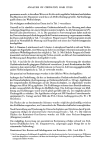
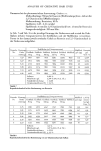
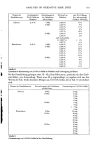
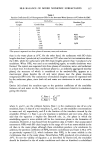
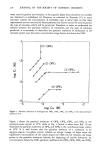
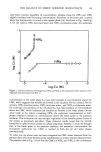
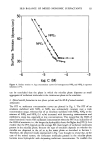
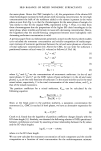
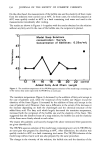
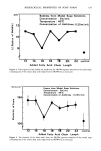
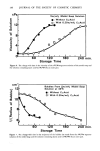
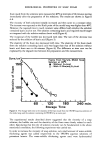
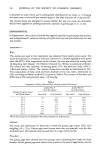
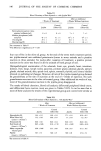
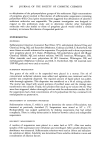
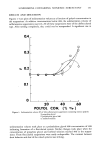
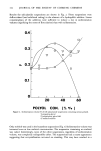
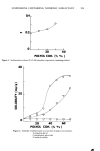
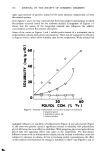
HLB BALANCE OF MIXED NONIONIC SURFACTANTS 119 were kept constant regardless of concentration, whereas those for OPE 4 and OPE 5 slightly increased with increasing concentration. Therefore, in the latter case, it seems likely that dimerization occurred in the organic phase (19). As shown in Fig. ! and Fig. 2, for the systems OPE4-isooctane-water and NPE6-cyclohezane-water, the surfactant -1 -2 -3 NPE6 I NPE8 I I I -5 -4 -3 -2 log Cw (M) Figure 2. Partition isotherms of homogeneous NPE 6 and NPE, in the cyclohexane-water system at 25øC. Reprinted with permission from Ref. 12. concentration in the water phase (C,) was held constant at concentrations above the CMC, which suggests that micelies are formed in the oil phase. On the contrary, for the systems OPE6-isooctane-water, OPEs-isooctane-water , and NPEs-cyclohexane-water, the surfactant concentration in the oil phase (Co) was held cons'tant at concentrations above the CMC, which indicates that micelies are formed in the water phase. On the other hand, in the system containing OPEs, the surfactant concentrations in both phases remained constant at concentrations above the break point in the partition isotherm. This is because the macroscopic separation of the miceIlar phase occurs in the system as previously described. These observed results reveal that the micelie formation is a phenomenon similar to a phase separation. Namely, it would be thought that, at the break point in the partition isotherm, the saturation concentration for monomeric surfactants (i.e., CMC) is reached in both the oil and water phases simultaneously. To make sure the above view, we have compared the CMC values obtained from the partition data with those determined by solubilization or surface tension measurements. The partition data in Fig. 2 show that the CMCs of NPE6 and NPE, in the cyclohexane

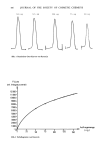
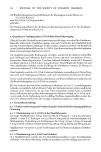
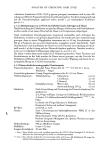
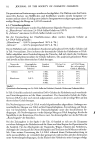
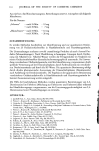
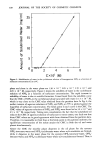
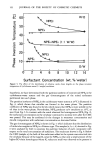
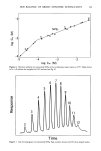
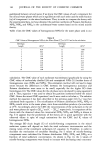
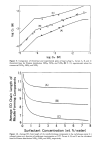
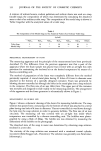
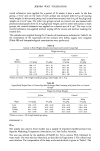
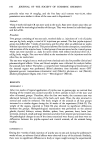
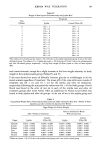
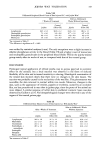
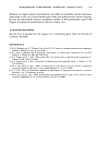
120 JOURNAL OF THE SOCIETY OF COSMETIC CHEMISTS E 25 E '- 20 'o 15 • lO • 5 • o 0 2 4 6 C XlO • (M) Figure 3. Solubilization of water in the cyclohexane solution of homogeneous NPE6 as a function of surfactant concentration (C) at 25øC. phase and those in the water phase are 1.30 x 10 -2, 2.85 x 10 -3, 2.70 x 10 -5, and 4.05 x 10 -5 M, respectively. Figure 3 shows the solubility of water in the cyclohexane solution of NPE6 as a function of surfactant concentration. The rapid increase in solubility of water is due to micelie formation. It was found from the solubility curve that the CMC of NPE6 in the cyclohexane phase saturated with water is 1.5 x 10 -2 M, which is very close to the CMC value obtained from the partition data. In Fig. 4, the surface tension of aqueous solutions of NPE 6 and NPE s at 25øC is plotted against the logarithm of surfactant concentration. The break point in each curve is the CMC. The CMC values of aqueous solutions of NPE6 and NPE8 were found to be 3.0 x 10 -5 and 4.5 x 10 -5 M, respectively. Taking into consideration the fact that the solubilized oil reduces the CMC of aqueous solution of surfactant to some extent, one finds out that these CMC values are in good agreement with those obtained from the partition data. Therefore, it is reasonable to think that, at the break point in the partition isotherm, the equilibrium concentration of the solute attains the CMC in both the oil and water phases simultaneously. Above the CMC the miceliar phase disperses in the oil phase for the systems OPE4-isooctane-water and NPE6-cyclohexane-water where w/o emulsions are formed, while it disperses in the water phase for the systems OPE6-isooctane-water, OPEs- isoctane-water, and NPEs-cyclohexane-water where o/w emulsions are formed. Thus, it
Purchased for the exclusive use of nofirst nolast (unknown)
From: SCC Media Library & Resource Center (library.scconline.org)