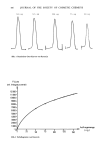
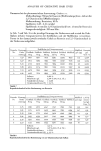
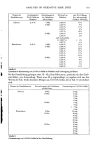
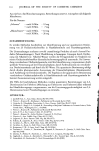
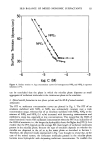
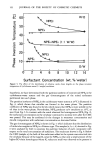
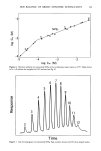
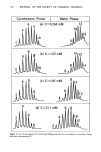
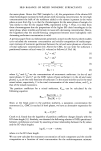
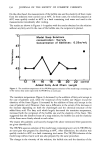
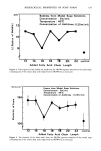
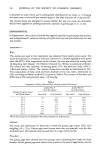
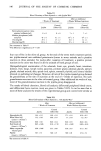
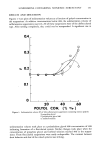
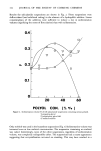
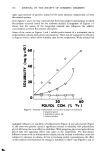
HLB BALANCE OF MIXED NONIONIC SURFACTANTS 125 the water phase. Above the CMC (samples b, c, d), the proportions of the shorter EO chain homologues increased in both phases with increasing concentration. At very high concentrations the bulk of the surfactant added to the system is present in the water phase as seen from Fig. 6, so that the chromatogram for the water phase of sample d is very similar to that for the original NPE• represented in Fig. 7. Thus, it is clear from these chromatograms that the proportions of the higher EO chain homologues in the water phase, where micelies are formed, increase with decreasing concentration. Hence, the hypothesis that the micelie-forming components become more hydrophilic with decreasing surfactant concentration is valid. A previous paper from our laboratories presented a mixed micelie theory which enables us to calculate the monomer concentration and micelie composition of multicompo- nent mixtures of nonionics partitioned between the oil and water phases as a function of total surfactant concentration (10). Above the CMC, we can write for surfactant.i partitioned between oil and water (1:1 volume) as follows (cf. Ref. 10): Cmi ø = xiCi ø (3) Cmi w = xiCi w (4) = (5) C + Ci ø + Ci w -- C m 2•xi-- 1 (6) where Cmi ø and Cmi w are the concentrations of monomeric surfactant i in the oil and water phases, Ci ø and Ci w are the CMC values of pure surfactant i in the oil and water phases, xi, c• i are the mole fractions of surfactant i in the mixed micelles and in the total mixed solute, respectively, C is the total concentration of the mixed solute, and Cm is that of the mixed monomers. The partition coefficient for a mixed surfactant, Kmix, can be calculated by the following equation: + 1) Kmi x = (7) ZCgi/(K i •1_ 1) Since, at the break point in the partition isotherm, a saturation concentration for monomers (i.e., CMC) is reached in both phases, we have an alternative expression for Ki: K i = Ciø/Ci w (8) Crook et al. found that the logarithm of partition coefficient changes linearly with the EO chain length (13). Similarly, we obtained the following relation of NPEs partitioned between cyclohexane and water by assuming a linear relationship between the K i values and the EO chain lengths. log K• = 5.19 -- 0.418n (9) where n is the EO chain length. We can now calculate the monomer concentration of each component and the micelle composition as a function of total concentration for the multicomponent mixtures

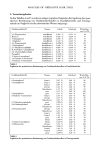
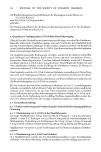
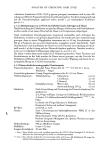
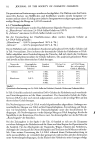
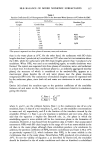
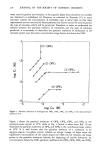
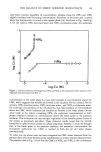
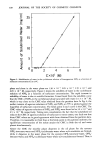
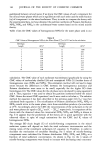
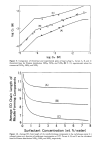
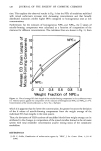
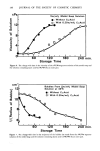
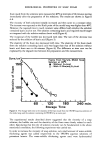
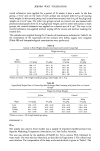
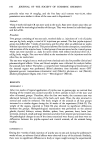
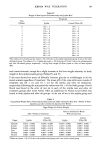
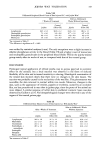
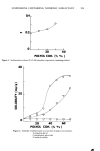
126 JOURNAL OF THE SOCIETY OF COSMETIC CHEMISTS partitioned between oil and water, if we know the CMC values of each component for the oil and water phases which are in equilibrium with each other and the mole fraction (c•i) of component i in the mixed surfactant. Thus, in order to compare the theory with the experimental data, we have obtained the partition isotherms of Poisson distribution NPEa, NPEa, and NPE•6 in the cyclohexane-water system based on the mixed micelie theory. Table 2 lists the CMC values of homogeneous NPEs for the water phase used in our Table II CMC Values of Homogeneous NPEs in the Water Phase (C,") at 25øC Used in the calculation EO Chain EO Chain Length 105 Ci" Length 10 I 0.70 11 8.80 2 0.92 12 10.0 3 1.20 13 10.5 4 1.50 14 11.2 5 2.00 15 11.8 6 2.70 16 12.2 7 3.30 17 12.8 8 4.05 18 13.4 9 5.50 19 14.1 10 7.00 20 14.7 calculation. The CMC value of each surfactant was estimated graphically by using the CMC values of molecularly distilled (20) and commei?cial NPEs (21) besides those of homogeneous ones (NPE6 and NPEs). This estimation method will not lead to large errors because the differences in CMC between the homogeneous nonionics and Poisson distribution ones seem to be small, especially for the higher EO chain homologues (22). The CMC values for the oil phase were calculated by using equation 8 and 9. Then, equation 7 was used to obtain the partition isotherms below the mixed CMC. Above the mixed CMC equations 5 and 6 were used to calculate xi. The solution method for equation 6 has been described in the previous paper (10). Cmi ø was then calculated from equation 3. The micellization of Poisson distribution NPEa, NPE• or NPE?6 would occur in the water phase, since these emulsifiers produce o/w emulsions at 25øC. Accordingly, above the CMC the concentrations of the surfactants in the oil and water phases are equal to ZCmi ø and C -- ZCmi ø, respectively. A comparison of the theory with the observed values for commercial NPEa, NPE•, and NPE?6 is shown in Fig. 9. It appears that the predictions of the theory are in good agreement with the observed values in spite of rough estimations for the CMC and Ki values of homogeneous NPEs. The average EO chain length (•) of micelie-forming components in the mixed surfactant system will depend on both the total surfactant concentration and the mixing ratios of the constituent surfactants (cf. equation 5). Therefore, in order to elucidate the mechanism of emulsifier blending, the • values of micelie-forming components were calculated for Poisson distribution NPEg, NPE•, and NPE• as a function of total surfactant concentration. As shown in Fig. 10, the • values of micelie-forming components were found to increase with decreasing total concentra-
Purchased for the exclusive use of nofirst nolast (unknown)
From: SCC Media Library & Resource Center (library.scconline.org)