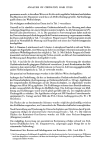
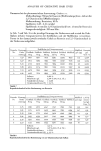
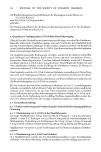
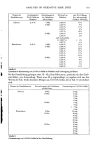
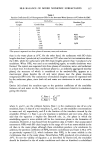
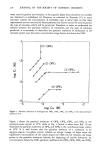
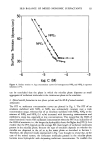
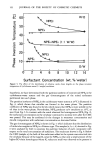
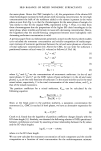
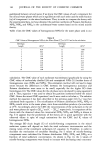
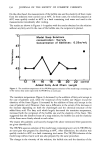
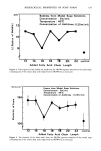
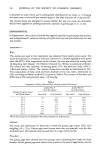
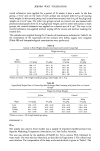
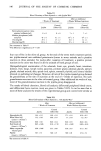
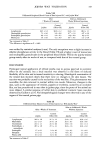
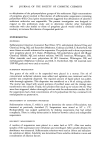
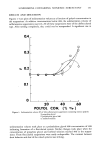
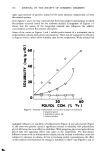
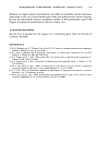
HLB BALANCE OF MIXED NONIONIC SURFACTANTS 121 50' 40 NPE6 30- NPE8 -6 -5 -4 -3 log C (M) Figure 4. Surface tension vs. log concentration curves for homogeneous NPE6 and NPEg in aqueous solution at 25øC. can be concluded that the phase in which the micellar phase disperses as small aggregates of surfactant molecules is the continuous phase in the emulsion. 2. Mixed micelle formation in two-phase systems ,and the HLB of mixed nonionic surfactants The PIT vs. surfactant concentration curves are plotted in Fig. 5. The PIT of an emulsion stabilized with NPE 6 or NPE8 was substantially constant over a wide concentration range, whereas that of an emulsion stabilized with NPF, g6, NPE• or the mixture of NPE 6 and NPE8 (1:1 w/w) increased with decreasing concentration and exhibited a steep rise, es ecially at low concentrations This mean• that the HLB of mixed nonionics varies --wlth suffactant concentration gitice the PIT ig an indication of the HLB of nonionics, ie ithe i0i:i•'•'• the"hs dro hilic chairS, the-h• •her t'he PiT (3) It is ß . g , , p ..... .g . evident that the PIT depends _on th• a•,•'•ageEo C'fialn length of surfactant molecules present in •he._•.mi.ce!.!a.r, phase, because the type?• e.m_u!•sion depends on whether the micelles are ,dispersed •in t.h•,.9i!.,•9_r•_..in•he..,•at•r_phase as described in Section 1. Therefore, the observed results represented in Fig. 5 are thought to reveal that, in the case of the mixed system, the surfactant molecules presen t in the miceliar phase become more hydrophilic with decoreasing Surfactant concentration. To confirm this

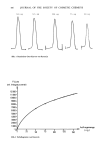
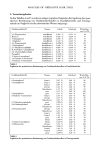
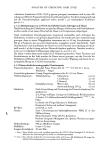
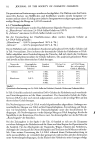
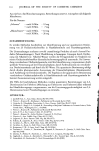
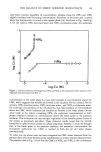
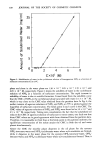
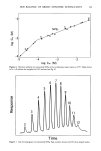
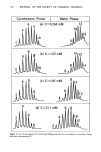
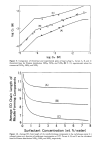
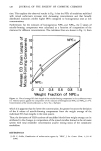
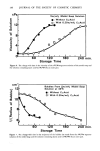
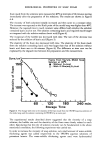
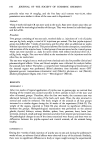
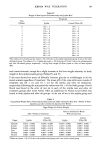
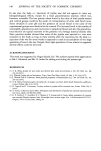
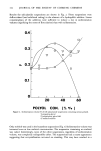
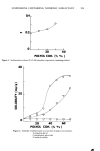
122 JOURNAL OF THE SOCIETY OF COSMETIC CHEMISTS 6o E 4O = 30 O 20 • w/0 NPE8 •• _ • NPE6-NPE8 (1'1 W/W) • o o NPE6 • o o/w I I I I I I I 2 4 6 8 Surfactant Concentration (wt. %/water) Figure 5. The effect of the distribution of ethylene oxide chain lengths on the phase inversion temperature of cyclohexane-water (1:! weight) emulsions. hypothesis, we have determined both the partition isotherm of commercial NPE• in the cyclohexane-water system and the gas chromatograms of the mixed surfactant partitioned into each phase. The partition isotherm of NPE• in the cyclohexane-water system at 25øC is illustrated in Fig. 6, which shows that micelies are formed in the water phase. The partition coefficient of NPE• was found to be 9.0, which means that NPE• is more soluble in the oil than in the water phase. Nevertheless, NPE• produces o/w emulsions at 25øC, as seen from Fig. 5. In contrast with the result obtained for homogeneous NPE8 (Fig. 2), the surfactant concentration in the oil phase continued to increase even after the CMC was passed. This may be attributed to the changes in monomer concentration and micelie composition with surfactant concentration as discussed below. The gas chromatogram of NPE• is shown in Fig. 7, which indicates that the distribution of molecular weights in NPE• is a Poisson type. The samples (a, b, c, d) denoted in Fig. 6 were analyzed by GLC to examine the partition behavior of each component with respect to the total concentration of surfactant. The results are shown in Fig. 8. Below the CMC (sample a), the bulk of the surfactant added to the system was extracted into the oil phase because of the large K i value for NPE•, so that only a small amount of the higher EO chain homologues whose Ki values are small was observed to be present in
Purchased for the exclusive use of nofirst nolast (unknown)
From: SCC Media Library & Resource Center (library.scconline.org)