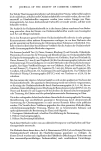
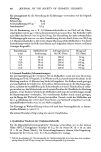
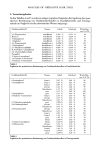
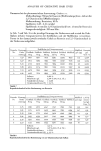
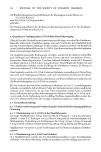
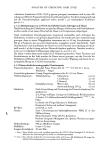
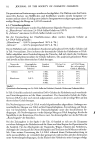
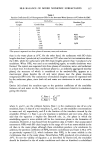
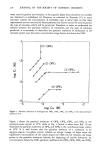
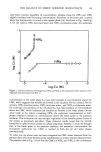
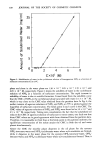
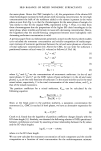
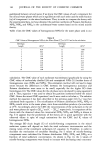
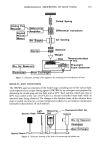
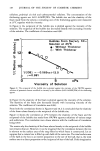
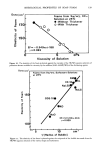
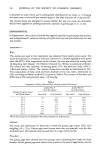
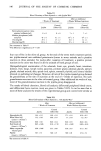
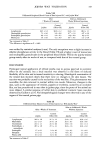
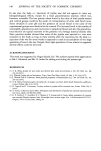
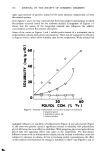
132 JOURNAL OF THE SOCIETY OF COSMETIC CHEMISTS A mixture of sodium laurate, sodium palmitate and sodium oleate was used as a soap (model soap), the composition of which was determined by simulating the dissolved state to that of an ordinary toilet soap. The composition of the model soap is shown in Table I together with the analytical values of a toilet soap. Table I The Composition of the Model Soap and the Analytical Values of an Ordinary Toilet Soap. (w/w%) •NaCn NaC•2 NaC•4 NaC•6 NaC• NaC• Others Toilet Soap 2 16 7 20 16 30 9 Model Soap -- 12 -- 40 -- 48 -- MECHANICAL MEASUREMENT OF FOAM The measuring apparatus and the principle of the measurement have been previously described (7). The difference from the previous apparatus was that a part of the apparatus where the foam sample was placed was covered with an air-tight box with provision for maintaining the enclosed air at the desired temperature by means of a thermo-controlling unit. The method of preparation of the foam was completely different from the method previously reported. A round metal plate having 25 holes of 0.1mm in diameter were attached to the bottom of a specially designed container. Foam was generated by blowing thermo-controlled air through the holes in the metal plate into a soap solution in the container. The flow rate of air was 200cc/min. The upper part of the container was movable and designed to slide readily to the measuring position. The arrangement of the apparatus and the foam generator is schematically shown in Figure 1. MEASUREMENT ON BUBBLE SIZE Figure 2 shows a schematic drawing of the device for measuring bubble size. The soap solution was poured into a measuring cell, the bottom of which was attached to a metal plate having one hole of 0.1mm in diameter. Therm0-controlled air was blown through the hole into the soap solution in order to generate bubbles. The flow rate of air was 12cc/min. The measuring cell was covered with an air-tight box inside which temperature was controlled by a thermo-controlling unit. The bubbles were photo- graphed by using a flash of 200#s. The bubble size was obtained by measuring the dimensions of the bubble on the photograph. The dissolved state of the soap in water was determined by observing soap solution enclosed in a test tube. The viscosity of the soap solution was measured with a rotational coaxial cylinder viscometer (Seiki Koggo Lab., Vismetron). The solution was generally non-Newtonian (thixotropic).

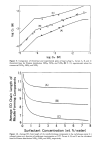
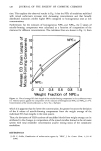
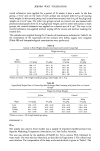
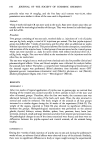
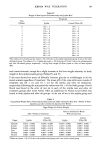
RHEOLOGICAL PROPERTIES OF SOAP FOAM 133 Analog Pen! Recorder •l--IDifferential ß ., i--JArnplifier IDigita'l I IPeriod I• I Meter/lAir Supply Coiled Spring Differential transducer Air bearing IStarter •, IDry Air Reservoir I I IFIowmeterl•--lHeat Exchanger I Solenoid Weight Thermocontrolled •11..: ?isk I 'box IFoam I0•.•:•• I PneurnatiGenera Figure 1. Schematic drawing of the apparatus for measuring the viscoelasticity of foam. RESULTS AND DISCUSSION The 5W/W% aqueous solutions of the model soap containing one of the various fatty acids respectively as a super-fatting agent 0.25W/W% by an outer part were prepared by dissolving the model soap and one fatt) acid at 60øC. Each solution which was clear at 60øC was cooled at the rate of 0.5øC/hr in a thermo-controlled water bath while its dissolved state being observed. The change in the dissolved state of the solution from clear to turbid occurred at a certain temperature (referred to as transition temperature hereinafter) characteristic of each solution. Optical Bench Light Electric Flash Diffuser Measuring /Thermøcøntrølled box Cell J Camera ]Dry Air Reservoir I I IFIowmeterl I •lHeat Exchanger] Figure 2. Schematic drawing of the device for measuring the bubble size.
Purchased for the exclusive use of nofirst nolast (unknown)
From: SCC Media Library & Resource Center (library.scconline.org)