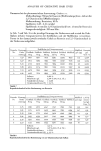
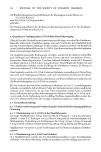
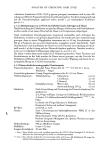
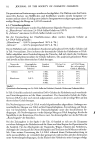
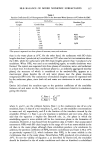
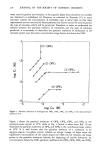
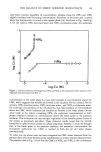
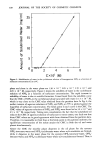
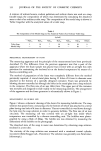
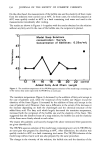
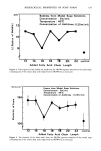
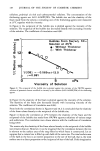
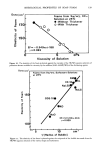
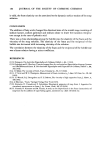
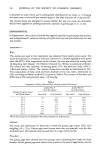
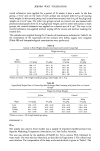
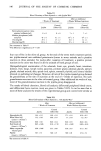
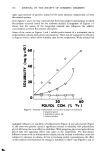
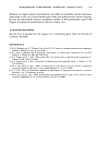
134 JOURNAL OF THE SOCIETY OF COSMETIC CHEMISTS On the other hand, the measurement of the bubble size and the elasticity of foam made from the solutions were carried out at 40øC. In these cases, the solutions prepared at 60øC were quickly cooled to 40øC in a bath containing iced water and used in the measurements immediately after cooling. The results are shown in Figures 3-5 together with the results obtained on the solution without any fatty acid. In the case of the bubble size, the reciprocal is plotted. øc 47 [ 45 43 Model Soap Solutions concentration: 5w/w% Concentration of Additives: 0.25w/w% • I I I ! __1 I I 12 14 16 18 18 20 22 Added Fatty Acid Chain Length control Figure 3. The transition temperature of the 5W/W% aqueous solutions of the model soap containing one of the various fatty acids respectively 0.25W/W% by an outer part. The transition temperature (Figure 3) decreased by the addition of fatty acid except in the case of palmitic acid, while the reciprocal of the bubble size (Figure 4) and the elasticity of the foam (Figure 5) increased by the addition of fatty acid except in the case of palmitic acid. However, there was a difference in the extent of the decrease or the increase depending on both the chainlength and the chemical structure of the added fatty acid. The fatty acid which largely decreased the transition temperature, increased both the reciprocal of the bubble size and the elasticity of the foam. This suggested that the dissolved state of a soap solution, the bubble size and the elasticity of the foam were closely related to each other. The reason why palmitic acid scarcely changed the above mentioned three parameters are given elsewhere (8). The 5W/W% aqueous solution of the model soap containing lauric acid 0.25W/W% by an outer part was prepared by dissolving at 60øC. After dissolution, the solution was quickly cooled to 40øC in a bath containing iced water. The 5W/W% solution of the model soap without lauric acid was also prepared by the same procedure. The change in the viscosity of the solution, the bubble size and the elasticity of the

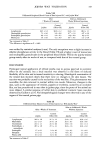
RHEOLOGICAL PROPERTIES OF SOAP FOAM 135 cm-1 Bubbles from Model Soap Solutions Concentration: 5w/w% Temperature: 40øC Concentration of Additives: 0.25w/w% ' I I I I I I ' 12 14 16 18 1--8 20 22 control Added Fatty Acid Chain Length Figure 4. The reciprocal of the bubble size made from the 5W/W% aqueous solutions of the model soap containing one of the various fatty acids respectively 0.25W/W% by an outer part. Dyne/cm = 150 100 Foams from Model Soap Solutions Concentration: 5w/w% Temperature: 40øC Concentration of Additives: 0.25w/w% ' I I I I I I 12 14 16 18 T8 20 22 Added Fatty Acid Chain Length i control Figure 5. The elasticity of the foam made from the 5W/W% aqueous solutions of the model soap containing one of the various fatty acids respectively 0.25W/W% by an outer part.
Purchased for the exclusive use of nofirst nolast (unknown)
From: SCC Media Library & Resource Center (library.scconline.org)