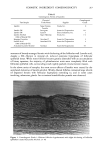
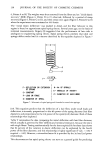
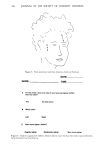
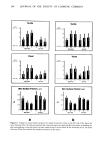
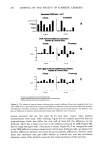
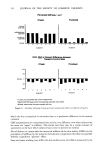
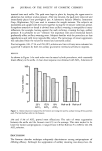
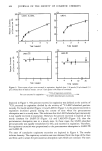
252 JOURNAL OF THE SOCIETY OF COSMETIC CHEMISTS MUCH I SOFTER SLIGHTLY SOFTER EQUAL Perceived Stiffness, t vs c* Cheek Forehead 1 2 3 4 5 6 7 1 2 3 4 5 6 7 SUBJECT SUBJECT +IO0 +50 EQUAL 0 -50 DSR, Shift in Percent Difference between Treated & Control Sites Cheek Forehead miniriB n 1 2 3 4 5 6 7 1 2 3 4 5 6 7 SUBJECT SUBJECT *T and C are treatment and control respectively. *MUCH SOFTER means that the treatment side was much softer. *EQUAL means that they were equally stiff, etc. Figure 11. Emollient softening of soap and water washed skin. Shift is as defined in Figure 9. which the skin is stretched in situ rather than to a qualitative difference in the stratum corneum. GBE measurements on contralateral sites may be very different, even when subjects say the areas are "equal" in stiffness. This shows that there may be a certain amount of asymmetry on the face which subjects have come to perceive as normal. Not all lotions or creams alter the measured stiffness of the skin surface (GBE) nor the perception of stiffness by the subjects formulation comparisons therefore are possible without a significant "placebo" effect. Soap and water washing may stiffen the skin surface some 20-100% as measured by the

FACIAL OILINESS AND DRYNESS 253 GBE. This change is readily perceived by subjects, but perceived stiffening may not correspond exactly to that measured by the GBE. Effective emollients soften the skin surface there is a change of 20-50% that is readily perceived by subjects. Changes are more easily perceived on the cheeks than on the forehead, whether the skin surface is stiflened or softened. The reason for this, as some subjects suggested, may be that the eyebrows reduce perceptiveness on the forehead, perhaps because the skin there is not as effectively "treated" by emollients, etc. In cosmetic science research, sensitive objective methods can be of limited usefulness if the changes measured by them are not perceived by subject or observer in real-life situations. In the present study, we have defined a range of instrumental changes which correspond to skin surface changes perceived by subjects. This exercise greatly enhances the utility of these instruments for development and evaluation of topical products. ACKNOWLEDGEMENT The authors thank Mr. B.C. Tillery for his many helpful suggestions and expert editorial assistance in the preparation of this manuscript. REFERENCES (1) S. Nacht, J. Close, D. Yeung, and E. H. Gans, Skin friction coefficient: Changes induced by skin hydration and emollient application and correlation with perceived skin feel,J. Sac. Cosmet. Chem., 32, 55-56 (1981). (2) M. S. Christensen, C. W. Hargens, S. Nacht, and E. H. Gans, Viscoelastic properties of human skin: Instrumentation, hydration effects, and the contribution of the stratum corneum,J. Invest. Derm., 69, 282-286 (1977). (3) E1-Shimi, A. F., In viva skin friction measurements,J. Sac. Cosmet. Chem., 28, 37-51 (1977).
Purchased for the exclusive use of nofirst nolast (unknown)
From: SCC Media Library & Resource Center (library.scconline.org)