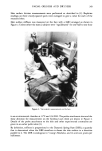
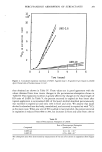
ANTIPERSPIRANT EVALUATION 259 Repeated testing of the same woman gave values which varied rather little, whether the interval between tests was days or weeks (r = 0.904, p 0.001). Moreover, we have not been able to show consistent differences between the right and left sides, rare persons excepted. The outputs were similar in opposite axillae. We also kept in mind that the greatest quality of sweat is generated in a small area about 5 cm in diameter at the apex of the axillary vault. The density of glands is highest here, and the output per gland is also larger. This knowledge is the basis of a simple surgical procedure for overcoming hyperhidrosis by excising a small ellipse of skin from the vault (15). It is this high output, high density area that is most refractory to the action of antiperspirants. Thus, this is the target region for antiperspirants. Another item to be considered is the pattern of recruitment of thermal sweating. Randall et aL (16) found that the dorsal foot sweated first spreading to progressively higher body levels. Using the starch-iodine method, we found that sweating began almost simultaneously on the forearms and the axilla. We decided, therefore, to utilize the onset of forearm sweating as the starting point for a ten minute collection of axillary sweat. Our ten minute collection is a practical compromise and seems to be quite dependable, perhaps because at 55øC sweating peaks at about this time. METHOD To preselect subjects, aluminum chloride responsiveness was determined on females as follows. Oval-shaped, 10 x 6 cm pads of a double layer of Webril © backed with impermeable tape (Blenderm ©, 3M Co., St. Paul, Minn.) were soaked in 20% aqueous AICI3, snugly pressed into one axilla, and held in place for 3 hours. The subjects sat quietly in an air conditioned room during the exposure. Occlusion was obtained by impermeable plastic film (Saran-Wrap ©, Dow-Chemical Co., Indianapolis, Ind.) cover- ing the entire axillary vault. An elastic tubular bandage (Hygi NetR ©, Jetnet Co., Carnegie, Pa.) tailored to the shoulder provided additional pressure to keep the pads constantly against the skin. We wished to avoid bandaging with adhesive tape. Sweating was measured 24 hours later (see below). Individuals with less than 35% sweat inhibition of the treated side as compared to the untreated opposite side were rejected. Five subjects comprised a panel. After pretesting, the subjects had a rest period of at least two weeks during which antiperspirants were not used. Shaving of the axillae was permitted. Then, the antiperspirant test was carried out on the axilla which had not been exposed to AIC13. To conduct the test one axilla of the supine subject received ! ml of the test solution from an automatic pipette. The area was vigorously rubbed for one minute using an empty roll-on applicator. The axilla was then covered with Saran Wrap © for another four minutes, to prevent evaporation. This sequence was immediately repeated with another one minute massage-application. The whole procedure took ten minutes. Massaging the skin was shown to enhance strongly the antiperspirant activity (11) it also mimics the way antiperspirants are used. This sequence was repeated on mornings and afternoons for three days (six exposures). Sweat inhibition was assessed gravimetri- cally on the following morning. The subjects were placed in an environmental chamber at 55øC and 30% R.H. Ten minutes after recruitment of forearm sweating (starch iodine visualization), the axillae were blotted dry, and 10 x 6 cm oval-shaped pads consisting of a double layer of nonwoven cloth (Webril©), tared in air-tight 2-ounce jars, were

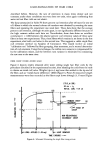
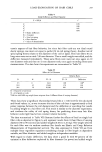
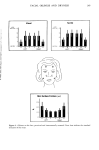
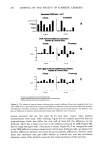
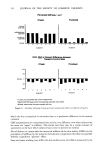
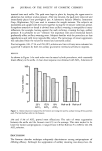
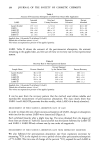
260 JOURNAL OF THE SOCIETY OF COSMETIC CHEMISTS inserted into each axilla. The pads were kept in place by keeping the upper arms in adduction but without undue pressure. After ten minutes, the pads were removed and immediately placed into preweighed jars. A laboratory balance (Mettier, Instrument Corp., Hightstown, N.J.) was used to measure the weight increase. The subjects sat motionless and upright with the knees together during the 10 minute collection period. Scrupulous attention to detail is advised since axillary sweating is susceptible to many influences, for example, leaning against the wall, reclining, crossing the legs, axillary pressure. It is advisable to use "veterans" for important tests since emotional factors profoundly affect axillary sweating rates. Subjects familiar with the procedure are less apprehensive and yield more reproducible values. The percentage of sweat suppression was calculated from the values for treated and untreated axillae. Five test agents, 10%, 17.5%, and 25% A1C13 solution and two roll-ons, were evaluated on a panel of 5 subjects by both the axillary gravimetric method and forearm imprints. RESULTS As shown in Figure 2 the rank order was the same by both procedures, with constantly lower efficacy in the axilla. A clear dose response was obtained with A1C13. Solutions of lOO 25- 250.% 1Z5% 10% Roll-on [] AICI 3 AICI 3 AI CI 3 Roll-on F Figure 2. Sweat reduction evaluated by the forearm screening test and by axillary testing of five panelists each. The hatched bars refer to the forearm. 25% and 17.5% of A1C13 proved most efficacious. The ratio of sweat suppression between the axilla and the forearm was 0.74 on the average. This ratio tended to be lower for weaker antiperspirants it ranged from 0.48 for Roll-on F to 0.89 for the 25% A1C13 solution. DISCUSSION The forearm chamber technique adequately discriminates among antiperspirants of differing efficacy. Although the suppression of axillary sweating was always less, the
Purchased for the exclusive use of nofirst nolast (unknown)
From: SCC Media Library & Resource Center (library.scconline.org)