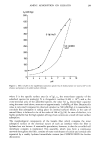
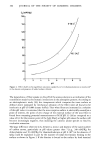
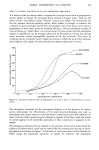
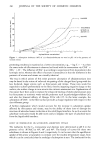
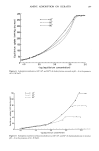
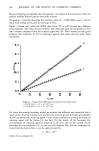
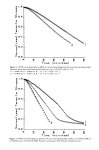
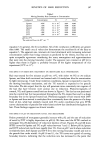
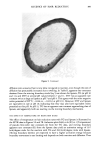
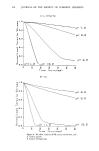
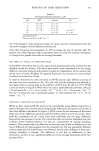
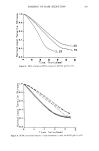
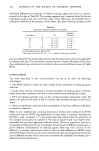
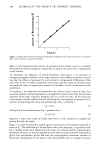
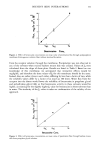
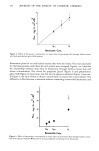
288 JOURNAL OF THE SOCIETY OF COSMETIC CHEMISTS reproducible. The detailed method is as follows: the aqueous diamine sample (approx. 1 ml containing 5-50 x 10 -8 moles diamine) was introduced into a stoppered tube. To this was added borate buffer (0.5 ml, 0.1 M Na2B407, 0.1 M NaOH), and the sides of the tube were washed down with water to give a total volume of 2 mi. A solution of TNBS dihydrate (0.05 ml of 0.55 M) was added, and the solution mixed by shaking. After standing for ten minutes, the solution was neutralized by the addition of glacial acetic acid (1 drop) and butanone (5 ml) added. The tube was then stoppered, and the contents shaken vigorously for 5 seconds. Saturated NaCI (1 ml) was added to speed-up phase separation when this was complete, the upper butanone layer was transferred by Pasteur pipette to a 10 ml volumetric flask. The aqueous layer was re-extracted with butanone (2 ml) which was combined with the first extract, and the volume made up to the mark with solvent. The optical density was measured at 415 nm against an extract of a water blank. The amount of diamine in the sample was estimated from a standard curve relating optical density to concentration. Precision was estimated to be _+ 2%. RESULTS AND DISCUSSION EFFECT OF pH ON SATURATION UPTAKE Figures ! and 2 show the dependence of equilibrium saturation uptakes (Cf) on the pH of the sorbing solution at 40 ø for dodecylamine and 1,12-diaminododecane.* Also shown in these two figures are the same relationships in the presence of sodium chloride (0.1 M). It is apparent from the plots that both adsorbing species have a low substantivity for the fiber at a pH of approximately 3, and it is only at pH values greater than 5 that appreciable fiber adsorption is observed in the pH range 7-9 the uptake shows a marked increase with increasing pH (pH values above 9 resulted in the incipient formation of insoluble free amine). The behavior just described for long-chain amines has been observed for other cationic surface-active species for example, Crewther (14) showed that the uptake of cetyltrimethylammonium bromide on wool increases as the pH of the adsorbate solution rises. The addition of sodium chloride (0.1 M) is observed from Figures 1 and 2 to cause a significant increase in the amount of amine taken up by the fiber at a given pH in the case of the monoamine the increase over the pH range 6-8 is approximately three-fold, while for the diamine the increase is approximately two-fold over the entire experimental range of pH. One further comment that could be made from the data shown in Figures 1 and 2 is that the use of the term "adsorption" as a description of the wool/amine interaction does not imply an external surface adsorptive process. When it is considered that wool has an apparent specific external surface area of approximately 0.5 m2/g •15), and the cross-sectional area of a straight-chain alkyl ammonium ion is around 24 (A) 2 (16), then according to the expression (17): S = Ym' N ß a ß 10 2ø, *Since the pKa values of all amine functions of the adsorbates used in this study are in the range 10-11 (12-13), the species present in solution of pH 8 and below will be essentially the ammonium ions. For the sake of brevity, however, only the free amine will be referred to.

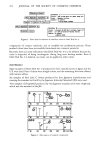
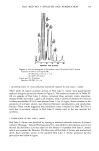
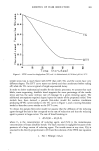
AMINE ADSORPTION ON KERATIN 289 Cf{rnM/Kg} 500 45O 400 350 300 250 200 150 100 50 pH Figure 1. Effect of pH on the equilibrium saturation uptake (Cf) of dodecylamine on wool at 40 ø in the absence and presence of added sodium chloride. where S is the specific surface area (in m2/g), Ym the mono-layer capacity of the adsorbed species (in moles/g), N is Avogadro's number (6.109 x 10²³), and a, the cross-sectional area of the adsorbed species, the value for Ym (mono-layer capacity) using the areas cited above, amounts to approximately 3 mM/Kg of fiber. Because this value is very small compared to observed uptakes (ca. 500 mM/Kg), it is reasonable to conclude that adsorption is taking place on internal surfaces which, in the case of natural fibers, is believed to be of the order of 100 m2/g (18). In view of this fact, it is highly probable that the high uptakes of long-chain cations are a result of inner-surface adsorption. The morphological components of the keratin fiber which comprise the inner adsorptive surface or the chemical nature of such an interface when the fiber is hydrated are not known. A reasonable speculation, however, is that the so-called cell membrane complex is implicated. This assembly, which may form a continuous network throughout the fiber, consists of outer membranes of cuticle and cortical cells separated by a readily hydrated intercellular cement (see CONCLUSION for further discussion).
Purchased for the exclusive use of nofirst nolast (unknown)
From: SCC Media Library & Resource Center (library.scconline.org)