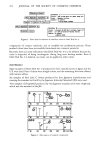
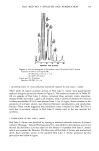
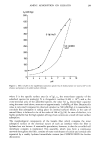
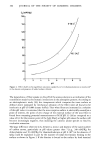
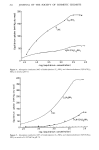
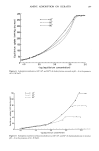
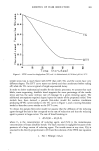
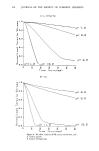
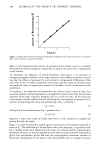
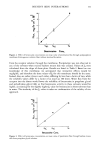
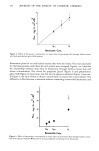
292 JOURNAL OF THE SOCIETY OF COSMETIC CHEMISTS 200 v 150 E ø• • o .o •-"' ø••H2N- [ CH2} •'•N H 2 oiO ß 0 I I I I I I 4.5 4.0 3.5 3'0 2.5 2'0 -log [equilibrium concentration} Figure 4. Adsorption isotherms (40 ø) of dodecylamine (Ct2-NH2) and diaminododecane (H2N-(CH2)•2- NH2) on wool at pH 7.8. 400 0 •0 -- 350 /o o • 300 • o "" 250 •. C12H25NH2 E -- 200 (I o 150 -r- 100 o • 50 0 ' • • • : • , • t , t t , , , , , , , , , 4'0 3-5 3'0 2'5 2-0 -log {equilibrium concentration} Figure 5. Adsorption •sotherms (40 ø) of dodecy]amine (C•2-NH•) and diaminododecane (H2N-(CH2)•2- NH2) on wool in 0.1 • NaC1 at pH 7.8.

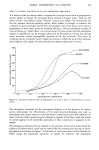
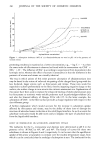
AMINE ADSORPTION ON KERATIN 293 not met. Even the Freundlich plot was not strictly linear, and hence interpretations of other isotherms in this work will be made only on a phenomenological basis. From a study by the Fuerstenau group (23) of the adsorptive interaction of an anionic surfactant with alumina, it was postulated that the adsorption process proceeds over three successive stages. The first (region I), characterised by a low isotherm slope [log (adsorption density) plotted as a function of log Cs], is operative at very low surfactant concentrations and is thought to be typical of uptake on a charged surface by ion exchange of individual molecules. The second (region II) is denoted by an abrupt increase in the isotherm slope. In this region surfactant ions are adsorbed by electrostatic attraction and hemi-micelle association of hydrocarbon chains. The third and final stage (region III) is identified by a reduction in the isotherm slope in this region of relatively high surfactant concentration, opposition to further adsorption is exerted by electrostatic repulsion between ions adsorbed on, and in the vicinity of, the surface. Fuerstenau has speculated that surfactant molecules adsorbed under these conditions may be oriented with the polar groups away from the surface. Rosen (24) has adopted this mechanism to explain the manner in which ionic surfactants are adsorbed to textiles such as wool and nylon that possess charged surfaces. It is possible that the change of slope shown by the isotherms in Figures 5 through 9 is indicative of a transition from region II to region III. At this point (log Cs ca. -2.5) the uptake has reached saturation level (i.e., Cf is constant with increasing Cs) unlike the above mentioned study with alumina where adsorption continued to a lesser extent in region III but was not halted. The concentration range over which region I predominates is, however, less clear, particularly in the absence of added electrolyte. The isotherms for mono- and diaminododecane shown in Figure 4 clearly display appreciable slopes at the lower limits of Cs (log C = ca. -4.5), and it is therefore likely that region II is still operative at this point (to extend the concentration to lower values would require radiochemical analytical techniques). It is possible, however, that the isotherm shown in Figure 5 for the diamine exhibits region I over the concentration range -log Cs = 4 to 3. The critical micelie concentrations (CMC) of the monoamine in the absence (Figure 4) and presence (Figure 5) of added salt are shown on the respective isotherms. It has been suggested (24) that monolayer coverage of the surface is complete in the neighborhood of the CMC. If this is the case for wool-amine systems, then higher orders of aggregation would need to be postulated to account for additional fiber sorption. Evidence that the first region of the isotherm represents a mode of adsorption influenced by electrostatic interactions can be gained by comparing the isotherms without and in the presence of added salt. This can be seen by comparing the isotherms for the C12 mono- and diamines in Figure 4 with the isotherms shown in Figure 5 which were determined in the presence of 0.1 M NaC1. It is readily apparent that over the concentration range log C from -4.0 to -3.5 the amount of amine taken up by the fiber is substantially lower when salt is present. By contrast, the amount taken up by the fiber at saturation uptake [termed the effectiveness of adsorption (23)] is approximately doubled when salt is added to the adsorbate solution. These two contrasting effects suggest that ionic interactions exert opposing influences. Thus at low concentrations of amine, adsorption is initiated largely by an electrostatic attraction to the fiber surface in which case high electrolyte concentrations effectively
Purchased for the exclusive use of nofirst nolast (unknown)
From: SCC Media Library & Resource Center (library.scconline.org)