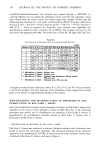
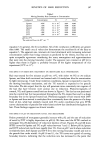
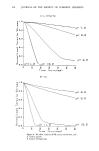
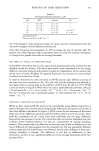
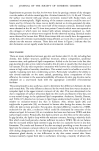
294 JOURNAL OF THE SOCIETY OF COSMETIC CHEMISTS inhibit amine uptake by contracting the electrostatic field around charged groups. On the other hand, at high amine concentrations the contraction of electrostatic fields surrounding the positive head-groups of the adsorbate molecules permit a higher density of packing. Consequently, the barrier to bilayer formation or other modes of aggregation is diminished. INFLUENCE OF SIZE OF HYDROPHOBIC CHAIN ON SATURATION UPTAKE Information concerning the arrangement of adsorbate molecules with respect to each other at the liquid/surface interface can be gained from a comparison of adsorption isotherms pertaining to amines of different hydrocarbon chain-lengths. If the adsorbed amines are arranged with their carbon chains perpendicular to the substrate surface, then variations in chain length will have little or no effect on the amount of adsorbate bound by the fiber (23). This is because the area occupied by each molecule is determined only by the size of the hydrophilic head-group. However, if the layer of adsorbate molecules is not close-packed or at an angle to the surface, then an increase in chain-length of the hydrocarbon-chain will favor more effective van der Waals' contacts, thereby creating a higher packing density and promoting hemi-micellar aggregation. The saturation uptakes at 40 ø and at two pH values for a series of mono- and c•,c0-diamines are listed in Table I. As already noted for the C•2 mono- and diamine TABLE I Saturation Uptake (mMole/Kg dry fiber) at 40øC of Straight-chain Mono- and Diamines on Wool in the Presence of 0.1 ]H NaCl Monoamines Diamines C n- NH 2 NH 2- Cn- NH2 pH (a) n = 8 10 12 n = 8 10 12 3.6 30 50 75 __(b) __ 40 7.8 65 115 385 10 (•) 120 (a) The pH value of the sorbate solution was that recorded at equilibrium for those samples which had attained maximum saturation sorption levels. (b) Uptake amount too small to be measured with certainty. shown in Figures 1 and 2, the saturation uptakes of the monoamines at pH 7.$ compared to pH 3.6 is considerably greater. For the C, and C•0 amines the increase is about double, while for the C,2 amine the increase is 5-fold. In the case of the diamines, a comparison can be made only for the C•2 where the increase in uptake at pH 7.8 compared to pH 3.6 is approximately 3-fold. In both classes of amine the effectiveness of adsorption increases significantly with the addition of two methylene groups in the hydrocarbon-chain. In the monoamine series the increase in uptake comparing C•2 to C, is 6-fold for the corresponding diamines a 12-fold increase is observed. From these results it could be concluded that hydrophobic interactions between adsorbate molecules serve to increase the extent of miceliar aggregation, and that the structure of these aggregates is such that the hydrocarbon chains are randomly oriented with respect to the fiber surface.

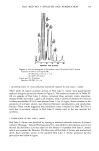
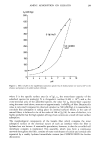
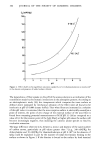
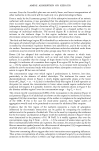
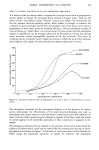
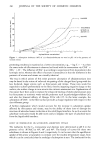
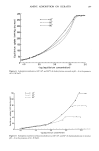
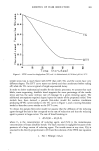
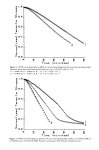
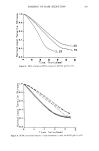
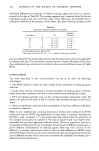
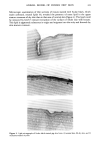
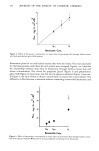
AMINE ADSORPTION ON KERATIN 295 EFFECT OF ADDED ELECTROLYTE ON THE ADSORPTION BEHAVIOUR It is believed that the anions which comprise the lyotropic series show a progressively greater ability to disrupt the hydrogen-bond network of liquid water. Thus for the series of ions--thiocyanate, nitrate, chloride, acetate, and sulfate--the thiocyanate ion has the greatest structure-breaking ability, while sulfate is thought to enhance the cohesion of water hydrogen bonds. The intermediate ions of the above series show a progression in their water-structure-breaking efficiency. Several adsorption studies of dyes on fibers, e.g., Direct Blue 1 on viscose rayon (25) have shown that the adsorption uptake at equilibrium can be strongly influenced by the presence of ions that disrupt water structure around hydrophobic sections of the dye molecule. The series of isotherms shown in Figures 6 and 7 display the extent to which the ions of the lyotropic series influence the uptake of dodecylamine and diaminododecane on wool. 600 500 400 300 200 100 ....... THIOCYANATE /. ./?•..•-.-•-•2"-•-' ..... A NITRATE I I [ i I I 0 2.5 2-0 / / [] / ! I / I I //..///e .// /// ,,ff'•// / // ?' •,,,/ ........... I I I I I I I I I I I I I I I I I I I I /.'5 4'0 3'5 3'0 -log [•quiiibrium ½on½•nJroJionl Figure 6. Adsorption isotherms (40 ø) of dodecylamine on wool at pH 7.8 in the presence of various anions. The adsorption isotherms for the monoamine (Figure 6) in the presence of various anions demonstrate the effectiveness of the water-structure-breaking ions such as thiocyanate and nitrate relative to chloride [which is believed to have little influence on water structure (26)] in promoting the adsorptive capacity of the fiber, while the action of acetate appears to be somewhat anomalous in that a maximum is apparent in the uptake. The adsorption isotherms for the diamine in the presence of the same anions (with the addition of sulfate which could not be tested with the monoamine because of amine precipitation) are shown in Figure 7. In this series it can be seen that it is the chloride ion which causes the maximum saturation of uptake. If, however, the adsorption
Purchased for the exclusive use of nofirst nolast (unknown)
From: SCC Media Library & Resource Center (library.scconline.org)