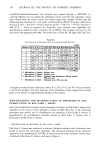
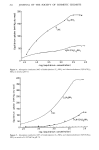
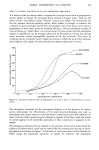
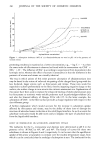
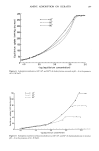
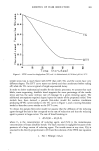
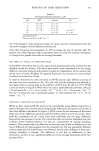
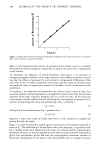
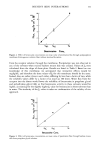
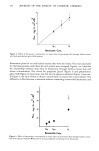
298 JOURNAL OF THE SOCIETY OF COSMETIC CHEMISTS TABLE II Standard Affinity (-- A#ø), Enthalpy (--AHø), and Entropy (AS ø) of Sorption at pH 8 of Dodecylamine and 1,12-Diaminododecane on Wool Over the Temperature Range 40ø-80øC Dodecylamine Diaminododecane -- A/t ø _ AH ø AS ø _ A/t ø _ AH ø AS ø T(øC) Kcal/mole cal/mole cal/mol/deg Kcal/mole cal/mole cal/mol/deg 40 2.654 1.604 approx. 60 2.877 0 8.5 1.687 250 80 2.993 1.782 4.3 diamine on the other hand clearly indicate from the decrease in saturation with temperature that adsorption is an exothermic process. An estimate of standard enthalpy (AH ø) for the adsorption of diaminododecane and standard entropy (AS ø) for the adsorption of both classes of amine were derived from the expression (28): in (D•s•) AHø AS o =-•-• R ' where D t is the concentration of adsorbate at equilibrium (mole/Kg dry fiber), and Ds is the corresponding concentration of adsorbate in the solution phase (mole/liter). The more usual form of the above expression is one in which the partition coefficient (Dr/Do) is considered as a ratio of activities (at/as). Although the activity coefficient of the adsorbate on the fiber can never be determined with certainty, variability with concentration is eliminated by selecting a constant Dt and determining the D s values for each temperature from the point at which the chosen Dt intersects each isotherm (29). This procedure could not be applied to the present study, however, because of the uncertainty of experimental measurement at low concentrations of diamine. The thermodynamic parameters are therefore to be considered as approximations only. The enthalpy of adsorption for the diamine was estimated from the slope of a plot of In (Dr/Ds) against 1/T (øK), and found to be approximately - 250 cal/mol, a value which is comparable to the heats of adsorption of Orange II and HCI (less than 0.8 Kcal/mole) to wool from 60 ø to 100 ø (30). The standard entropy (AS ø) was derived from a plot of standard affinity (Aø/z) vs T (øK) where -A/z ø = RT ln(Dt/D s). The values are shown to be in the range of + 4 to +8 cal/deg/mole (Table II) for diaminododecane and dodecylamine respectively. Because the enthalpies of adsorption are close to zero, the affinity of long-chain amines for keratin fibers must be derived solely from the gain in entropy. Such a conclusion may be relevant to other surface-active cationic species in view of a recent study which found that the adsorption of cetyl pyridinium chloride on carbonized wool is virtually athermal (13). CONCLUSION The results of this study allow broad conclusions to be reached concerning the manner in which long-chain amines interact with keratin fibers. The increase in amine uptake

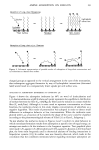
AMINE ADSORPTION ON KERATIN 299 with increasing pH clearly demonstrates that electrostatic interactions play an important role in the adsorption process. The initial binding of the cation to the fiber surface is most likely induced by charge-pairing, while the subsequent cooperative formation of hemi-micellar aggregates would be controlled to some extent by like-charge repulsion between cationic head groups. The non-conformity of the isotherms to Langmuir or Freundlich analysis is clear evidence that the structure of the adsorbed amine at fiber saturation cannot be a monolayer (even though such a structure may be formed at low concentration), while the positive entropy change associated with adsorption indicated the absence of an ordered structure in the surface layer. It is possible, however, that the sign of the entropy change may simply be a consequence of the randomization of adsorbed water molecules following displacement by long-chain ammonium ions. The results of this study nevertheless indicate that aggregation of the amine on the fiber by way of van der Waals' forces is a predominant feature of the adsorption process. Such a two-stage adsorption process in which multilayer formation follows electro- static interactions has been proposed as a likely mechanism for the binding of dodecylammonium chloride on mineral particles with a polar surface (16). As stressed earlier, the nature of the keratin surface upon which cationic species such as amines or indeed all types of ionic substances initially adsorb prior to bulk diffusion has not been clearly defined. Peters and Lister (30) in a fundamental thermodynamic study on the interaction of HC1 and Orange II free acid with wool came to the conclusion that adsorption occurs over a *'vast internal miceIlar surface in a mobile monolayer that inhibits water adsorption," thereby supporting a postulate that was proposed by Speakman (32) over fifty years ago. It has been suggested (33-34) that dyes and other substantive ions may be transported throughout keratin fibers by the cell membrane complex. This structure, which is thought to form a continuous network throughout the fiber, consists of a "sandwich" made up of two membranes (from adjoining cortical cells or cuticle layers) and inter-cellular cement. Such a model may be conceptually similar so that proposed by Speakman who described the internal structure of the fiber in terms of "lameliar micelies" separated by narrow pores which are capable of extensive swelling by water. REFERENCES (1) J. C. Harris, Adsorption of surface-active agents by fibers, Text. Res. J., 18, 669-678 (1948). (2) A. S. Weatherburn and C. H. Bayley, The sorption of synthetic surface-active compounds by textile fibers, Text. Res. J, 22, 797-804 (1952). (3) R. G. Aickin, The adsorption of sodium alkyl sulfates by wool and other fibers, J. Soc. Dyers & Colorists, 60, 60-65 (1944). (4) J. C. Griffith and A. E. Alexander, Equilibrium adsorption isotherms for wool/detergent systems. Parts I and II,J. Coil. Interface Sci., 25, 311-321 (1967). (5) G. Reese, Adsorption processes of amines on hair keratin, Fette, Seifen, Anstrichmittel, 68, 763-765 (1966). (6) G. V. Scott, C. R. Robbins, and J. D. Barnhurst, Sorption of quaternary ammonium surfactants by human hair,.J. Soc. Cosmet. Chem., 20, 135-152 (1969). (7) J. R. Cook and D. E. Rivett, Amine pretreatments for enhancing the polymer shrinkproofing of wool, Text. Res. J, 51,596-600 (1981). (8) I. W. Stapleton, The enhancement of shrinkresist efficiency of two polymers on wool by polyamine pretreatments, Text. Res. J, 53,445-452 (1983).
Purchased for the exclusive use of nofirst nolast (unknown)
From: SCC Media Library & Resource Center (library.scconline.org)