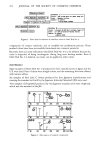
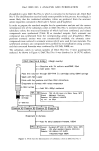
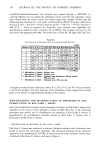
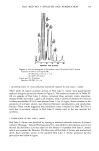
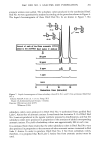
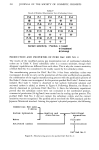
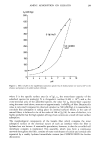
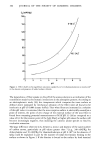
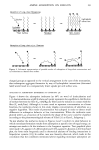
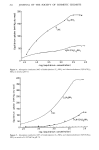
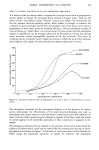
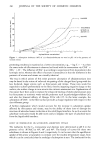
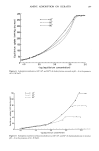
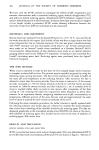
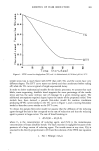
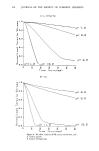
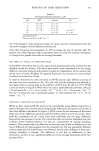
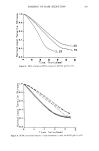
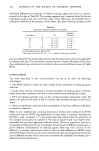
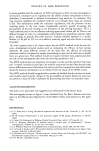
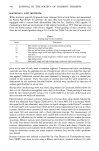
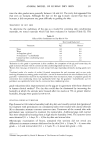
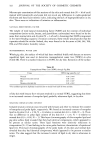
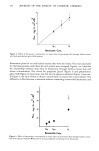
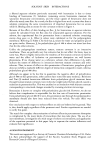
296 JOURNAL OF THE SOCIETY OF COSMETIC CHEMISTS 120 • 100 • 8o E • 6o õ 4o '•. .o ._ ._ • 2o r, o CHLO o /// / // o/// / ,' •- * ß SULFATE /// /•_....•.'"'"'"•/./ /' .....½_ • -_..•.__.•• •..---. t- ,••-'•-'•-'"- -'-T'-, , , , , , , , , , , , , , , 4'0 3• 3'0 2-5 2'0 -log Jequilibriurn concenJraJion) THIOCYANATE NITRATE IA) ACETATE I b) Figure 7. Adsorption isotherms (40 ø) of 1,12-diaminododecane on wool at pH 7.8 in the presence of various anions. promoting tendency is examined at a lower concentration, e.g., -log C -- -3.2, then the same order of effectiveness is observed as found with the monoamine viz. CNS- NOD- C1-. The influence of SOft is according to expectation from its position in the lyotropic series, whereas the effect of acetate is anomalous in that the isotherms in the presence of acetate and nitrate are virtually identical. The way in which anions of this series promote adsorption of alkylammonium ions may be based in the action of enforced ion-pairing of the charged head group with the less hydrated, larger anions such as thiocyanate and nitrate. These ions would be expected to adsorb preferentially to the fiber, thereby imparting negative charge to the surface the surface charge in turn attracts the cationic ammonium ion. Explanations of this nature have been used to explain the enhanced binding of dodecylammonium ions by thiocyanate to nonionic water-soluble polymers such as polyvinylpyrrolidone (26), and also the lowered affinity of Orange II for silk (27). In the latter example, the adsorption of CNS- to the fiber surface provides a charge repulsion with respect to the dye sulfonate group. A further explanation which would account for the increase in adsorption uptake affected by thiocyanate and nitrate, may be the ability of these ions to distrupt the structure of adsorbed water molecules at the solid/liquid interface. In such an event the adsorbate molecules would be able more easily to displace the layer of adsorbed water from the liquid-solid interface. EFFECT OF TEMPERATURE ON SATURATION ADSORPTION UPTAKE The isotherms for the C12 monoamine and diamine were determined at pH 8 in the presence of 0.1 M NaC1 at 40 ø, 60 ø, and 80 ø. The family of curves for these two adsorbates is shown in Figures 8 and 9 respectively. It can be seen that the equilibrium uptake of the amine at saturation is constant over the studied temperature range, from which it can be concluded that the enthalpy of adsorption is zero. The isotherms for the

AMINE ADSORPTION ON KERATIN 297 4OO o o- -o 60. • 3oo [] [] 8o //?/,,' • d // _E / ,',,, © 200 / ./ ,/ ¾ /o / ./' • /'/,,- //////=' E //.//' '• 100 I I I I I I I I I I I I I I I I I I I I I 4-0 3.5 3'0 2'5 2.0 -log Jequilibrium ½oncentrotionJ Figure 8. Adsorption isotherms at 40 ø, 60 ø, and 80øC ooe dod½c¾1amin½ on wool at pH • 8 in the o(OA M N•C1. 120 o ø 100 • 80 ..,.... •, 60 .+_. E 40 .•_ ._ '5 20 ß ß 40 ...... 60' ...... 80' ß ßo ß I I I I I I I I I 4.0 3-5 3.0 2.5 -log {equilibrium concentrotion) Figure 9. Adsorption isotherms of diaminododecane at 40 ø, 60 ø, and 80 ø of diaminododecane on wool at pH - 8 in the presence of 0.1 M NaC1.
Purchased for the exclusive use of nofirst nolast (unknown)
From: SCC Media Library & Resource Center (library.scconline.org)