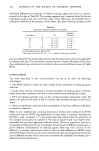
328 JOURNAL OF THE SOCIETY OF COSMETIC CHEMISTS Interpretation of solvent effects with regard to skin permeation can become very complicated when both interactive and noninteractive influences are operating simultaneously. Simple comparison of permeation rates from different solvents can be quite misleading. In their study of phenol penetration through rat skin, Roberts and Anderson (3) found that use of dimethyl sulfoxide (an interactive solvent) yielded lower flux levels than did light liquid petrolatum (a noninteractive solvent). Although dimethyl sulfoxide increased.the diffusivity of phenol, this was more than offset by decreased partitioning of phenol into the stratum corneum. A more complete understanding of the role of solvents in percutaneous absorption requires separation and evaluation of interactive and noninteractive solvent effects. In this paper, we describe a proposed technique for doing so. Our approach is to assume that no interaction occurs and to apply the equations describing diffusion through an inert membrane to the experimental results. These equations take differences in solvent-permeant affinity into account. Thus, agreement of our calculations with experiment indicates that membrane interaction is not significant. On the other hand, large differences between theoretical and measured values mean that interactive effects are important. This approach is first tested on a series of penetration studies in which an inert membrane is used as a barrier. We then apply our technique to studies of penetration through hairless mouse skin. EXPERIMENTAL MATERIALS Benzocaine was the same material used in previous studies (4-5). Propylene glycol (J. T. Baker Co.) and polyethylene glycol 400 (Ruger Chemical) were USP grade and used as received. Distilled water was boiled and cooled before each use to eliminate dissolved gases. SOLUBILITY DETERMINATION A moderate excess of benzocaine was added to premeasured solvent system in an Erlenmeyer flask with a screw top. The flask was shaken in a temperature controlled water bath at 30 ø _+ 1 ø C. This temperature was chosen to conform to conditions in the donor portion of the diffusion cells, since only the receptor portion of the cells was jacketed. With the receptor maintained at 37 ø C., skin surface temperature was found to be 30 ø _+ 0.5 ø C. with a thermocouple probe. Solution samples were withdrawn and filtered at 30 ø C., first through a filter paper and then through a 3/xm membrane filter. After dilution, benzocaine concentration was determined spectrophotometrically at 286 nm using a control blank without benzo- caine. The procedure was repeated every 24 hours until the system reached equilibrium. This required one day for the aqueous system, and seven days in the case of polyethylene glycol 400. MEMBRANE PREPARATION The excised hairless mouse skin samples were prepared as previously described (4). Only fresh skin samples were used.

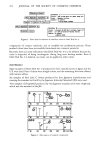
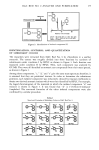
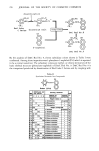
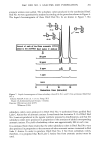
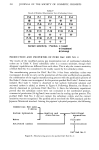
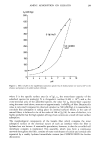
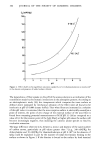
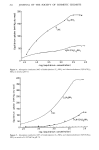
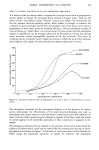
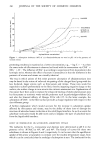
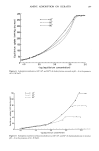
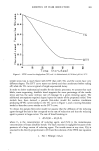
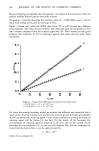
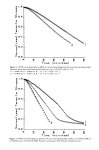
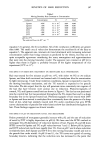
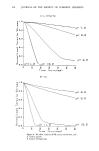
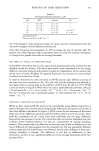
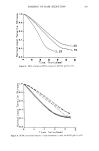
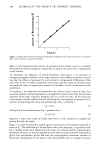
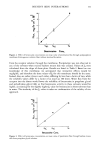
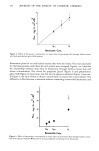
SOLVENT SKIN INTERACTIONS 329 The polypropylene membrane (Celgard 2400, Celanese Corp.) had an effective pore size of 0.02 •m and nominal thickness of 25 •m. Approximately one square inch pieces of the membrane were cut from a sheet 24 hours prior to the experiment. They were washed in 50 ml of ethyl alcohol to remove any chemical agents deposited on the surface. The washed and dried pieces were carefully weighed and soaked in mineral oil USP (Fisher Scientific). One-half hour before the experiment, each piece of membrane was removed from the oil. Excess oil was removed carefully by repeated wiping. The membrane was then accurately weighed and the amount of mineral oil retained was calculated. The weight gain ranged from 48 to 52 percent of the initial dry weight. Membranes were then cut to the required size and used for penetration studies. PENETRATION EXPERIMENTS The diffusion apparatus, procedure, and assay have been described (4). The receptor solution (normal saline) was maintained at 37 ø + 0.1øC. All experiments were performed at least in triplicate. Individual flux values for each donor solvent were averaged mean flux values are repQrted in this paper. RESULTS AND DISCUSSION BENZOCAINE SOLUBILITY Table I shows the measured values of benzocaine solubility in the three solvents studied. Values obtained for water and propylene glycol were in close agreement with those reported earlier (6-7). Table I Values for Benzocaine Permeation • Solubility at 30 ø (mg/ml) j, (mg cm -2.hr •) Polypropylene Hairless Mouse Skin Water 1.26 0.089 0.10 Propylene glycol 146 0.16 0.094 Polyethylene glycol 400 435 0.13 0.010 PENETRATION EXPERIMENTS Figure 1 is a typical plot of benzocaine penetration through the inert polypropylene membrane. The curves are linear, signifying steady state penetration. The steady state flux, J, for membrane controlled penetration under sink conditions is given by Eq. 1. J=KC (1) In this equation, K is the permeability constant, and C is the donor permeant concentration. An equivalent relationship, expressed in terms of different parameters, is given by Eq. 2 (8). J--La (2)
Purchased for the exclusive use of nofirst nolast (unknown)
From: SCC Media Library & Resource Center (library.scconline.org)