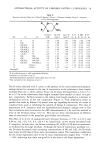
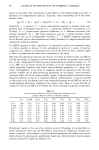
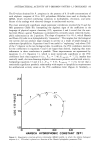
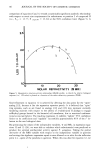
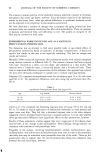
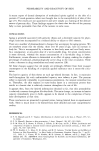
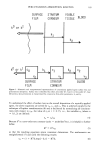
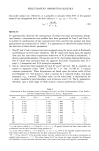
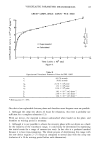
ANTIBACTERIAL ACTIVITY OF 5-BROMO-5-NITRO-1,3-DIOXANES 83 Table III QSAR Development for 2-Alkyl-5-Bromo-5-Nitro-1,3-Dioxane Analogs Using P, aeruginosa as Test Microorganism Equation No. n r s Fx,y 4. log 1/D = 2.13 (+0.23) - 0.12 (+0.13) Z•r 12 0.543 0.154 5. log 1/D = 1.96 (+0.14) - 0.05 (-+0.34) Zo'* 12 0.114 0.182 6. log 1/D = 2.16 (-+0.24) - 0.01 (-+0.01) ZMR 12 0.569 0.151 7. log 1/D = 2.02 (-+0.38) - 0.03 (-+0.14) ZBt 12 0.141 0.182 8. log 1/D = 2.03 (-+0.30) - 0.02 (-+0.06) •B 4 12 0.220 0.179 9. log 1/D = 2.10 (-+0.31) - 0.02 (-+0.04)•L 12 0.341 0.173 10. log 1/D = 1.97 (-+0.33) + 0.02 (-+0.17) ZE s 1P 0.073 0.192 11. log 1/D = 2.38 (-+0.26) - 0.02 (-+0.01) ZMR -- 0.33 (-+0.28) •Eo'* 12 0.794 0.118 Ft, 9 12. log 1/D = 1.82 (-+0.26) + 0.05 (-+0.04)•MR -- 0.002 (-+0.001)(•MR) 2 12 0.855 0.100 F•, 9 (ZMR) o = 12.28 (6.14- 14.57) 13. log 1/D = 1.93 (-+0.24) + 0.32 (-+0.35) Z•r --0.16 (-+0.12) (Z•r) 2 12 0.799 0.116 FL9 (E•r)o = 1.03 (--0.38- 1.34) 14. log 1/D = 1.83 (-+0.23) + 0.05 (-+0.03) •MR --0.002 (-+0.001)(•MR) 2 11 • 0.902 0.088 (ZMR)o = 11.93 (6.99- 14.07) = 7.46 (11 vs 6) = 13.77 (12 vs 6) 9.31 (13 vs 4) Data point for analog 13 not used in the derivation of this equation. See text. terial effect against P. aeruginosa during the first few hours of the D-value determination study. Although the reason for this is not known, it is expected that this delay may have been due to a lag in the uptake of the analog by the bacteria, which were not provided with any nutrients in the test system (18). The antibacterial effects of the 2-substituted aliphatic analogs against P. aeruginosa in 10% polysorbate 80/saline were similar to those observed in the propylene glycol/saline test system. In general, the D-values for P. aeruginosa were smaller than those observed for S. aureus in the presence of the same test compounds. This was not unexpected, since the parent compound of the series, II, is reported to possess greater antibacterial activity against gram-negative organisms than against gram-positive organisms (5). In the aliphatic series studies, the most active monosubstituted congener against P. aeru- ginosa in polysorbate 80/saline was the n-propyl analog [4], whereas di-ethyl analog [10] was the most active disubstituted compound tested. QUANTITATIVE STRUCTURE-ACTIVITY RELATIONSHIPS (QSAR) Mechanistic Implications Within the last 15 years, a useful technique for analyzing structure-activity relation- ship, the Hansch QSAR Paradigm, has been developed and is finding increasing ac- ceptance in pharmaceutical studies of biologically active compounds. Since the Hansch approach has been reviewed extensively (19), only a brief description will be given here. Essentially, the underlying concept of the "QSAR Paradigm" is that the biological activity of a given compound depends on the difference in hydrophobic, electronic, and steric factors between the derivative under consideration and the parent-active corn-

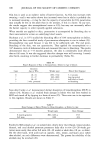
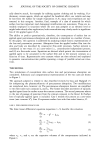
84 JOURNAL OF THE SOCIETY OF COSMETIC CHEMISTS pound in the series. The contribution of each effect to the overall biological activity is assumed to be independently additive. Typically, these relationships are of the math- ematical form: log 1/C = K + log P + b(log p)2 q_ C(Y q- des + elx + ... (15) wherein K = a constant, C = molar concentration required to produce some stan- dardized level of biological response (i.e., a minimum inhibitory concentration, or a D-value), P = 1-octanol/water partition coefficient, cr = Hammett electronic sub- stituent parameter, Es = Taft steric parameter, and Ix = dipole moment. Corre- sponding to the use of n-independent variables, 2 n --1 QSAR correlation equations can be derived, and so these equations are usually bbtained via computer-assisted mul- tiparameter regression analysis. If a QSAR equation is truly "significant" in a physical as well as in a statistical sense, it is often possible to discern: 1) the mechanism of action of a series of bioactive congeners on a cellular or subcellular level, and 2) the direction that a chemist ought to take in synthesizing the most active compound in the series. The basis for substituent selection was the set of criteria set forth by Biel and Martin (20) for the design of congeneric series of bioactive materials. In general, these criteria are: 1) only compounds for which accurate physicochemical parameter values (i.e., •r, cr, Es, MR, etc.) are known should be included 2) no two compounds should be made which essentially duplicate each other's physicochemical properties (i.e., steric, elec- tronic, hydrophobic) 3) the series of congeners should be planned so that the inde- pendent variable sets of physicochemical parameters are not highly "cross-correlated" with each other and 4) the widest possible "range" of physicochemical parameter values should be inherent in the set of congeners selected. Unfortunately, it was not possible to effectively avoid the almost total cross-correlation between •r and MR for the set of simple aliphatic derivatives explored in the current work. Thus, it is seen that the co- variance (r 2) for •r and MR is 0.94 (Table IV). This is discussed in greater detail below. Table IV Cross-Correlation Matrix (r 2) for the Substituent Parameters of the 2-Alkyl~ 5-Bromo-5-Nitro- 1,3-Dioxane Analogs • 'n' • MR • o "• • Es • F • R • L • B•. • B 4 • •r 1.00 0.94 0.33 0.07 0.40 0.02 0.31 0.04 0.35 • MR 0.94 1.00 0.35 0.10 0.00 0.00 0.12 0.00 0.14 • o '• 0.33 0.35 1.00 0.00 0.13 0.27 0.01 0.00 0.07 • E s 0.07 0.10 0.00 1.00 0.00 0.06 0.00 0.06 0.00 • F 0.40 0.30 0.13 0.00 1.00 0.06 0.51 0.52 0.46 • R 0.02 0.00 0.27 0.06 0.06 1.00 0.20 0.33 0.38 • L 0.31 0.12 0.01 0.00 0.51 0.20 1.00 0.74 0.94 • B 1 0.04 0.00 0.00 0.06 0.52 0.33 0.74 1.00 0.69 • 84 0.35 0.14 0.07 0.00 0.46 0.38 0.94 0.69 1.00 Preliminary results in the case of an aromatic series of II analogs to be described in a future manuscript show that the Biel-Martin injunctions of "maximum variance/min- imum covariance" with respect to physicochemical parameters are readily and success- fully achieved by selecting aryl substituents based upon the hierarchical cluster analysis scheme outlined by Unger and Hansch (21).
Purchased for the exclusive use of nofirst nolast (unknown)
From: SCC Media Library & Resource Center (library.scconline.org)