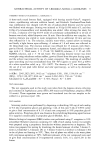
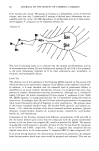
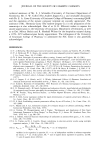
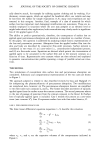
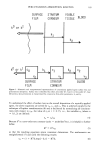
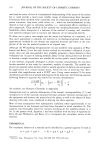
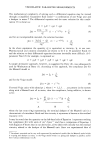
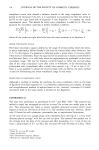
106 JOURNAL OF THE SOCIETY OF COSMETIC CHEMISTS v1 -- u 1 -- v0 kl (exp[- k•t] - exp[- k2t]) - k 2 - k• 1 + (k•exp[- k•t] - k2exp[- kit]) k 2 k 2 - k• (7) v2 1 -- u2 = 1 + (klexp[- k2t] - k2exp[-klt]) - Vo k2 - kl [ t kl + k2 exp[- kit] exp[ T_k2t] .] + + (8) k'k2Kø k7k2 k•k22 k•(kl- k2) k•(k•- k2)_] Attention in subsequent discussions will be focused upon the time dependence of u0 and ul. The u2 variable describes arrival of the applied agent into the blood. As the simulation has been kept as simple as possible, no subsequent elimination processes from the blood have been included. This is a refinement which can, of course, be introduced but for the present objective (namely to indicate the effect of potential surface loss processes on percutaneous absorption) will not be addressed. It should be pointed out that these equations (6-8) are valid for as long as material is present on the skin surface. The constant surface loss depletion can only continue until Uo = 0. At this point, equation 6 can be used to determine the time (t 0) at which all applied material has either been physically (surface) lost or absorbed into the skin: t o = -- In + 1 (9) k• CASE II: FIRST-ORDER SURFACE LOSS Equations 10-12 describe the first-order situation depicted in Figure 1: dc 0 = -(k I + kl)Co (10) dt dc 1 Vo - klc0 - k2c• (11) dt vl dc2 = Vl k2Cl (12) dt v2 Solutions for u0, ul, and u2 are found following exactly parallel mathematical steps as described for Case I. The results are: u0 = exp[-(k • + kl)t] (13) Vl kl --u• = [exp[-(k I + k•)t] - exp[-k2t]] (14) v0 k 2 - (k I O r- k l) v• klk2 I k2exp[-(kI + kl)t] - (kI + kl)exp[-k2(15) --u2 = 1 + va (k I Or-, kl)k 2 , (k I or- kl) - k2 Once again, the time dependence of u0 and ul will be the focus of subsequent discussion. The purely exponential forms of equations 13-15 preclude the evaluation of to for

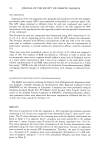
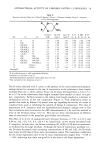
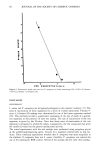
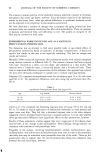
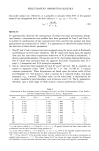
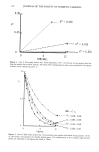
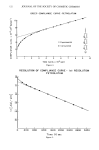
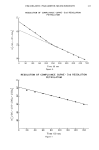
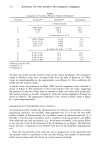
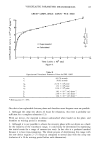
PERCUTANEOUS ABSORPTION KINETICS 107 first-order surface loss. However, it is possible to calculate when 90% of the applied material has disappeared from the skin surface (t = t9o, u o = 0.1) viz., ln(10) - (16) %0 k I + k• RESULTS To quantitatively illustrate the consequences of surface loss upon percutaneous absorp- tion kinetics, concentration-time profiles have been generated for Case I and Case II. A number of combinations of rate constants have been used for this purpose and these permutations are summarized in Table I. It is appropriate to identify the reasons behind the selection of these kinetic parameters: 1. The K ø and k I rate constants have been assigned using the recent work of Riefenrath and Robinson (4) with insect repellants. The K ø values were based upon the applied dose and the zero-order evaporation behaviour of N,N-diethyl-p-toluamide, 1- (butyl-sulphonyl)hexahydro- 1H-azepine and N, N'-dicyclohexa-hexamethyleneurea. The k • values were extracted from the apparent first-order evaporation rates of 2- ethyl-1,3-hexanediol and N,N-diethyl-m-toluamide. 2. Two k• values have been assigned for each K ø and k I selected. The k• constants are chosen to represent either "slow" (0.036 hr -•) or "fast" (0. 180 hr -•) stratum comeurn penetration. These designations are based upon the earlier work of Guy and Hadgraft (7). The slower k• value is typical for a relatively bulky, non-polar penetrant, e.g., asteroid. The faster value, on the other hand, is characteristic for a small, moderately rapid absorbant such as benzoic acid (7,9). The k• parameters, therefore, span a wide range of likely stratum comeurn penetration kinetics. Table I Combination of Rate Constants Used to Generate the Case I and Case II Concentration-Time Profiles and the Corresponding Values of to • and t9o b, Respectively Case Kø/hr - Ic k•/hr - 1 kJhr- i k2/hr- 1 t o (hrs) t90 (hrs) Ia O. O01 lb 0.001 Ic 0.010 Id 0.010 Ie 0.050 If 0.050 IIa lib IIc lid -- 0.036 1.800 100 -- O. 180 1.800 29 -- 0.036 1.800 42 -- O. 180 1.800 16 -- 0.036 1.800 15 -- O. 180 1.800 8.5 O. 100 0.036 1.800 -- O. 100 O. 180 1.800 -- 0.200 0.036 1.800 -- 0.200 0.180 1.800 • -- 17 8.2 9.8 6.1 • t o is the time at which u o = 0 (Case I), i.e. at t = to, all applied material has been either surface lost or absorbed into the skin (calculated using equation 9). t90 is the time at which u 0 = 0.1 (Case II), i.e. at t = t9o, 90% of the topically applied material has been either surface lost or absorbed into the skin (calculated using equation 16). c K 0 = k0/c00, where k ø is the zero-order surface loss rate constant and Coo is the surface concentration of applied topical agent at t = 0. The values chosen for K ø are within the range identified by Riefenrarh and Robinson (4) and have been calculated from their surface loss kinetics and applied concentrations.
Purchased for the exclusive use of nofirst nolast (unknown)
From: SCC Media Library & Resource Center (library.scconline.org)