j. Soc. Cosmet. Chem., 35, ! 15-129 (March/April 1984) A new method for measuring the viscoelastic parameters of pharmaceutical and cosmetic semisolids S. PURWAR, Pharmaceutical Development Service, Pharvzacy Department, Clinical Center, National Institutes of Health, Bethesda, MD 20205, A. R. PADHYE, Department of Mechanical and Aerospace Engineering, West Virginia University, Morgantown, WV 26506, and J. K. LIM, School of Pharmacy, West Virginia University, Morgantown, WV 26506. Received June 8, 1983. Presented at the Annual Scientific Seminar of the Society of Cosmetic Chemists, Cincinnati, Ohio, May 5-6, 1983. Abstracted in part from a dissertation submitted by Shivaji Purwar to the Graduate School, West Virginia University, in partial fulfillment of the Doctor of Philosophy degree requirements. Synopsis Pharmaceutical and cosmetic semisolids, besides being commonly described as non-Newtonian, have earlier been reported to be also viscoelastic. Unfortunately, semisolid viscoelasticity had hitherto been demon- strable only through the use of sophisticated and usually inaccessible devices such as the rheogoniometer or modified creep apparatus. A simple new method, initially developed for measuring absolute viscosity but later also found capable of revealing the viscoelastic nature of these materials, is discussed. The main device, consisting of two parallel plates between which material shaped in cylindrical form is pressed to obtain flow rate, is based upon application of normal stress rather than conventional shear stress. The originally developed equation of the system for measuring viscosity which converts observed data to compliance values (ratio of strain/stress) has been modified by partially incorporating the creep compliance equation to determine the viscoelastic parameters •qi, ?i, J,, etc. The values of these parameters for two common substances, petrolatum and PEG 1500, obtained by resolving the compliance curve via the residual technique, agreed favorably with values reported in the literature. The method is assessed to possess several advantages over the modified creep apparatus, particularly, because of its simple engineering design, with ready accessibility. It appears to fill an existing gap in fundamental studies related to the viscoelastic analysis of semisolid materials. INTRODUCTION Pharmaceutical and cosmetic semisolids constitute a class of materials which are most difficult to characterize rheologicatly because they combine both liquid- and solid-like properties within the same material. According to Barry (1), much published work on the rheology of semisolids is incorrect or confusing in that the dominant "viscoelastic" nature of these materials has not been recognized. Such recognition is not only impor- 115

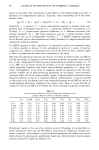
116 JOURNAL OF THE SOCIETY OF COSMETIC CHEMISTS tant from the point of view of a fundamental understanding of the nature of the system but it could provide a much more reliable means of characterizing these materials. Continuous shear methods most commonly used for evaluating semisolids provide ap- parent viscosities, loop areas, yield values, etc., which are non-fundamental as they depend at least in part on operating variables, i.e., instrumental effects contribute to their magnitude. These methods in fact examine the complex phenomena of structure breakdown where disruption is a function of the method of testing, and, therefore, true material constants such as viscosity and elasticity are not measured directly. To allow one to gain a true insight into the nature and behavior of a semisolid, it is thus more appropriate to examine the material in its rheological ground state where experimental methods do not disrupt any organized structure and where at the com- pletion of the test the material remains in its original state. Although the Weissenberg rheogoniometer (2) and modified creep apparatus of War- burton and Barry (3) are the only devices utilized for viscoelastic evaluation of semi- solids, their cost and inaccessibility have probably presented a major obstacle in their widespread use. In spite of existing methods, Barry (1) has clearly pointed out the need to develop a simple viscoelastic test suitable for on-line quality control procedures. A new method, originally developed to obtain viscosity measurements (4), has been further extended in this study for viscoelastic analysis of materials. The method em- ployed two parallel plates between which a sample specimen of definite size was pressed by application of a certain normal stress, while the rate of pressing was chart- recorded after amplification with a LVDT • unit. Using tensor analysis (5) for stress distribution and the rate of sample deformation (6) for shear rate, the following equation following Newton's equation was derived for viscosity measurement: F 7a = • (1) (for symbols, see Glossary of Symbols in Appendix) Assumptions such as uniform deformation of the sample incompressibility (5,7) and isotropicity (5) of the material minimal frictional resistance between moving parts of the equipment and between the material and the plates as well as the absence of shear thinning with time, were considered in deriving the above equation. Most of these assumptions were subsequently confirmed either experimentally or via documentation in the literature and have been discussed in detail elsewhere (4). The equation was thoroughly tested for viscosity involving all the variables present in it (4). In the present work, Equation 1 has been modified with the help of equations by Ferry (8) and Warburton and Barry (3) to incorporate the viscoelastic nature of the material. THEORETICAL The viscoelastic behavior of a material can be described by a general equation (5) such as O' q- p•6- q- p2 • q- .. = K + q•½ + q2 { q- q3i• q- .... (2) • Schaevitz, Eng., Pennsauken, N.J. Type 1000 HR S/N 5599 CAS series.
Purchased for the exclusive use of nofirst nolast (unknown)
From: SCC Media Library & Resource Center (library.scconline.org)