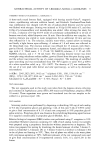
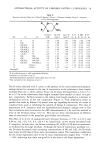
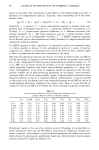
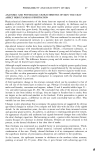
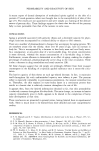
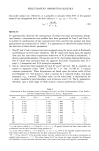
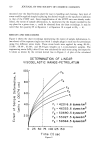
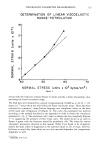
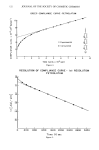
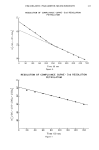
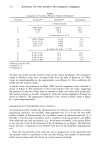
ANTIBACTERIAL ACTIVITY OF 5-BROMO-5-NITRO- 1,3-DIOXANES 79 Table II Structure-Activity Data for 2-Alkyl-5-Bromo-5-Nitro-l,3-Dioxane Analogs Using P. aeruginosa as Test Microorganism R• •Br R 2 NO 2 D-Value a log 1/D log 1/D • •c • MR c No. R• R 2 (HR) (obsd.) (pred.) t' R•, R 2 R•, R 2 Ri, R2 1 H H 4.8 2.00 1.91 0.00 2.06 2 CH 3 H 5.0 1.98 2.05 0.56 6.68 3 CH3CH2 H 4.3 2.05 2.11 1.02 11.33 4 CH3(CH2) 2 H 3.8 2.10 2.08 1.55 15.99 5 CH3(CH2) 3 H 5.2 1.96 1.98 2.13 20.64 6 CH3(CH2) 4 H 9.2 1.72 1.79 2.53 25.27 7 c-C6H• H 14.6 1.52 1.66 2.51 27.72 8 CH• CH 3 4.6 2.02 2.11 1.12 11.30 9 CH 3 CH3CH 2 4.0 2.08 2.08 1.58 15.95 10 CH3CH 2 CH$CH 2 3.7 2.11 1.98 2.04 20.60 11 CH3CH 2 CH3(CH2) 2 7.2 1.83 1.79 2.57 25.26 12 -- (CH2) 4 -- 8.2 1.77 d 1.39 18.59 13 - (CH2) 5 -- 4.9 1.99 1.84 1.77 24.25 Bronopol © 4.5 -- -- 0.98 0.49 0.39 0.37 0.36 0.33 0.34 0.00 -0.10 -0.20 -0.22 -O.26 -0.18 0.10 mM solutions in 10% polysorbate 80/saline. Predicted on the basis of eq 12. Extrathermodynamic parameter values taken from Not included in the derivation of eq 12. ref (12). The D-values obtained with S. aureus in the presence of the mono-substituted aliphatic analogs showed an increase in the rate of inactivation as the substituent chain length increased from one to three carbons. Thus, the D-values decreased from 4.3 hr to 3.2 hr to 2.2 hr as the substituent chain length increased from methyl- to ethyl- to n-pro- pyl-, respectively. Further increase in the carbon chain length resulted in a decrease in antibacterial activity of the test compounds (Figure 1). This observation seems to parallel that made by Kabara (14) several years ago regarding the activity of a series of octadecyl fatty acids in inhibiting the growth of Group A streptococci. The rates of inactivation of P. aeruginosa with the monosubstituted aliphatic analogs were so fast that no bacteria were recovered at the APC determination at 3 hr, and this resulted in most of the D-values being 0.6 hr. This did not allow discrimination of different rates of inactivation in the propylene glycol/saline test solutions. The effect of 0-0.2% of analogs [8] and [10] gave D-values of 30, 4.4, 0.3, and 0.04 hr, and 30, 6.6, 0.9, and 0.3 hr, respectively, in test lotions inoculated with P. aeruginosa. In both cases, the lotions containing 0% of [8] or [ 10] were not preserved, as evidenced by the large D-values. Although the rates of inactivation increased (i.e., the D-values decreased) with increasing concentrations of [8] and [10], the D-values were lower for [8] than [10] at each concentration tested. The correlation coefficients for the linear regressions used in the D-value determinations ranged from -0.98 to - 1.00, indicating that there was good fit of the data to the linear regressions.

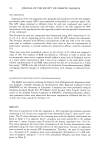
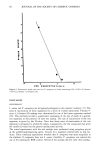
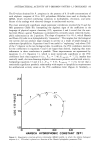
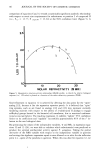
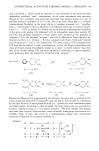
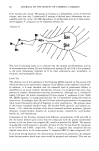
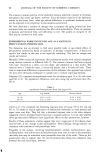
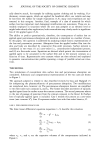
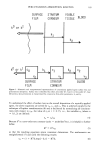
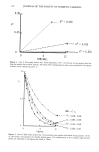
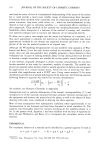
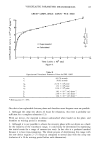
80 JOURNAL OF THE SOCIETY OF COSMETIC CHEMISTS o 4- 0 I 2 3 4 5 CHAIN LENGTH Figure 1. Effect of aliphatic substituent chain length in 2-alkyl-5-bromo-5-nitro-1,3-dioxane analogs on the rate of inactivation (i.e., D-Values) of S. a•re•s in propylene glycol/saline. The D-values obtained with the different concentrations of [8] or [10] in lotion (Figure 2 illustrates this for analog It0]) were used to construct the preservative death time curve for P. aer•ginosa. The preservative death time curve obtained in this manner for analog It0] is illustrated in Figure 3. From these curves, it was calculated that 0.04% and 0.06% of analog [8] and It0], respectively, would be required to obtain D-values of 4 hr in the test lotions. The correlation coefficients for these linear regressions were -0.88 and -0.89, which indicates a moderately good fit of the data to the linear regressions. All potentially meaningful QSAR, involving linear combinations of the Hansch hy- drophobic parameter (•), the Taft-Hammett electronic parameter (•r•), the Taft steric parameter (Es), the molar refractivity parameter (MR), the Swain-Lupton field and resonance electronic parameters (F and R), and the Verloop steric parameters for mo-
Purchased for the exclusive use of nofirst nolast (unknown)
From: SCC Media Library & Resource Center (library.scconline.org)