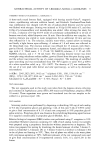
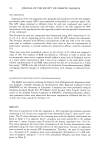
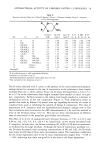
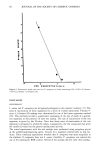
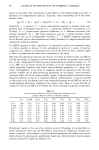
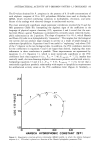
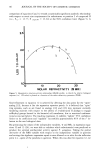
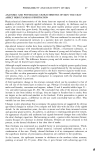
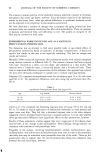
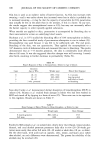
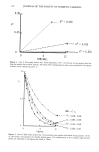
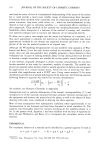
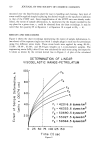
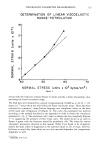
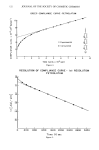
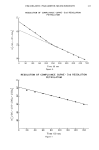
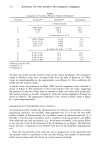
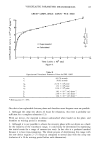
VISCOELASTIC PARAMETER MEASUREMENTS 121 DETERMINATION OF LINEAR VISCOELASTIC RANGE- PETROLATUM z 19- 17 15 15 II i i i 940 50 60 70 NORMAL STRESS (units Figure 3. x I0 • dynes/cm 2) strains with the respective stresses (Figure 3) shows initially a linear relationship, thus providing the linear viscoelastic range. The final data were obtained for a period of approximately 10,000 sec at 24.52 x 10³ dynes cm-2-stress which was well within the linear viscoelastic range. These data were converted by computer, 7 using Fortran language into compliance values on the basis of left hand side of Equation 10 (Figure 4). The curve thus generated was resolved according to the method described in the Appendix in order to obtain the viscoelastic parameters Ti, 'qi, Ji- The resolution took 3 steps to exhaust the data completely (Figures 5-7), suggesting the presence of three Voigt units. The model shown as an inset in Figure 4 agrees with the literature model for petrolatum (14). The values for various viscoelastic parameters obtained in this manner (Table I) are found to be of approxi- mately the same orders of magnitude as the reported values (3, 15). It must, however, be borne in mind that these values are not only material-dependent but temperature- dependent as well. 7 AMDAHL 470 V/7A.

122 JOURNAL OF THE SOCIETY OF COSMETIC CHEMISTS bJ Z CREEP COMPLIANCE CURVE-PETROLATUM o ExperimeCalculaled ß - I I I I i i I i I 2 5 4 5 6 7 8 Time (unils x 10 3 sec) Figure 4. RESOLUTION OF COMPLIANCE CURVE- I st RESOLUTION PETROLATUM I I I I I I 400 800 1200 1600 2000 2400 Time (t) sec Figure 5. i I 2800 3200
Purchased for the exclusive use of nofirst nolast (unknown)
From: SCC Media Library & Resource Center (library.scconline.org)