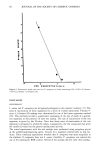
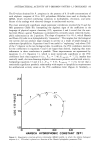
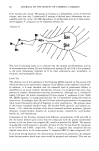
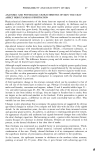
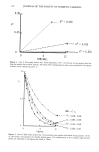
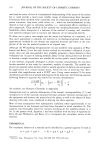
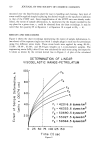
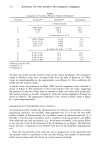
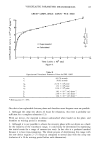
ANTIBACTERIAL ACTIVITY OF 5-BROMO-5-NITRO-1,3-DIOXANES 85 The D-values obtained for P. aeruginosa in the presence of 0.10 mM concentrations of each aliphatic congener of II in 10% polysorbate 80/saline were used to develop the QSAR, which involved correlating variations in hydrophobic, electronic, and steric factors of the analogs with observed changes in antibacterial activity. The most statistically significant single parameter correlations involved the • and the MR parameters (Table III). Interpreting the algebraic signs of the coefficients in the language of physical organic chemistry (22), equations 4 and 6 reveal that the anti- bacterial efficacy against Pseudomonas is promoted by sterically small, relatively hydro- philic substituents at the 2-position. The slope of equation 4 is 0.4, which Hansch and Dunn (23) refer to as hydrophobically "insensitive". This implies that the biological test system did not produce large changes in activity as a result of small changes in substituent lipophilicity. Equations 4 and 6 are useful in "explaining" only about 25% of the r 2 inherent in the raw biological data. In addition, the 95% confidence intervals for the coefficients in equations 4 and 6 are larger than desired, implying that some refinement in these correlations is possible. These improvements are represented by equations 11-13. Equation 11, which is more statistically significant at the 95% confidence limit than equation 6 (i.e., F•, 9 = 7.46 F1,9tx0.025 = 7.21), implies that sterically small, electron-donating aliphatic substituents promote antibacterial activity. Comparing equations 13 and 4 (i.e., F•, 9 = 9.31 FL9tx0.025 = 7.21), we see that a statistically significant parabolic relationship with respect to lipophilicity requirements for antibacterial activity exists at the 95% confidence limit (Figure 4). Similarly, a I.U 2.5 2,O, 1.5 1.O • 8 5& 11 ß ß 12 I i I I I I 1.0 2.0 3.0 HANSCH HYDROPHOBIC CONSTANT Figure 4. Quantitative structure-activity relationship (QSAR) profile, in which the relative biological response (i.e., I/D-value) is plotted as a function of the Hansch hydrophobic parameter (•'rr).

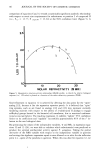
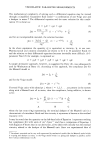
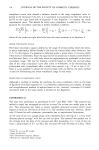
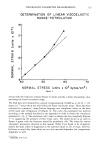
86 JOURNAL OF THE SOCIETY OF COSMETIC CHEMISTS comparison of equations 6 and 12 reveals a statistically significant parabolic relationship with respect to steric size requirements for substituents at position 2 of compound II (i.e., F•, 9 = 13.77 F •,9=0.005 = 13.61) at the 99% confidence limit (Figure 5). A uJ •) ..J 2.5 2.0 0 10 20 30 MOLAR REFRACTIVlTY I•MRI Figure 5. Quantitative structure-activity relationship (QSAR) profile, in which the relative biological response (i.e., 1/D-value) is plotted as a function of the molar refractivity parameter (•MR). final refinement in equation 12 is achieved by deleting the data point for the "spiro" analog [13], because it fits the regression equation poorly. It is believed that "spiro" ring systems, such as are found in analogs [12] and [13] may represent sterically hindering moieties with respect to the ability of 2-substituted II analogs to engage sulfhydryl groups located in the bacterial cell membrane, due to restricted conforma- tional access (see below). The resulting regression 14 exhibits "tighter" 95% confidence limits on its coefficients and "explains" successfully approximately 81% of the r 2 in- herent in the raw biological data. By optimizing the values of the independent variables, -rr and MR, in regression equa- tions 12 and 13 (24), we were able to calculate which substituent(s) were predicted to produce the optimal antibacterial activity against P. aeruginosa. Taking the partial derivative of the RBR variable with respect to the independent variable in question and setting this algebraic expression equal to zero allowed us to solve for the inflection point (i.e., apex) of the parabola in question. When this was done for equation 12, we
Purchased for the exclusive use of nofirst nolast (unknown)
From: SCC Media Library & Resource Center (library.scconline.org)