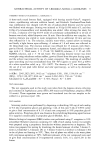
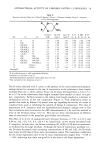
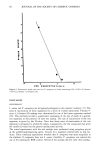
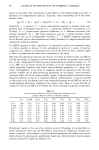
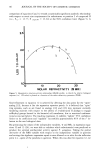
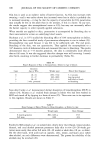
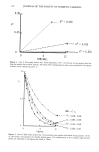
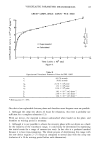
112 JOURNAL OF THE SOCIETY OF COSMETIC CHEMISTS F I 1,0 0,5 CASE, K I, K1 .•$• I Ic, 0,200, 0,036 /$/• .I -'•""'4' I •-- I IA, 0,100,00,180 / • •4_..F..•_4.__4q4•__ liD, 0,200, 0 6 12 24 TIME/HRS, Figure 7. Case II: First-order surface loss. Time-dependence of F I, the fraction of the applied dose lost from the surface due to the k • process. The combinations of k • and k• corresponding to each curve are identified in the figure and listed in Table I. Calculation of these curves utilized equation 18. DISCUSSION In considering the results, it is first useful to compare the u0 and u 1 expressions for Case I and Case II. Equation 13, the expression for u0 with first-order surface loss kinetics, is straightforward and shows that the applied concentration will decay expo- nentially with a half-life given by ln2/(k • + kl). The Case I, zero order, situation also has a first-order component (the first term in equation 6) but this is superimposed upon a second, constant, decay controlled by the ratio Kø/kl . The equations for u• (equations 7 and 14 for Case I and Case II, respectively) have similar properties. Equation 14 is characteristic of a single compartment expression in which input and output to the compartment are described by first-order processes (k • + kl) and k 2 respectively. Equation 7 contains an analogous first term but also includes a modulating second term that is proportional to the zero-order surface loss kinetics K ø. The details of equations

PERCUTANEOUS ABSORPTION KINETICS 113 17 and 18, which describe the fractions of topically applied agent lost to the K ¸ or k • processes, have been discussed above. The results in Figures 2-7 and Table I (to, %0) are qualitatively as one would reasonably predict. However, for the first time, in a basically straightforward fashion, quantitative determinations of the effect of surface loss on percutaneous absorption are presented. The sources for the chosen rate parameters have been described and are based upon published information. It should be stated, though, that assessments of surface loss behavior are limited and thus the focus of this paper is to illustrate, using a range of kinetic values, when concomitant removal and absorption may produce a desired or disadvantageous result. It may be suggested that the subject deserves and requires considerable further atten- tion. ACKNOWLEDGEMENTS Research support was provided in part by the Wellcome Trust and the Burroughs Wellcome Fund, and by the National Institutes of Health (1-RO3-OH01830-01). REFERENCES (1) S. Rorhberg, R. C. Crounse, and J. L. Lee, Glycine-14C incorporation into the proteins of normal stratum corneum of psoriasis, d. Invest. Dermatol., 37, 497-506 (1961). (2) H. Baker and A.M. Kligman, Technique for estimating turnover time of human stratum corneum, Arch. Dermatol., 95, 408-411 (1967). (3) T. S. Spencer, J. A. Hill, R.J. Feldmann, and H. I. Maibach, Evaporation of dierhylroluamide from human skin in vivo and in vitro, d. Invest. Dermatol., 72, 317-319 (1979). (4) W. G. Riefenrarh and P. B. Robinson, In vitro skin evaporation and penetration characteristics of mosquito repellanrs, d, Pharm. Sci., 71, 1014-1018 (1982). (5) B. M. Cumpelik, Substanriviry of sunscreens, Cosmetics and Toiletties, 91, 59-62 (1976). (6) I. H. Blank, J. H. Cohen, R. R. Anderson, K. F. Jaenicke, and J. A. Parrish, Observations on the mechanism of the protective action of sunscreens, J. Invest. Dermatol., 78, 381-385 (1982). (7) R. H. Guy and J. Hadgraft, A pharmacokinetic model for percutaneous absorption, Internat. d, Pharmaceut., 11, 119-129 (1982). (8) G. Stephenson, Mathematical Methods for Sdence Students, 2nd edition, (Longman, London, 1973), pp 449-460. (9) D. M. Anjo, R. J. Feldmann, and H. I. Maibach, "Methods for predicting percutaneous penetration in man," in Percutaneous Penetration of Steroids, P. Mauvais-Jarvais, C. F. H. Vickers, and J. Wepierre Eds. (Academic Press, New York, 1980), pp 31- 51. (10) R. J. Scheuplein, Mechanism of percutaneous absorption. II. Transient diffusion and the relative importance of various routes of skin penetration, d. Invest. Dermatol., 48, 79-88 (1967). (11) G. E. Roberts and H. Kaufman, Table of Laplace Transforms, (W. B. Saunders, Philadelphia, 1966) pp 181-199.
Purchased for the exclusive use of nofirst nolast (unknown)
From: SCC Media Library & Resource Center (library.scconline.org)