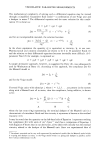
VISCOELASTIC PARAMETER MEASUREMENTS 117 The mathematical complexity of solving such a differential equation may be viewed through a simplified 3-parameter fluid model--a combination of one Voigt unit and a dashpot in series. • The differential equation and the exact solution for this combi- nation (5) is shown as: cr + p•o = q•{ + q2i• (3) J(t) = P•q• - q2 t q• (1 -- e-q•t/q2) -{- q• (4) and for an incompressible material, the solution becomes J(t) = 2(p q'• - qS) (1 -- e -q•t/q•) -5- 2t (5) 3q{ 2 3q• In the above expression the quantity q• is equivalent to viscosity, 'q, in our case. Pharmaceutical and cosmetic semisolids are shown to be 6 to 10 parameter fluids (1) and the solution to their differential equations becomes inevitably more difficult. A 6- parameter fluid (5) for example, is expressed as: g q- pl 0 q- p2 • -5- p3'O = q•{ + q2i• -5- q3'• (6) A simple alternative approach, however, as suggested by Ferry (8), was subsequently used by Warburton & Barry (3). According to this approach, the compliance J(t) for the Maxwell model is: t J(t) = J0 + (7) •q0 and for the Voigt model: J(t) = J(1 - e -t/') (8) If several Voigt units with subscript i, where i = 1,2,3 . ß ß are present in the system along with a Maxwell unit all in series, then the compliance, being additive, is shown to be: J(t) = Jo + • [Ji(1 - e-•/'i)] + t (9) i=1 •10 A B C where the last term (t/'q0) representing the terminal dashpot of the Maxwell unit is a characteristic of viscoelastic fluids and the viscosity it represents is known as the residual viscosity (1,5). It may be noted that the quantity on the left-hand side of Equation 1 represents nothing but compliance J(t) with units of cm 2 dynes- • and thus a comparison of Equation 1 with Equation 9 shows that in our derivation, all we dealt with initially was the residual viscosity related to the dashpot of the Maxwell unit. Since our experimental data of ** Viscoelastic materials can be very well represented by mechanical models like the Maxwell model which is a spring and dashpot in series, or the Voigt model which is a spring and dashpot in parallel, and/or their various combinations (1,5,8).

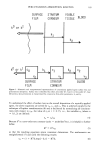
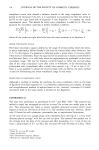
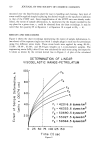
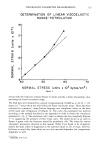
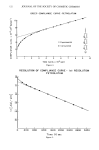
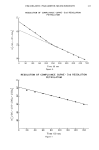
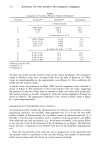
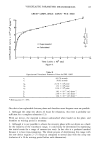
118 JOURNAL OF THE SOCIETY OF COSMETIC CHEMISTS compliance versus time showed a behavior similar to the creep compliance curve re- ported in the literature (5,8-10), it is convenient to incorporate the first two terms A and B on the right hand side of Equation 9 into Equation 1 to explain the entire experimental curve. This should be valid, since compliance is additive (3). Thus our equation for viscoelastic materials is finally modified as follows: F •aa'/J = Jo + [Ji(1 - e-•/•'i)] + •t (10) •=0 where all the terms on right hand side have the same meaning as in Equation 9. LINEAR VISCOELASTIC RANGE The linear viscoelastic range is defined as the range of stresses within which the stress- to-strain relationship follows Hooke's Law and the viscous effect obeys Newton's Law (1,5). In this region, if a material is deformed under a given stress, it recovers totally when stress is withdrawn. Since the equation for viscoelasticity is based on both Hooke's and Newton's Laws, it is valid only when the experiments are performed in the linear viscoelastic range. The test for linearity could be based on either the recovery phase data of the creep compliance curve after stress is withdrawn, or by determining the strain/stress ratio (compliance) after a small time interval, e.g., 75 sec or less (1,11). Since it is not possible to obtain the recovery phase with our device, the latter method is used for determining the linear viscoelastic range in this study. RESOLUTION OF COMPLIANCE CURVE Although a method of analysis for resolving the creep compliance curve on the basis of Equation 9 has been reported (3), it is somewhat cumbersome and complex. A simple and straightforward method of analysis based on the "residual" technique (12) which ultimately leads to the same results is detailed in the Appendix. EXPERIMENTAL The tests were performed on petrolatum U.S.P. 2 and PEG 1500. '• The material was melted to expel any entrapped air and set in trays 4 for at least two weeks prior to the test. This precaution was taken to ensure complete structural recovery which could require as much as 240 hours or more (13). The modified creep test, however, allows only 24 hours for such relaxation, presumably due to instrumental limitations. At the time of the test, sample plug., were withdrawn with the help of a 1.2-cm inner diameter plastic syringe 5 with the top end cut open. The material was pushed out of the syringe with the help of the plu'nger and after discarding 2 to 3 mm of the top layer, a plug length of 0.7 cm (H0) was sectioned off with the help of a floss. Three Fisher Sci. Co. (lot #712418). Ruger (lot # 1305). Ekco Housewares Company, Illinois.- Monoject 5cc disposable plastic syringe.
Purchased for the exclusive use of nofirst nolast (unknown)
From: SCC Media Library & Resource Center (library.scconline.org)