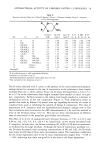
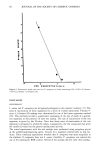
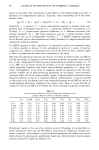
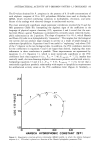
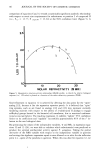
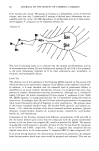
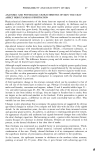
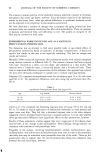
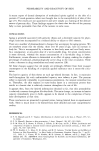
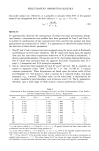
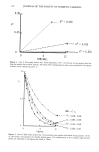
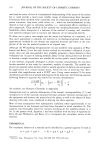
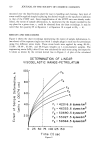
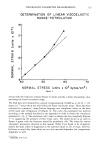
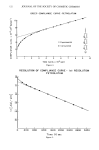
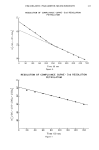
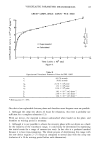
VISCOELASTIC PARAMETER MEASUREMENTS 125 CREEP COMPLIANCE CURVE-PEG 1500 o 7,,, IO o • I ß Calculated z 2 I I I I I 0 0 I 2 $ 4 5 6 7 8 9 Time (units x I0 $ sec) Figure 8. I Table II Experimental Viscoelastic Parameter Values for PEG 1500' 'r• 441.70 seconds % 58.62 seconds •q0 21.70 x 10⁸ poise •q• 1.52 108 poise qq2 0.36 X 10⁸ poise Jo 1.82 x 10 -6 cm 2 dynes -• J• 2.90 x 10 -6 cm 2 dynes -• J2 1.64 x 10 -6 cm 2 dynes -• * Melting point 37-38øC. Our device has replaceable bottom plates and therefore more frequent runs are possible. 2. Although the creep test allows 24 hours for relaxation, this time is probably not sufficient for a complete relaxation (13). With our device, the material is almost undisturbed when loaded on the plate, and therefore no waiting period is necessary. 3. Although it is not possible to obtain the recovery phase with our device as a check for the linearity of the viscoelastic range, it could easily be determined by examining the initial strain for a range of stresses (see text). In fact this is a preferred method because it is less time-consuming. The whole process of determining this range with the new device requires 2-21/2 hours as compared to several days with the creep test (inclusive of a 24-hr waiting period before each observation).

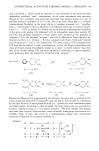
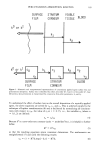
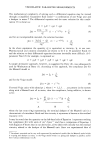
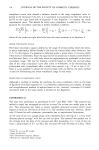
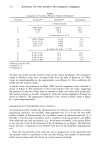
126 JOURNAL OF THE SOCIETY OF COSMETIC CHEMISTS 4. For day-to-day comparison studies or quality control where measurements in the linear viscoelastic range are not essential, our device 'could provide data in less than 100 sec (4). 5. With this device, sample specimens are visible throughout the test, and therefore, slippage or fracture (resulting in plug flow) are clearly visible thus doubtful results are conveniently avoided. 6. Only very small quantities of sample are needed for the test (three plugs of less than 1-cc each). 7. The new device is far less expensive than either the rheogoniometer or the modified creep apparatus. 8. One of the limitations of the device is that being an open system, measurements can only be taken at ambient room temperature unless a controlled environmental chamber is available. 9. Material for testing should be firm enough to retain its shape prior to the taking of measurements. CONCLUSION A simple device and method have been developed which reveal the viscoelastic nature of pharmaceutical and cosmetic semisolid materials, hitherto possible only through such unaccessible devices as the rheogoniometer or the modified creep aparatus. Various viscoelastic parameters can be obtained which characterize the material more specifically than with currently employed parameters such as apparent viscosity, yield value, area of hysteresis loop, etc., the magnitudes of which are partly influenced by the method used. As indicated by Barry and Grace (15), such small strain tests are sensitive enough to even distinguish variations in the official grades of raw materials which are otherwise undetectable with current devices. Thus the accurate specifications of raw materials could possibly lead to smooth processing in manufacturing and ultimately a better product. Fundamental viscoelastic parameters such as residual viscosity which reflect the true nature of materials could also be used more effectively than apparent viscosities when assessing drug diffusion in topical bases (1). In addition, these kinds of tests may also help in elucidating on a molecular level the nature and rates of configurational rearrangements of structural entities within semisolid materials (1,16). APPENDIX The equation for a typical creep compliance curve (Figure 9) is as follows: j(t) = Jo + • [Ji (1 - e-t/'ri)] q- t i=• 'q0 which in expanded form can be written as J(t) = Jo + J• + J2 + J3 + ß ß + __ _ jle-•/½• - J2e-t/,r2 __ (1) (2)
Purchased for the exclusive use of nofirst nolast (unknown)
From: SCC Media Library & Resource Center (library.scconline.org)