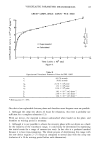
VISCOELASTIC PARAMETER MEASUREMENTS 129 Ji = compliance of the Voigt units (cm 2 dynes-•) •i = retardation times of Voight units (sec) x h = viscosity of Voigt units (poise) g = normal stress (dynes cm -2) ½ = normal strain Pi,qi = various constants P'i,ql = various constants for incompressible material K = bulk modulus (dynes cm -2) ACKNOWLEDGEMENTS The authors wish to express their sincere appreciation to the Society of Cosmetic Chem- ists for their scholarship grants (1980, 1981) in supporting the research, and also Dr. William R. Powell, formerly Associate Professor of the WVU Department of Me- chanical Engineering and Mechanics, for his encouragement and assistance in the initial development of the apparatus. REFERENCES (7) (8) (9) (10) (11) (12) (13) (14) (15) (16) (1) B. W. Barry, "Rheology of Pharmaceutical and Cosmetic Semisolids" in Advances in Pharmaceutical Sciences, H. S. Bean, A. H. Beckerr, and J. E. Carless, Eds. (Academic Press, London, 1974), Vol. 4, pp 1-72. (2) J. R. Van Wazer, J. W. Lyons, K. Y. Kim, and R. E. Colwell, Viscosity and Flow Measurement: A Laboratory Handbook of Rheology, (Interscience, New York, 1963), through Reference 1. (3) B. Warburton and B. W. Barry, Concentric cylinder creep investigation of pharmaceutical semisolids, J. Pharm. Pharmacol., 20, 255-268 (1968). (4) S. Putwar, A. R. Padhye, and J. K. Lim, Paper presented at the 130th annual APhA meeting, New Orleans, April 9-14 (1983). (5) W. Fliigge, Viscoelasticity (Blaisdell Publishing Company, 1967), pp 1-25, 97-103. (6) C. O. Bennet and J. E. Myers, Momentum, Heat and Mass Transfer-Chemical Engineering Series, 2nd ed., (McGraw-Hill, New York, 1974), pp 104-111. D. H. Kaelble, Physical Chemistry of Adhesion, (Wiley Interscience, John Wiley & Sons, Inc., New York, 1971), pp 221. J. D. Ferry, Viscoelastic Properties of Polymers, 2nd. ed., (John Wiley & Sons, Inc., New York, 1970), pp 1-35. S. S. Davis, Viscoelastic properties of pharmaceutical semisolids. I. Ointment bases, J. Pharm. Sci., 58, 412-418 (1969). B. W. Barry, Evaluation of theological ground state of semisolids, J. Soc. Cosmet. Chem., 22, 487- 503 (1971). B. W. Barry, Continuous shear viscoelastic and spreading properties of a new topical vehicle, FAPG base, J. Pharm. Pharmacol., 25, 131-137 (1973). M. Gibaldi and D. Perrier, Pharmacokinetics-Drugs and the Pharmaceutical Sciences, J. Swarbrick, Ed., (Marcel Dekker, Inc., New York, 1975), pp 281-283. B. W. Barry and A. J. Grace, Rheological and sensory evaluation of work softening and recovery of pharmaceutical white soft paraffins, J. Pharm. Sci., 60, 1198-1203 (1971). B. W. Barry and A. J. Grace, Rheol. Acta, 10, 113-120 (1971), through Reference 1. B. W. Barry and A. J. Grace, Grade variation in the rheology of white soft paraffin, B.P. ,J, Pharm. Pharmacol., 22, 147S- 156S (1970). A. S. Krausz and H. Eyring, Deformation Kinetics, (John Wiley & Sons, Inc., New York, 1975), pp 33-44.

j. Soc. Cosmet. Chem., 35, 131-132 (March/April 1984) Book Review ALLERGIC CONTACT DERMATITIS TO INGREDIENTS USED IN TOPI- CALLY APPLIED PHARMACEU- TICAL PRODUCTS AND COSMET- ICS, by A. Dooms-Goossens. Leuven Uni- versity Press, Leuven, Belgium, 1983. 164 pages, paper bound. Price: 580 FB. This book is divided into three sections dealing with clinical experiences covering the identification and surveillance of al- lergic contact dermatitis using a computer system factors derived from ingredients and products which influence the fre- quency of allergy and a discussion on hy- poallergenicity. In most sections, there are ample clinical examples which demon- strate the point that the author wishes to express. Identification of allergens in cosmetic and pharmaceutical preparations has been a perplexing problem because of several factors, including confirmation of dermal reactions with suspected ingredients or products. Dooms-Goossens proposes a system which relies on the computer for storage of clinical data relating to the fre- quency of allergic contact dermatitis. The items of data entry include the patient's history, exposure to a product or ingre- dient, and the contents of the open liter- ature. Even though this system seems to be a quick method of correlating clinical manifestations with known allergens, it seems that the quality and quantity of data which is currently available on ingredients will not allow for a completely reliable surveillance system. There are occasions where the allergen is produced within the finalized formulated product via a chem- ical reaction or when small quantities of impurities are introduced into a product. In these cases, the computer system would not be extremely reliable. The author dis- cusses other drawbacks of the system such as the difficulties in the identification of ingredients, inasmuch as ingredient la- beling laws from country to country are not consistent. One of the most important aspects of the book deals with the multitude of fac- tors which influence the allergenicity of products. This section well describes how changes in manufacturing, processing, and stability conditions of ingredients may render an ingredient allergenic. The au- thor thus implies the importance of testing the entire formulated product when testing potential allergens. This is well emphasized in his discussions on the importance of vehicle potentiation in such areas as increasing derreal penetration of the allergen, maximization through the induction of a mild irritant response, and the formation of an allergen depot in the skin. In addition to potentiation, the re- duction in allergenicity through the phe- nomena of quenching is discussed. The au- thor provides an in-depth evaluation of quenching and some possible explanations for the reduction in allergenicity when multiple allergens are present in a for- mulation. There is an extensive discussion con- cerning the petrolatums, emphasizing the differences between the so-called white 131
Purchased for the exclusive use of nofirst nolast (unknown)
From: SCC Media Library & Resource Center (library.scconline.org)