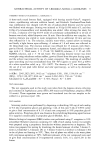
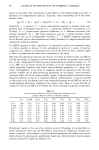
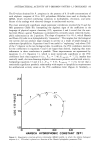
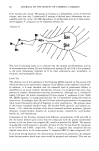
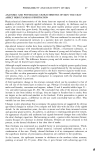
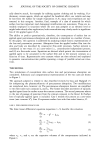
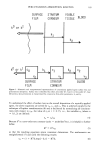
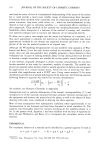
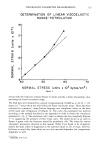
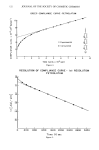
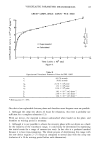
VISCOELASTIC PARAMETER MEASUREMENTS 127 ANALYSIS OF COMPLIANCE CURVE t (time) Figure 9. Since Jo + J• + J2 + J3 + .... is a constant quantity, K' (Figure 9), by substitution and rearrangement, we have K' + •t _ J(t) = J•e -t/?• + J2 e-t/?2 + ..... (3) 'qo where quantity (K' + (t/qqo)) is the extrapolated linear part of the creep curve and may be represented as J(e)• (Figure 9). For conditions of 'r• • 'I' 2 • 'I' 3 . . . etc., at the larger times and smaller ?i, quantities (e-t/?0 and (e -t/?2) etc. become less dominant compared to higher terms (e-t/%). Thus Equation 3 for larger times can be ap- proximated as (K' + •oo)- J(t) = J3e-•/% or, J(e)• - J(t) = J3e -t/?, If [J(e)] - J(t)] is represented as x, then by taking the natural log, we get (4) In x = In J3 - t/?3 (5)

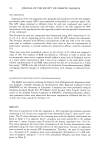
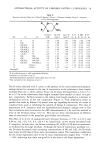
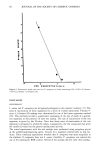
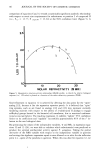
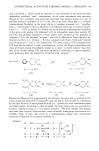
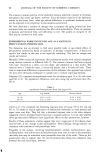
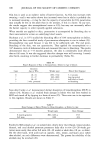
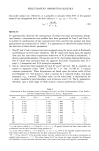
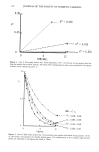
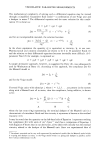
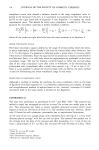
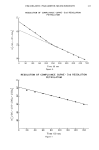
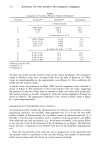
128 JOURNAL OF THE SOCIETY OF COSMETIC CHEMISTS which is the equation for a straight line. Since quantity x at different time intervals can be graphically obtained from the creep curve, a plot of In x versus t should provide a negative slope of 1/'r 3 and an intercept of In J3 from which x3 and J3 can be obtained. It should be noted that in the plot obtained with Equation 5 at smaller times, we have a curve rather than straight line because of the dominance of x•, x2 in this region. The equation for this part of the curve in nonlogarithmic form would be x = J•e -t/½• + J2 e-t/•2 q- J(e)2 (6) where term J(e)2 is the extrapolated portion of the plot obtained with Equation 5. Again, with the same argument as before, the first term is less dominant than the second term in Equation 6. Thus, x = J2 e-t/•2 q- J(e) 2 or, If [x - J(e)2] = Y, then x - J(e)2 = J2 e-t/•2 y = J2 e- t/,r2 or, In Y = In J2 - t/'r2 (7) from which J2 and •2 can be obtained. This analysis can be continued in a similar manner such that Y - J(e)3 = Jle -•/½• (8) from which J1 and •1 can be calculated. Values for Jo could be obtained from the value of K', other Ji values and the relationship Jo = K' - (J1 + J2 + J3 + .... ). While the terminal linear portion of the creep curve provides the value for Xlo, other x h values could be obtained from the relationship '1] i -- ,ri/Ji. GLOSSARY V z j(t) = J0 = w10 = OF SYMBOLS volume of sample specimen (cm 3) initial height of sample specimen (cm) height of sample at time t (cm) time (sec) applied force (= applied weight X 981 g cm/sec 4V/-rr (cm 3) H07/2 / ( H0•/2 •aa '/ (cm•/2) viscosity (g/cm sec or poise) compliance as a function of time (cm 2 dynes- compliance of Maxwell unit (cm 2 dynes-•) residual viscosity of the Maxwell unit (poise)
Purchased for the exclusive use of nofirst nolast (unknown)
From: SCC Media Library & Resource Center (library.scconline.org)