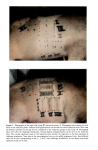
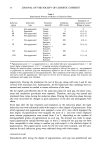
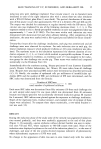
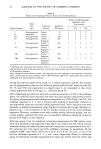
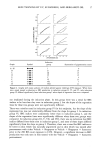
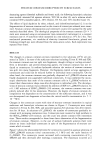
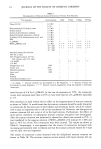
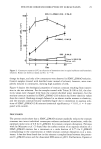
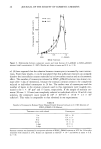
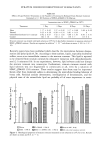
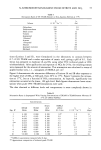
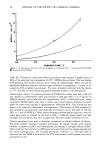
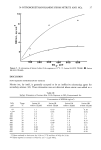
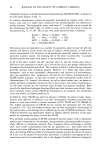
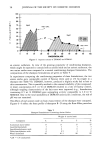
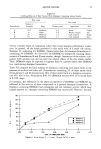
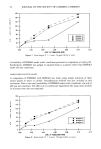
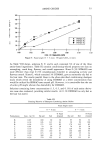
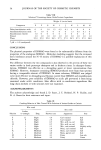
18 JOURNAL OF THE SOCIETY OF COSMETIC CHEMISTS DISCUSSION Quantification of changes in skin pigmentation is particularly difficult when invasive techniques must be avoided. In this study we arbitrarily assessed skin pigmentation by visually inspecting the skin and assigning numerical scores to the degree of pigmenta- tion. Since this method was more qualitative than quantitative, no attempt was made to analyze the data statistically. However, the non-pigmented skin of these pigs was tanned by several treatment combinations, and this induced tan was often comparable to the pigmentation of the natural pigmented skin of these animals. Pretreatment, prior to irradiation, with either Vehicle or Vehicle + Bergapten permitted pigment induc- tion in non-pigmented skin. Vehicle + Sunscreen pretreatment virtually abolished pigment induction due to UVR, while Vehicle + Bergapten + Sunscreen pretreat- ment permitted pigment induction. Therefore, while the sunscreen ingredient virtually negated the induction of tan, the addition of bergapten to the product re-established the tanning capability of UVR. Even though there was some indication, within individual pigs, that induced pigmen- tation decreased susceptibility to erythema upon subsequent UVR, the differences were not statistically significant when the results from all subjects were pooled. This lack of statistical significance may be attributed to several factors, including between-pig vari- ability with respect to the degree of induced pigmentation for each induction site, variability with respect to UV senstivity attributable to the anatomical location of the irradiation sites, the increment of challenge exposures, the relatively small number of experimental subjects, and difficulties associated with assessing both pigmentation and erythema qualitatively and quantitatively. Of course, one or more of these factors would also be expected to impact on the SBC data. Epidermal cell damage was quantified by determining SBC indices after challenge irra- diation. SBC production, in general, indicated a positive role for tan in providing protection against further UVR exposure. This is consistent with earlier works done with miniature swine (4,5). However, certain anomalies in the study warrant consideration. The first involves in- duction group III which developed definitive tan that did not provide protection from subsequent UVR as assessed by SBC production. This may be attributed to one or more of the factors given above concerning statistical analyses. Alternatively, this may indi- cate mechanistic differences among the treatment groups with respect to tan induction and/or protection. The second anomaly involves the 4-minute challenge exposures and SBC production. In all except one group (i.e., induction group VI), SBC indices were very similar after 4 minutes of UVR exposure, and this similarity in responsiveness certainly contributed to the lack of statistical significance observed when induction groups II and IV were compared to group I. Again, this may be related to the factors given above. Alternatively, it may indicate that induced tan in the normally non-pig- mented skin of miniature pigs is often less likely to offer protection against large UVR exposure. In summary, the naturally white (i.e., non-pigmented) skin of miniature swine was successfully tanned by certain treatment regimens in combination with UVR, and a positive role for the protective value of tan was found when epidermal cell damage was assessed by SBC production after challenge irradiation. A bergamot oil-containing sun- screen product was effective in enhancing UVR-induced tan, and the induced tan of this

SKIN TANNING BY UV, SUNSCREEN, AND BERGAMOT OIL 19 product afforded protection against subsequent exposure to UVR when epidermal cell damage was assessed. ACKNOWLEDGEMENT This study was supported by a grant-in-aid from Laboratoires Goupil S.A., Cachan (France). REFERENCES (1) M. M. Lang-Brown, "Australian Field Trials with Bergamot Oil-Containing Sun Tan Products," in Psora/ens in Cosmetics and Dermato/ogy, J. Cahn, P. Forlot, C. Grupper, A. Meybeck, and F. Urbach, Eds. (Pergamon Press, France, 1981), pp. 399-409. (2) H. Tronnier and P. Agache, "Field Trials on Suntan Products Containing Bergamot Oil in Tunisia," in Psora/ens in Cosmetics and Dermato/ogy, J. Cahn, P. Forlot, C. Grupper, A. Meybeck, and F. Urbach, Eds. (Pergamon Press, France, 1981), pp. 411-417. (3) R. Sigafoes, "Evaluation of the Tanning Potential of Topical Sunscreens Containing Psoralens," in Psora/em in Cosmetics and Dem•ato/ogy, J. Cahn, P. Forlot, C. Grupper, A. Meybeck, and F. Urbach, Eds. (Pergamon Press, France, 1981), pp. 419-426. (4) C. P. Sambuco, The miniature swine as an animal model in photodermatology: Factors influencing sunburn cell formation, Photodermato/., 2, 144-150 (1985). (5) C. P. Sambuco and P. D. Forbes, "Miniature Swine in Photodermatology," in Swine in Biomedical Research, M. E. Tumbleson, Ed. (Plenum Publishing Corporation, New York, 1986), pp 681-687. (6) C. Verger, "Control and Dosage of 5-Methoxypsoralen in Raw Material and Finished Products in Cosmetics by High Performance Liquid Chromatography," in Psora/ens in Cosmetics and Dermato/ogy, J. Cahn, P. Forlot, C. Grupper, A. Meybeck, and F. Urbach, Eds. (Pergamon Press, France, 1981), pp. 337-346. (7) P. D. Forbes, R. E. Davies, and F. Urbach, Phototoxicity and photocarcinogenesis: Comparative effects of anthracene and 8-methoxypsoralen in the skin of mice, Fd. Cosmet. Toxicol., 14, 303-306 (1976). D. S. Berger, The sunburning ultraviolet meter: Design and performance, Photochem. and Photobid., 24, 587-593 (1976). D. S. Berger, Specifications and design of solar ultraviolet simulators, J. Invest. Dermatol., 53, 192-199 (1969). W. J. Conover, Practical Nonparametric Statistics (John Wiley & Sons Inc., New York, 1971), pp. 264-270. C. P. Sambuco, P. D. Forbes, R. E. Davies, and F. Urbach, An animal model to determine sun- screen protectiveness against both vascular injury and epidermal cell damage, J. Am. Acad. Dermatol., 10, 737-743 (1984). A. L. Edwards, An Introduction to Linear Regression and Correlation (W. H. Freeman and Company, San Francisco, 1976)pp. 103-127. (8) (9) (lO) (11) (12)
Purchased for the exclusive use of nofirst nolast (unknown)
From: SCC Media Library & Resource Center (library.scconline.org)