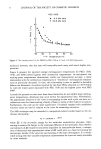
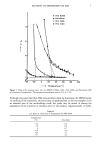
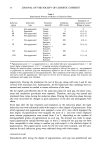
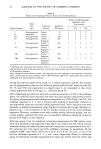
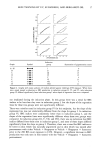
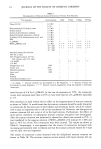
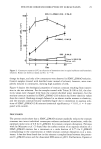
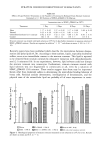
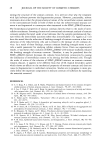
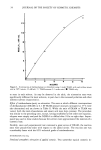
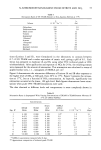
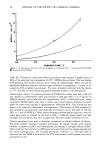
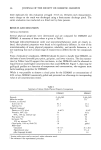
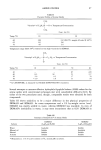
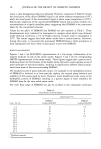
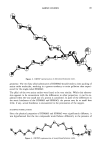
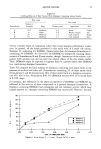
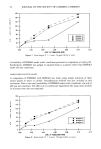
N-NITROSODIETHANOLAMINE FROM NITRITE AND NO 2 33 desired levels by carefully controlled flowmeters. Most experiments were designed for 24 hour exposures to NO2, at 600 ppb to nondetectable levels. MEASURING FOR ATMOSPHERIC LEVELS OF NO 2 To assure accuracy and since the concentration of NO 2 in cylinders often decreases with time, the final diluted stream was measured for NO2 at the ppb level. In the assay, a constant-flow air sampling pump (Dupont Model P125A, Wilmington, DE) was oper- ated at 200 ml/min. Collection of the NO 2 in a bubbler was made via a 10 ml aqueous solution of 1.5% triethanolamine, which contained 2 drops of butanol. Ten ml of 2% sulfanilamide in 5% H3PO4 and 1.4 ml of 0.1% N-(1-napthyl)ethylenediamine ß 2HC1 were then added to the above solution and diluted to 25 ml with water. After five minutes, the resulting color was measured at 540 nm with a spectrophotometer by the accepted US-EPA Method P & CAM 231 (9). However, to increase sensitivity and precision, the method was slightly modified by eliminating hydrogen peroxide. Calcu- lations were based on the prevalent concept that 1 mole of NO 2 produces 0.63 mole of NO2- , an empirically determined value, yet one that is not universally held (10, 11). ANALYTICAL TECHNIQUES FOR NDELA EXTRACTION After air exposure, the tubes were removed from the manifold and sealed on one end with 18-mm septa. NDELA was extracted by adding 10 ml of 2% methanol in dichlo- romethane (DCM) to each tube. The contents were then shaken, transferred to 13 ml centrifuge tubes, and evaporated with nitrogen to i ml, near 0øC. Samples were mea- sured in triplicate for NDELA by direct injection into the HPLC/TEA. When needed, UV-photolysis was used for confirming it a nitrosamine. Nitrite scavengers were not used. Thus, two types of blanks were examined to guard against artifact problems. The first blank consisted of exposing the prepared sample tubes to essentially NO=-free air (indicated by 2 ppb NO2). The second blank con- sisted of isolating the prepared sample tubes in a NO=-free desiccator. The tubes were kept at the specified temperature for 24 hours and measured for NDELA as above. RESULTS NITROSATION VIA NITRITE Effect of stearic acid on non-aqueous nitrosation of triethanolamine. When one mole of stearic acid was added to a chloroform solution containing one molar technical grade trietha- nolamine (85%) and 25 nM of nitrite, significant nitrosation occurred at 50øC. The formation of nitrosamine with time is depicted graphically in Figure 3. In contrast, a mixture of one molar TEAM and nitrite in CHC13 with no stearic acid, under the same conditions, provided no detectable NDELA. Nitrosation rates of TEAM-stearate in non-aqueous solvents. Similar measurements at 37øC were made of 6% equimolar TEAM-stearate mixtures using other nonaqueous solvents. The pH of these equimolar mixtures were near 8.5, and nitrite was added to obtain 25 nM/ml. Using those conditions described above, aliquots were taken at specific time periods for each of the 11 solvents listed in Table I. The first order rate constants, k, were calculated in hr-•, as well as the time required for « of the available nitrite, t•/2,

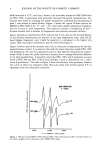
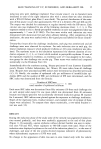
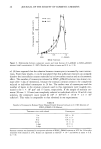
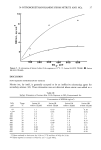
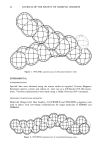
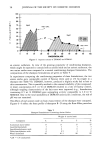
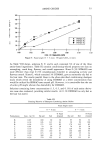
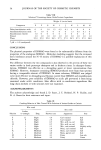
34 JOURNAL OF THE SOCIETY OF COSMETIC CHEMISTS 12 10 ,m i 2 3 4 5 6 HOURS Figure 3. N-nitrosation of diethanolamine in chloroform using 1 molar TEAM, with and without stearic acid at 50øC (nitrite, 25 nM/ml). ¸: TEAM-stearate (1: ! molar ratio). I: TEAM only. to react in each solvent. As may be observed in the table, the nitrosation rates were significantly different for most solvents, in part due to the increased polarities and other inherent solvent characteristics. Effects of triethanolamine purity on nitrosation. The rates at which different concentrations of diethanolamine (DEAM) in 0. ! M TEAM-stearate mixtures nitrosated at 37øC were also determined and are shown in Table II. While the ratio of DEAM to TEAM was varied, both the total ethanolamine and stearic acid were kept constant. The procedure was similar to the preceding ones, except, having established a first order rate equation, aliquots were simply analyzed for NDELA in nM/ml after 24 hr or eight days. Isopro- panol was used in these studies because the solvent more approximated the matrices of a cosmetic base. Notably, since each experimental test contained a great excess of DEAM, the reaction rates were pseudo-first-order with respect to the added nitrite. The reaction rate was considerably faster with the 85% technical grade of triethanolamine. NITROSATION VIA NO 2 Simulated atmospheric nitrosation of applied cosmetics. Two somewhat typical cosmetic lo-
Purchased for the exclusive use of nofirst nolast (unknown)
From: SCC Media Library & Resource Center (library.scconline.org)