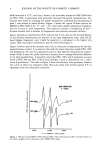
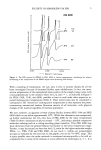
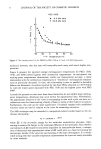
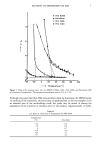
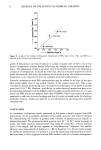
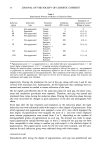
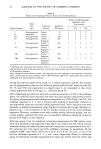
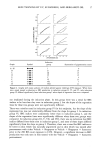
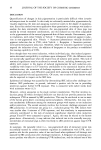
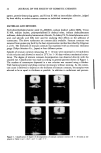
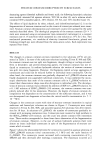
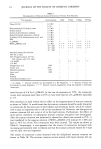
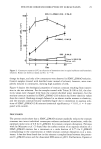
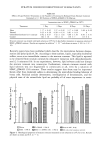
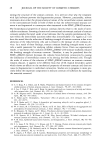
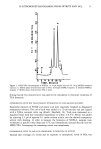
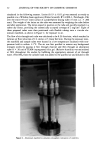
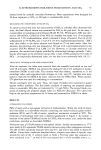
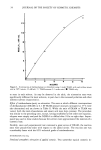
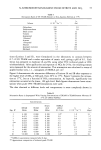
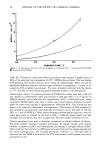
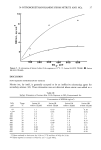
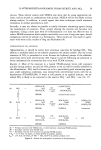
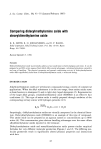
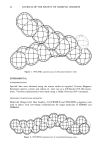
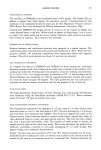
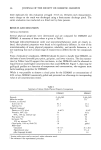
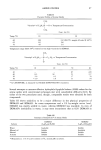
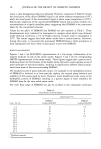
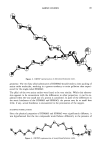
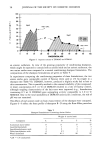
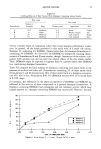
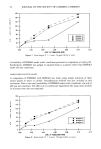
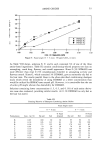
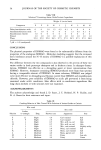
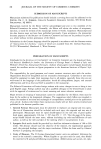
N-NITROSODIETHANOLAMINE FROM NITRITE AND NO 2 35 Table I Nitrosation Rates of 6% TEAM-Stearate in Non-Aqueous Solvents at 37øC k t• Solvent (X 10 -3 hr -•) (hr) Chloroform 240 2.9 Dichloromethane 120 5.8 Ethyl acetate 59 12 Toluene 35 20 Isopropanol 31 22 1-Butanol 18 39 Acetone 16 43 1-Propanol 13 53 Ethanol 7.1 98 Isopropyl myristate 5.5 130 Methanol 4.1 170 tions (Lotions I and II), were formulated in the laboratory to contain between 0.7-0.9% TEAM and a molar equivalent of stearic acid, giving a pH of 8.1. Each lotion was prepared in duplicate (A and B), using either 85% technical grade or 99% triethanolamine. After application and exposure to NO 2 for 24 hr, the resulting smears were measured for the amount of nitrosation. This nitrosation was calculated in terms of applied surface area, i.e., nanograms of NDELA per cm 2. Figure 4 demonstrates the nitrosation differences of Lotions IA and IB after exposure to the higher level of NO2 at 600 ppb, from 20øC to 37øC. Figure 5 presents the nitrosa- tion at 37øC, but as a function of NO 2 concentration. As expected, significantly less nitrosation occurred at the lower, 100 ppb level. Both figures demonstrate lower nitro- sations when purer 99% TEAM formulations were used. The data obtained at different levels and temperatures is more completely shown in Table II Nitrosation Rates in Isopropanol With Varying Concentrations of DEAM in TEAM-Stearate Mixtures @ 37øC (25 nM/ml NaNO2) Concentrations Stearic NDELA DEAM TEAM Acid nM/ml k t• Exp. # Molar Molar Molar @ 24 hrs (( 10 -3 hr-2) (days) 1 0.100 0.000 0.100 1.0' 1.9 14 2 0.075 0.025 0.100 2.9 5.1 5.7 3 0.050 0.050 0.100 4.8 8.9 3.2 4 0.025 0.075 0.100 7.5 15 1.9 5** 0.015 0.085 0.100 8.6 18 1.6 6 0.010 0.090 0.100 6.3 12 2.4 7 0.005 0.095 0.100 4.9 9.1 3.2 8 0.003 0.097 0.100 3.4 6.1 4.7 9 0.001 0.099 0.100 2.0 3.5 8.3 10 0.001 0.100 0. 100 1.0' 2.0 14 * NDELA concentration measured after 8 days. ** Approximate composition of technical grade TEAM.

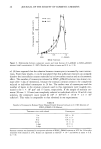
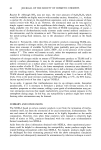
36 JOURNAL OF THE SOCIETY OF COSMETIC CHEMISTS 20 25 30 35 TEMPERATURE, C F•ure4. N-NitrosationofLotionIa•er24-hrexposureto600ppbNO2. O:LotionIA(85%TEAM). •:LotionIB(99%TEAM). Table III. It should be noted that when the products were exposed to higher levels of NO2 at the relatively low temperature of 20øC, NDELA did not form. This was further demonstration that artifacts did not occur within the methodology. There was also no significant difference between the two types of blanks. Consequently, it could be as- sumed the NO 2 scrubber was adequate. The trace nitrosation detected with the blanks at 37øC was due to trace nitrosating agents originally present in the formulation. Interestingly, when a 1% aqueous solution of TEAM (w/o stearic acid and at pH 10) was smeared in polyethylene tubes and exposed to 600 ppb NO2, 5 to 8 ng/cm 2 of NDELA formed, even at relatively low temperatures (30øC). In additional tests, where concentrated TEAM smears were used, a certain ease toward surface nitrosation occurred when the tubes were exposed to approximately 1000 ppb NO 2. This nitrosation was shown to be relatively independent of temperature. (The amount of NO2 absorbed to that nitrosated was measured colorimetrically and found to be on the order of 250 nm NO2 to 1 nm of NDELA.) These results showing triethanolamine reactivity with ni- trosyl gases were in contrast to the nitrite (NO2-) additions where stearic acid was necessary for nitrosation, but were in agreement with the studies of Challis (12,13). Various procedures were used to eliminate nitrosation on simple addition of solvent. The most extreme treatment included scavenging the sample initially with sodium bisulfite in aqueous H3PO 4 and subsequently percolating it through sodium sulfate. After correction for recovery, no differences were noted between the regular analysis and the nitrite-scavenged one. The accepted procedures of Krull et al. were also used to ascertain that the NDELA detected by the TEA was neither a nitrite/nitrate ester nor a nitramine (14,15).
Purchased for the exclusive use of nofirst nolast (unknown)
From: SCC Media Library & Resource Center (library.scconline.org)