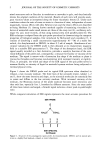
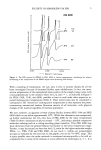
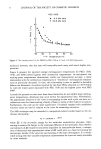
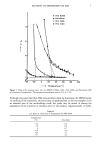
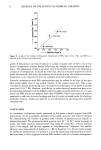
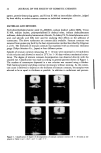
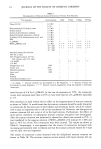
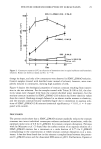
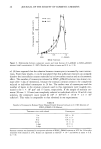
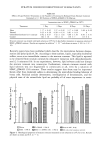
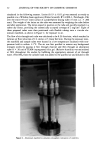
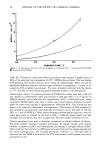
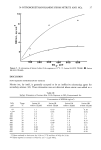
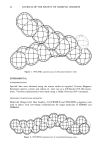
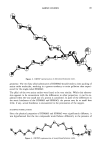
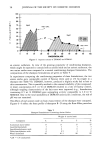
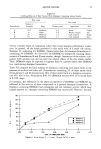
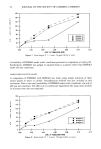
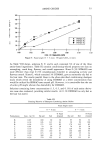
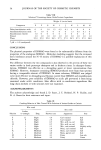
j. Soc. Cosmet. Chem., 38, 43-55 (January/February 1987) Comparing didecylmethylamine oxide with stearyldimethylamine oxide K. R. SMITH, R. O. JOHANNESSEN, and D. P. BAUER, Ethyl Corporation, Ethyl Technical Center, P.O. Box 14799, Baton Rouge, LA 70898. Received September 8, 1986. Synopsis Didecylmethylamine oxide is potentially useful as a hair conditioner in both shampoos and rinses. It can be prepared as an 80% active aqueous fluid which offers several advantages, including formulation versatility and ease of handling. The physical properties and general conditioning activity of didecylmethylamine oxide differ significantly from those of stearyldimethylamine oxide, a structural analog. INTRODUCTION Alkyldimethylamine oxides are well-known compounds having a variety of commercial applications. When the alkyl substituent is in the coco range, these amine oxides serve as foam boosters in shampoos (1) and in light duty liquid detergents (2). Representative of the larger alkyl groups, stearyldimethylamine oxide (SDMAO) is an effective hair conditioner (3). This type of amine oxide is readily prepared through oxidation of the corresponding tertiary amine with hydrogen peroxide (4,5). H202 R3N • R3N • O d- H20 Surprisingly, dialkylmethylamine oxides are virtually unreported in the chemical litera- ture. Didecylmethylamine oxide (DDMAO) is an example of this type of compound. This amine oxide can be prepared as an aqueous system at concentrations up to 80% active (6). This concentration gives obvious handling advantages over the more dilute alkyldimethylamine oxides reported in the literature. Didecylmethylamine oxide and stearyldimethylamine oxide possess similar empirical formulae but very different molecular geometries (Figures 1 and 2). The differing mo- lecular geometries result in significantly altered physical properties and interactions with hair. 43

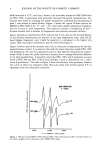
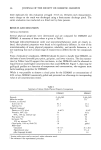
44 JOURNAL OF THE SOCIETY OF COSMETIC CHEMISTS Figure 1. SPACEFILL representation of didecylmethylamine oxide. EXPERIMENTAL INSTRUMENTATION Spectral data were obtained using the amine oxides as supplied. Nuclear Magnetic Resonance spectra, proton and carbon-13, were run on a GE/Nicolet NT-360 instru- ment. Viscosity measurements were made using a Haake Rotovisco-RV viscometer. MODELING OF MOLECULAR GEOMETRY Molecular Design Ltd's (San Leandro, CA) PRXBLD and SPACEFILL programs were used to depict local low-energy conformations for single molecules of SDMAO and DDMAO. Figure 2. SPACEFILL representation of stearyldimethylamine oxide.
Purchased for the exclusive use of nofirst nolast (unknown)
From: SCC Media Library & Resource Center (library.scconline.org)