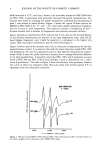
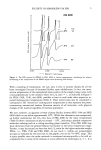
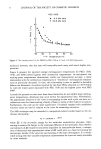
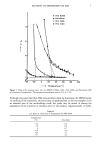
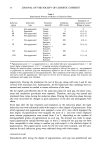
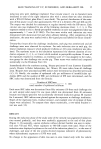
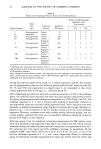
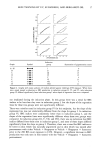
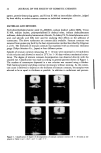
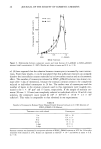
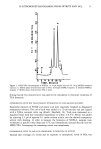
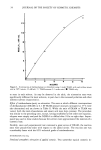
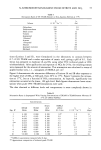
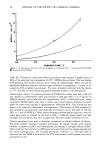
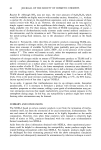
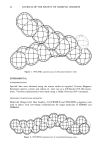
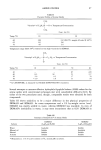
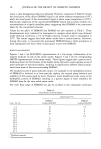
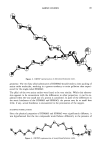
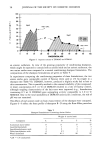
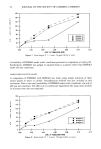
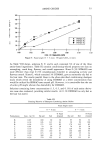
FLUIDITY IN SEMISOLIDS VIA ESR 7 ß PEG 6000 ß Petrolalum o PEG 1500 ß PEG 1540 I I -40 -20 0 20 40 60 I i 80 I00 ) Temperature/oc Figure 5. Plots of the intensity ratio, I•/I3, for DBNO in PEGs 1500, 1540, 6000, and Petrolatum USP as a function of temperature. The estimated measurement error in I•/I 3 is + 5%. Although this paper describes ESR measurements made by dispersing the DBNO probe via melting of the semisolids, this procedure of applying heat to the test samples is not an essential part of the methodology itself the probe may be mixed in during the preparation of the ointment or emulsion prior to the analysis. Approximately 10 milli- Table II I•/I 3 Ratio as a Function of Temperature for PEG 6000 Temperature (øC) I•/I 3 Ratio -20 6.9 - 10 8.0 0 6.7 + 10 4.9 +20 4.1 +31 3.2

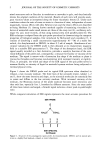
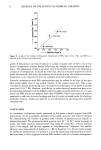
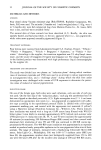
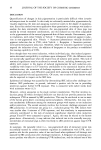
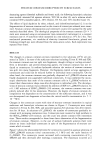
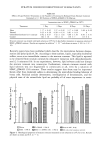
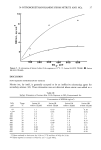
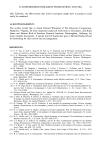
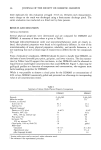
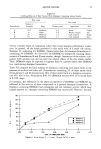
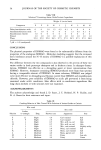
8 JOURNAL OF THE SOCIETY OF COSMETIC CHEMISTS 380- v 360' E • 340' .o_ • 320- 6000 • 300 +•PEG1540 280 •500 26a0 310 310 310 = Melting Point/K Figure 6. A plot of the average melting-point temperature of PEG bases 1500, 1540, and 6000 as a function of the intersection temperatures. grams of the product can then be placed in a glass or quartz tube (5 mm o.d.) at any desired temperature without further subjecting the sample to any mechanical distur- bance. The application of heat is necessary only if the fluidity data are to be obtained as a function of temperature. It should be noted that only trace amounts (ppm level) of the probe are required, and hence the addition of the probe during the emulsion/ointment preparation is not expected to alter the sample's structural characteristics. Potential interferences with ESR measurements may be related to the type of the spin label probe added since it can modify fluidity of the system under test. This is not considered a serious shortcoming since the required concentration of the probe is usually quite low (--• 10 -4 M). However, insolubility or other chemical interactions may occur necessitating replacement of the DBNO probe by other nitroxide molecules (7). In cases where the ESR spectra are different from that of DBNO, Freed's procedure (9) may be employed to take into account the shape and size of a given nitroxide probe for studying molecular motions. Studies are planned in our laboratories for obviating these possible complications. CONCLUSION In conclusion, preliminary results presented in this paper strongly suggest that ESR spectroscopy can be successfully developed into a rapid, accurate, and sensitive method for characterizing the fluidity or ground state viscosity of pharmaceutical liquids or semisolid systems. The proposed method requires only 10-4 to 10-5 molar amounts of probe, and these sensitive measurements may easily be conducted, without external stress to the sample, and are thus regarded as "non-destructive." Moreover, this method allows an easy measurement of barriers (i.e., AE in Equation 1) to the activation energy for molecular reorientation in a system as a basis for improving understanding of mate- rial structures. A direct application of the ESR method could be its further development
Purchased for the exclusive use of nofirst nolast (unknown)
From: SCC Media Library & Resource Center (library.scconline.org)