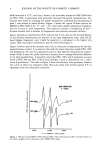
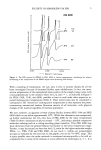
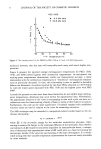
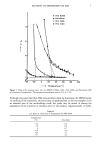
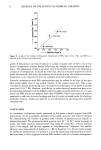
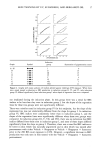
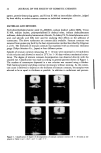
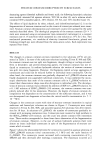
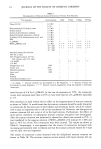
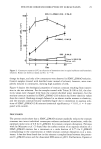
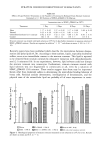
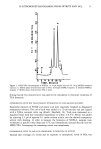
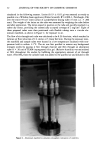
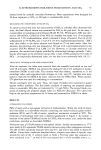
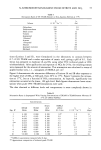
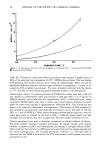
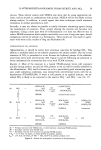
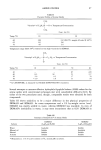
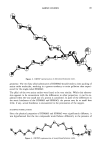
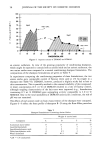
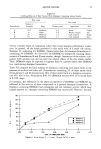
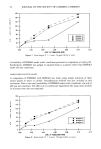
STRATUM CORNEUM DISRUPTION BY SURFACTANTS 25 150 100 50 SDS / C•2 DMAO (2:8) - 0.1M/• C•2 DMAO ' 0.1M/•, I I SDS ß 0.1M/•, i // i 8 30 Day Figure 2. Corneocyte counts (at 25øC) as a function of immersion time in typical surfactant and keratolytic solutions. Results are shown as means and S.E. (n -- 8). change its shape, and only a few corneocytes were observed in SDS/C•2DMAO solution. Control samples (treated with distilled water instead of solvent), however, were com- pletely reduced to corneocytes, showing high numbers of cells. Figure 4 depicts the rheological properties of stratum corneum resulting from immer- sion in the test solutions. For the samples treated with Triton X-100 or SA, the elas- ticity values were changed little from the control (distilled water treatment), but the stratum corneum immersed in SDS/C•2DMAO (2:8) solution had lower elasticity values than the control. Breaking strength behaved in an almost similar manner to elasticity, and the stratum corneum became markedly fragile due to immersion in aqueous solu- tions of SDS/Cz2DMAO (2:8) mixture (statistical significance p 0.01, n = 4 com- pared with control). DISCUSSION The present results show that a SDS/C•2DMAO mixture markedly reduces the stratum corneum into intact individual corneocytes without mechanical stimulation, with the optimum molar ratio of 0.8 for C•2DMAO, for stratum corneum disruption. Previous work by Miyazawa et al. (7) found that the surface tension of an aqueous solution of a SDS/C•2DMAO mixture has a minimum at a mole fraction of 0.75 for C•2DMAO corresponding to the concentration at which stratum corneum disruption is at a max- imum. It has also been found that in this mixture a complex forms between the proton- ated C•2DMAO cation and the dissociated SDS anion at pH 9. Furthermore, Epstein et

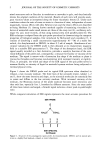
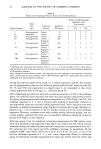
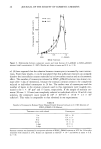
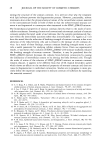
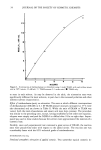
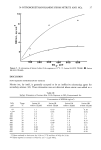
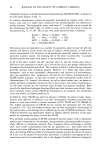
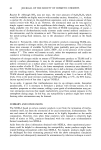
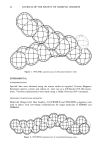
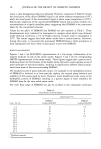
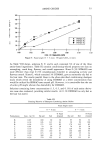
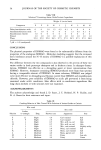
26 JOURNAL OF THE SOCIETY OF COSMETIC CHEMISTS 150 100 50 0---0 25oc o 0.5 lO SDS C• DMAO Mole fraction Figure 3. Relationship between corneocyte counts and mole fraction of C•2DMAO in SDS/C•2DMAO mixture (total concentration 0.1 M/l). Results are shown as mean and S.E. (n = 8). al. (8) have reported that the cohesion between corneocytes is increased by ionic interac- tions. From these results, it can be postulated that this surfactant mixture can uniquely dissolve the intercellular cement materials by its low surface tension and an electrostatic effect. The number of corneocytes released in SDS/C•2DMAO solution was almost con- stant after 1 day of immersion, because the stratum corneum seems to be completely reduced to individual corneocytes in 24 hrs. The surface area of corneocytes and the number of layers in the stratum corneum used in this experiment were roughly esti- mated to be 1 x 10³ }xm 2 and 15 layers, respectively. If the sample of stratum cor- neum (10 mm X 10 mm) was completely reduced to individual cells in 10 ml of a test solution, the corneocyte count would be (104 X 104/103) X 15/10 = 1.5 X 10⁵ cells/cm 3. This value is comparable to that obtained in our experiments. Table II Number of Corneocytes Released From Ethanol-Treated Stratum Corneum in 0.1 M/1 Solution of SDS/Cx2DMAO (2:8) Mixture , Treatment time with ethanol Corneocytes 1 hr 182 + 10 3hr 131 + 9 8 hr 104 ñ 12 24 hr 71 - 11 3 days 29 ñ 6 5 days 9 ñ 3 Stratum corneum was immersed in an aqueous solution of SDS/C•2DMAO mixture at 50øC for 24 hrs after treatment with ethanol at 25øC. Results are expressed as cells/cm 3 x 10 -3 and shown as mean - S.E. (n = 8).
Purchased for the exclusive use of nofirst nolast (unknown)
From: SCC Media Library & Resource Center (library.scconline.org)