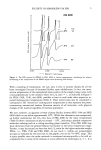
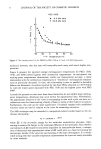
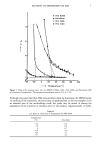
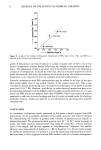
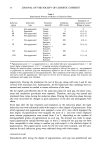
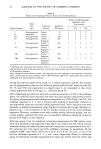
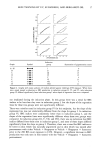
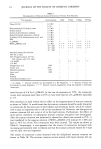
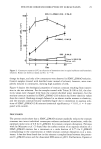
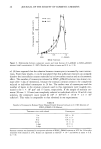
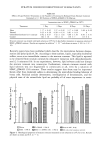
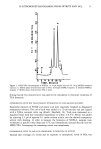
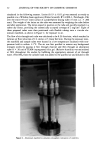
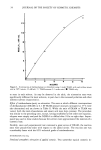
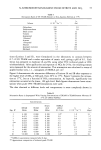
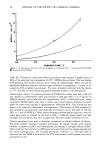
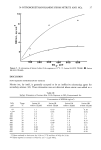
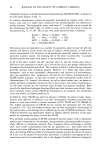
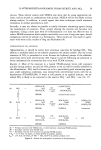
STRATUM CORNEUM DISRUPTION BY SURFACTANTS 27 Table III Effects of Lipid Solvent Treatments on the Number of Corneocytes Released From Stratum Corneum Immersed in 0.1 M/1 Solution of SDS/C•2DMAO (2:8) Mixture Immersion time in SDS/C•2DMAO (at 50øC) Treatment 1 Day 3 Days 8 Days 30 Days Ether 1.17 + 0.42 1.17 - 0.49 3.17 + 0.68 1.00 _4- 0.49 Ethanol 0.25 -+ 0.18 0.58 -+ 0.34 0.83 -+ 0.34 0 Chloroform/methanol (2:1)mixture 0.92 - 0.67 3.42 + 1.92 4.00 + 1.93 0.83 + 0.51 Control 104 + 10 130 - 14 139 + 7 113 _4- 6 Stratum corneum was treated with lipid solvents at 25øC for 6 days before immersion in aqueous solution of SDS/C•2DMAO mixture. Results are expressed as cells/cm 3 X 10 -3 and shown as mean + S.E. (n = 8 - 10). Recently papers have been published which describe the interrelation between desqua- mation and polar lipids (9, 10). According to these authors, lipids, especially cholesteryl sulfate, serve as an intercellular cement in the stratum corneum. This lipid is reported to be removed from stratum corneum by exhaustive extraction with chloroform/meth- anol (2:1) mixtures (10). In our experiments, however, lipid solvents could not disrupt the stratum corneum into corneocytes. Furthermore, stratum corneum treated with lipid solvents was not fragmented to corneocytes at all, even by a solution of SDS/C•2DMAO (2:8) mixture. These results suggest that there may be important factors other than cholesteryl sulfate in determining the intercellular binding behavior of horny cells. Residual annular desmosomes, interdigitation of keratinocytes, and the physical state of the extracellular lipid are probably all of some importance in main- E E 1.0 "'0.5 o o 5.0 [•l Water IrlTII C12 DMAO , 0 1M/g [•:ITr•ton X-100 , 0 1% [] SDS , 0 1M/g [] SDS / C12 DMAO (2 8) , 0 1M /g [•l SA staturated aqueous solution Figure 4. Rheological properties of stratum corneum immersed in test solutions at 25øC for 2 hrs. Results are shown as mean and S.E. (n = 4).

28 JOURNAL OF THE SOCIETY OF COSMETIC CHEMISTS taining the structure of the stratum corneum. It is still not clear why the treatment with lipid solvents prevents the fragmentation process. However, presumably, solvent treatments alter either the physicochemical nature of the intercellular cement material or the intercorneocyte bonds or both of these so that the solvent-treated stratum cor- neum is not fragmented to corneocytes when immersed in the SDS/C•2DMAO mixture. The biomechanical properties of stratum corneum directly relate to the mode of inter- cellular attachment. Scanning electron and conventional microscopic analysis of stratum corneum samples fractured under a load indicates that the samples predominately frac- ture within the intercellular junctions rather than intracellularly (11). Agach et al. (12) have also stated that the reduction of breaking strength of stratum corneum is due to an alteration of the links between cells and is related to the damage of cell cohesion de- vices. As a result of these findings, stratum corneum breaking strength seems to pro- vide a useful parameter for studying cellular cohesive forces. From our experimental results, it was shown that a solution of SDS/C•2DMAO (2:8) mixture markedly reduced the breaking strength of stratum corneum. Therefore, it may be postulated that the SDS/C12DMAO mixture decreases the cohesive forces between corneocytes by causing the dissolution of intercellular cement or by altering the links between cells. Though the mode of action of the solution of SDS/C12DMAO mixture on stratum corneum remains obscure, it appears to be different from that of SA (typical keratolytic agent) which shows no effects on the mechanical properties of stratum corneum and does not cause its fragmentation to individual corneocytes. Studies are in progress to more pre- cisely define the important components in stratum corneum cell adhesion by examining the materials extracted. REFERENCES (1) (2) (3) (4) (5) (6) (7) (8) (9) (10) (11) (12) C. S. King, P. J. Dykes, and R. Marks, Preparation and characterization of the nonionic detergent- soluble proteins of human stratum corneum, J. Invest. Dermatol., 79, 297-302 (1982). S. Lee, Y. Park, Y. Kim, and J. Kang, An experimental study on corneocytes of acutely and chroni- cally irritated skin. Arch. Dermatol. Res., 275, 49-705 (1983). A.M. Kligman and E. Christophers, Preparation of isolated sheets of stratum corneum, Arch. Der- matol., 88, 702-705 (1963). C. Huber and E. Christophers, "Keratolytic" effect of salicylic acid, Arch. Dermatol. Res., 257, 293-297 (1977). H. P. Baden and J. C. Alper, A keratolytic gel containing salicyclic acid in propylene glycol, J. Invest. Dermatol., 61, 330-333 (1973). W. P. Smith, M. S. Christensen, S. Nacht, and E. H. Gans, Effect of lipids on the aggregation and permeability of human stratum comeurn. J. Invest. Dermatol., 78, 7-11 (1982). K. Miyazawa, M. Ogawa, and T. Mitsui, The physico-chemical properties and protein denaturation potential of surfactant mixtures. Int. J. Cosmet. Sci., 6, 33-46 (1984). E. H. Epstein, M. L. Williams, and P. M. Elias, Steroid sulfatase, X-linked icchthyosis, and stratum corneum cell cohesion, Arch. Dermatol., 117, 761-763 (1981). P. M. Elias, Epidermal lipid, barrier function, and desquamation, J. Invest. Dermatol., 80, 44s-49s (1983). S. A. Long, P.M. Wertz, J. S. Strauss, and D. T. Dowing, Human stratum corneum polar lipids and desquamation, Arch. Dermatol. Res., 277, 284-287 (1985). R. H. Wildnaur, J. W. Bothwell, and A. B. Douglass, Stratum comeurn biomechanical properties, J. Invest. Dermatol., 56, 72-78 (1971). P. Agach, J. P. Boyer, and R. Laurent, Biomechanical properties and microscopic morphology of human stratum corneum incubated on a wet pad in vitro. Arch. Derm. Forsch., 246, 271-283 (1973).
Purchased for the exclusive use of nofirst nolast (unknown)
From: SCC Media Library & Resource Center (library.scconline.org)