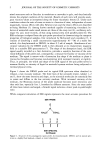
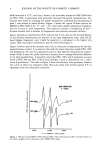
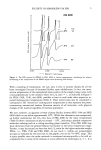
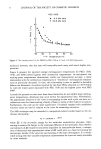
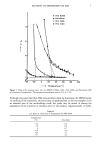
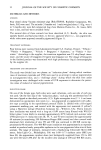
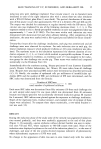
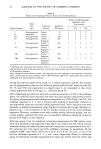
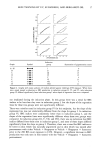
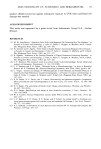
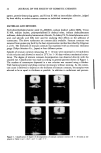
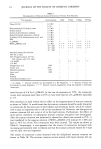
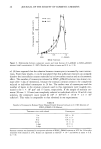
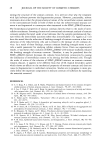
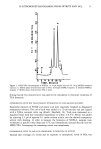
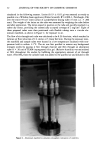
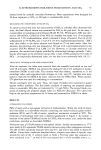
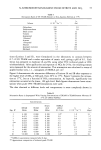
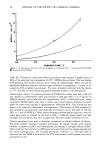
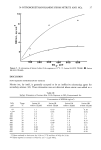
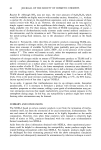
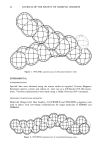
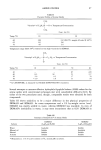
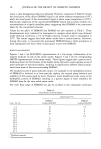
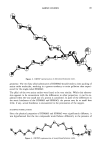
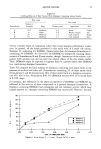
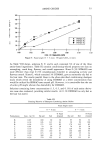
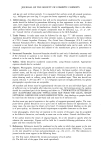
FLUIDITY IN SEMISOLIDS VIA ESR 5 1___ PEG 6000 T 1•/13 -- 87'C 1.4 37'C 2.4 -3øC 6.7 i i 12 •5.•0 12,•580 12,4•50 ) Mognetic Field/( (]uss Figure 3. The ESR spectra for DBNO in PEG 6000 at various temperatures, exhibiting the relative broadening of the components of the DBNO triplet with decreasing base fluidity. With a lowering of temperature, the I1/I 3 ratio is seen to increase sharply for all the bases investigated because of decreased fluidity upon solidification. In fact, the inter- section temperatures of the extrapolated linear portion of the steeply rising curves with a line perpendicular to the ordinate where the I1/I 3 ratio = 1, as indicated in Figure 5 for PEGs 1500, 1540, and 6000, parallels at least in rank order their respective re- ported melting-point temperatures (Table I). These intersections may be considered to correspond to the "theoretical" melting-point temperatures as they represent the phase- commencing unrestricted random Brownian motion of all molecules, with physical changes of the material regardless of external appearance. We note, however, an apparent reversal of phase fluidity between PEG 1540 and PEG 6000 which occurs below approximately 20øC. While this observation was unexpected, on further examination the I1/I 3 ratio data of PEG 6000 for the lower temperatures (Table II) show a maximum or spur at around - 10øC, indicating a possible cooperative molecular ordering such as a coiling-uncoiling phase transition. Thus PEG 6000 may show deviations from the general behavior for fluidity in the lower temperature range. Further, it may be pointed out here that the I1/I 3 ratios for the higher molecular weight PEGs, i.e., PEG 1540 and PEG 6000, do not reach 1, within our measurement accuracy as indicated by the error bars on the graphs, even at the 70-80øC range. This is quite possible since the probe molecule is envisioned microscopically to be still in- completely free to rotate in the medium at a rate sufficient for rendering I1/I 3 = 1. It is

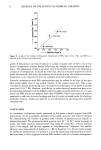
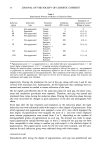
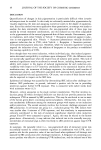
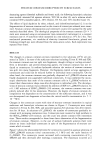
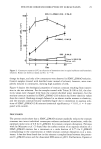
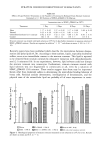
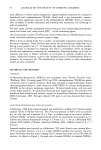
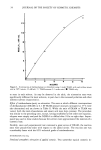
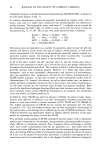
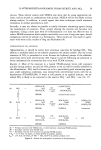
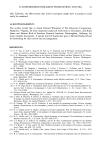
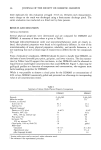
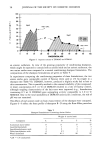
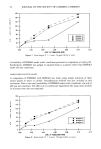
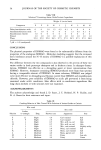
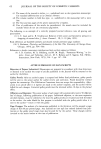
6 JOURNAL OF THE SOCIETY OF COSMETIC CHEMISTS PEG I500 ß 9.5 GHz data ß 33.8 GHz data - ß e e I I I I I -40 -20 0 20 40 60 ) Temperoture/ø C Figure 4. The intensity ratio I/I 3 for DBNO in PEG 1500 at 9.5 and 33.8 GHz frequencies. projected, however, that this ratio will eventually reach unity with much higher tem- peratures. Figure 6 presents the reported average melting-point temperatures for PEGs 1500, 1540, and 6000 plotted against their intersection temperatures. As anticipated, the melting-point temperatures demonstrate, within our measurement accuracy, a linear relationship with the intersection temperatures or "theoretical" melting-point tempera- tures as previously discussed. In turn, this relationship is seen to parallel in favorable fashion the Kinematic viscosities reported for the three PEGs obtained at 210øF (Table I), with the lowest point associated with PEG 1500 and the highest point with PEG 6OOO. It should be pointed out that since these bases themselves do not exhibit sharp melting- point temperatures, deviations may occur within the experimental data. Nevertheless, the approximate linearity of the curve is encouraging in that such a plot can serve as a calibration curve for characterizing a family of bases in terms of their relative viscosities. Furthermore, the scale can be made quantitative if standard samples with established viscosity values are used in relation to the curve for measuring viscosities. The ESR technique may be extended to temperature-related studies based on the Ar- rhenius relationship: AE/kT (1) x I = constant e where AE is the activation energy for the molecular reorientation processes, repre- senting in essence the barrier to the rotational diffusion of the molecules. Since theoret- ical estimates of AE would be sensitively dependent on intermolecular forces, a compar- ison of theoretical and experimental values of AE could serve as a basis for learning the microscopic details of the structure and bonding of the bases investigated. It is worth- while noting here that variable temperature measurements for x I are not easily attainable by other methods.
Purchased for the exclusive use of nofirst nolast (unknown)
From: SCC Media Library & Resource Center (library.scconline.org)