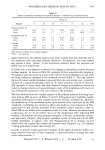
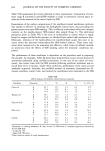
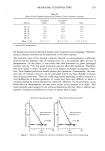
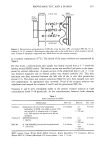
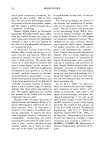
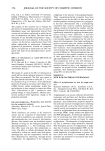
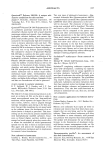
POLYMERS AND LIPIDS ON SKIN BY ESCA 303 Table VI Substantivity of Polymers on SDS-Washed Skin--High-Resolution Results Atomic % C N Polymer CH C - O C = O COO N N + Polyquaternium- 10 Outer 47.1 19.8 6.2 1.0 4.8 0.7 Inner 44.0 19.6 6.6 0.8 6.5 0.8 Polyquaternium-24 Outer 45.1 21.8 6.2 1.6 4.4 0.4 Inner 38.0 21.4 9.1 1.8 7.8 0.6 Chitosan Outer 50.8 15.4 6.6 1.8 5.6 1.4 Inner 49.4 14.9 7.2 1.8 6.6 0.9 All entries are average of two separate samples. occurring upon immersion in the polymer solutions, lipid removal, if any, by the polymer solution not being compensated for. Such removal would also influence the observed C/O ratio in a manner similar to polymer deposition. This assumption seems to be a reasonable one for SDS pretreated samples in which the majority of the lipid has already been removed. In the case of the unwashed samples, however, this assumption may lead to error, causing erroneously high calculated deposition values. However, the detection of significant levels of quaternary nitrogen on the inner surfaces of the un- washed specimens leaves no doubt that polymer deposition is occurring on these sur- faces. EFFECT OF EMOLLIENT TREATMENTS In addition to studying the effects of conditioning polymers, ESCA was also applied to determine the ability of various emollients to persist and protect the native lipid layer when the treated skin surfaces were exposed to a surfactant wash. In this work, effec- tiveness of the emollient is evidenced by an increased hydrocarbon content on the sur- face, with a corresponding decrease in the surface concentration of elements specific to the skin substrate (nitrogen and sulfur) relative to untreated samples washed in the surfactant (SDS) solution. Table VII Polymer Surface Coverage of Treated Skin Samples--Fractional Surface Coverage X Skin pretreatment None SDS Polymer Outer Inner Outer Inner Polyquaternium- 10 0 0.09 0.48 0.45 Polyquaternium-24 0.48 0.29 0.45 0.52 Chitosan 0.06 0.24 0.36 0.33

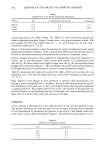
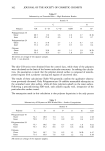
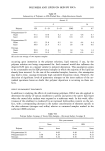
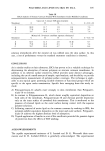
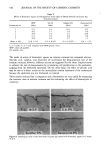
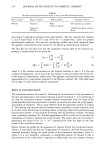
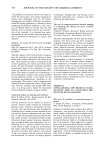
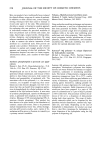
304 JOURNAL OF THE SOCIETY OF COSMETIC CHEMISTS Table VIII summarizes the results obtained in these experiments. Comparison of treat- ment stage B (untreated control/SDS washed) to stage A (untreated control) again re- veals the facile removal of the native lipids by SDS. Examination of the surface compositions of the emollient-treated membranes indicates that lanolin is effective in retaining the hydrophobic barrier layer, thus providing the greatest protection upon SDS washing. This is reflected as decreased sulfur and nitrogen contents on the lanolin-treated, SDS-washed skin sample (Stage C). The additional parameter given in Table VIII is the ratio of hydrocarbon to carbon which is singly bound to oxygen (alcohol/ether groups), as obtained from carbon high-resolution data. Obviously, retention of the hydrocarbon-rich emollient/lipid causes this ratio to in- crease versus the relatively hydrocarbon-free SDS-washed surfaces. These same indi- cators show mineral oil to be somewhat less effective, while castor oil affords virtually no protection from the effects of SDS washing under the treatment conditions em- ployed. The performance of these emollients is dependent on the procedure used in preparing the samples. As examples, Table IX shows data obtained from castor oil and mineral oil treatments performed using modified procedures. In the case of the castor oil treat- ments, the contact time with the SDS solution following emollient treatment was re- duced from 30 to 5 minutes. Under these conditions, performance of the castor oil was markedly improved. Similarly, the modified mineral oil treatment eliminated the 30- minute emollient contact time, and instead the membranes were immersed in the SDS Table VIII ESCA Analysis of Emollient-Treated Stratum Corneum Emollient Treatment C O N S C - C/C - O Castor oil A 81.7 12.7 2.2 0.4 5.8 B 72.8 15.5 8.1 1.5 4.1 C 73.4 15.7 8.5 1.6 3.8 Mineral oil • A 84.7 11.6 1.5 0.3 7.5 B 74.8 14.6 8.6 1.2 4.2 C 81.5 10.3 4.8 0.8 8.6 Glycerid acid 2 A 77.8 14.0 3.6 0.4 7.4 B 72.6 15.0 8.3 1.8 3.9 C 74.2 15.2 6.8 2.0 4.8 Oleic acid A 81.0 12.6 2.8 0.4 10.4 B 72.2 16.9 4.5 3.1 5.8 C 72.7 15.8 8.7 1.9 5.2 Lanolin A 84.2 11.7 2.2 0.4 8.9 B 70.4 16.2 9.5 1.7 4.1 C 86.2 9.2 1.0 0.6 10.4 Treatments: A, starting membrane B, after 30-min 1% SDS wash 30-min SDS wash. • Acroprime 350. 2 Agent GII, Westvaco. Values listed are results of single measurements. C, emollient application followed by
Purchased for the exclusive use of nofirst nolast (unknown)
From: SCC Media Library & Resource Center (library.scconline.org)