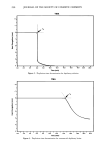
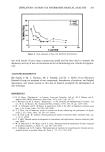
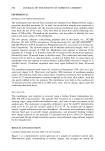
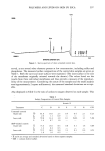
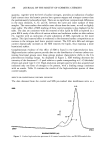
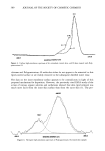
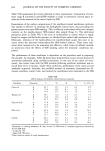
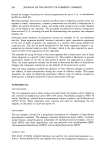
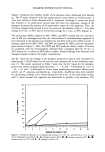
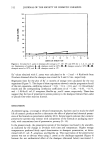
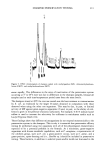
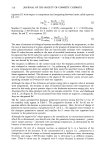
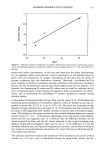
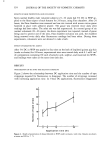
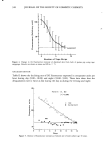
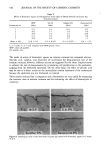
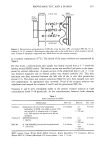
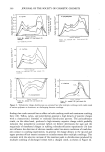
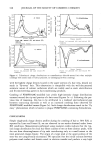
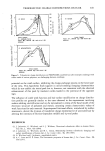
SHAMPOO PRESERVATIVE TESTING 315 o -1 -2 -3 -4. -5 -6 -7 -8 -9 -lO 11 -12 -13 -14. -15 -16 -17 -18, -19 -20 o 1 2 3 4 5 6 7 • 9 lo 11 12 13 14 MONTHS ON STABIUTY TEST Figure 7. Change in apparent activation energies (Ea') for the shampoo preservative system during the stability study, determined using test organisms. Explanation of symbols: I--I, E. coli O--O, P. aeruginosa •--•, Bacillus sp. and l•__,, S. aureus. more than chemicals with known antimicrobial activity. Factors such as pH, water activity, nutrient availability, surfactant concentration, sequestering agents, and other interferences will determine the extent to which preservative action is manifested in any given formulation. Thus, the preservative system of a product involves both specific preservative chemicals and the physicochemical constitution of the entire formulation. The inhibition of bacterial growth in a shampoo may conceivably be due to more than one mechanism (i.e., surfactant destabilization of cell membranes, preservative action on cellular metabolism, sequestration of divalent metal ions by tetrasodium EDTA, unavailability of nutrients, etc.). One would not expect organisms with different meta- bolic capabilities to be inactivated at the same rate in any cosmetic product. In the current study, it was found that the four test organisms responded differently to the net antibacterial effect of the shampoo. Although the goal of this investigation was not to determine the cause of change in preservative efficacy, the HPLC results revealed the presence of all three preservatives initially, but only MP was unchanged after one week of storage at room temperature (Figures 5 and 6). This suggests that CMIT and/or MIT reacted with some component in the formula--possibly hydrolyzed animal collagen, because these isothiazolinones are known to react with amines (15). It is known that the rate constants for chemical reactions are influenced by temperature, as represented by the Arrhenius equation (17) k = Ae -r'•RT where k is the reaction rate constant, A is the pre-exponential factor, Ea is the activa- tion energy, R is the gas constant, and T is the absolute temperature. Differentiating

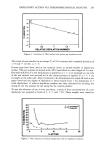
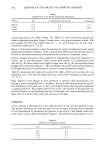
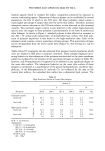
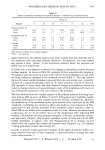
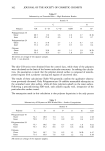
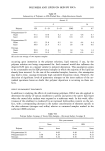
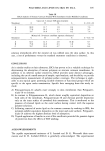
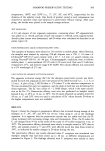
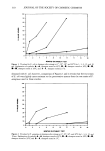
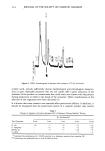
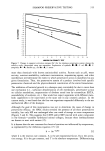
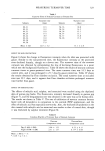
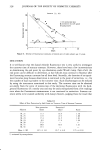
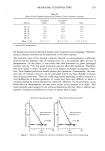
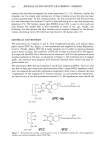
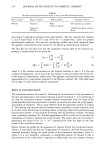
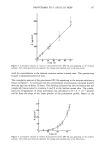
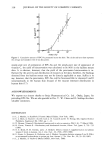
316 JOURNAL OF THE SOCIETY OF COSMETIC CHEMISTS equation (1} with respect to temperature and integrating between limits yields equation {2} (17): log k2 - Ea (T2 - T,) {2} k• 2.303R (T•T 2) Stumbo (7) reported that the D-value = 2.303/k consequently, k = 2.303/D-value. Substituting 2.303/D-values for k enables one to use an expression that relates D- values, Ea and T, as in equation {3}: D-value• _ Ea (T 2 - T•) {3} log D-value2 2.303R (T•T 2) The rates of reactions in biological systems are affected similarly by temperature, so that the rate of inactivation of a given organism in the presence of preservative chemicals (or other physicochemical conditions that are bacteriocidal) increases with temperature. Since D-values become smaller as the rates of microbial inactivation increase, it would be expected that the D-value for a given organism in a test sample would decrease with an increase in preservative efficacy test temperature--as long as the preservative system was not altered by the assay conditions. The situation is different in the current study since the shampoo preservative potency was evaluated at constant conditions (i.e., by performing all preservative efficacy tests at room temperature) after test samples had been stored for specified times at different temperatures. The preservative system was found to be unstable when tested by the linear regression method. This decrease in preservative potency with time and tempera- ture of storage resulted in decreases in the slopes of the survivor curves (4) and corre- sponding increases in D-values for each test organism. Although the slope of the Arrhenius activation energy plot is negative when k increases with temperature, the decrease in rates of bacterial inactivation with temperature ob- served in this study gives a positive slope in the Arrhenius activation energy plot, as is illustrated for the data obtained with the test samples stored for 12 mo. and challenged with E. coli (Figure 8). The Ea calculated from these results are negative consequently, they are designated Ea'. The Ea' values calculated for shampoo preservative potency during the first 12 mo. of the stability study appear in Table I. The progressive decrease in Ea' for all test or- ganisms reflects the decrease in preservative system potency. Here, the rate of change of preservative system potency was greatest for E. coli (i.e., the organism most resistant to the shampoo preservative system) and smallest for S. aureus (the test organism least resistant to the preservative system). Although the negative Ea' values appear to be contradictory to conventional systems in which Ea is determined, one should note that the parameter being measured--preser- vative system potency--decreased with increasing temperature, as determined by the kinetics of inactivation of the test organisms. In general, the rate of a chemical reaction, as expressed by k, is a function of the concentration of the reactants. If the concentration of a reactant (i.e., preservative) is changed as a result of storage at elevated temperatures for different times, determining D-values and using 2.303/D-value enables one to determine k at different tempera- tures. These k values may be compared with k values obtained in systems of known
Purchased for the exclusive use of nofirst nolast (unknown)
From: SCC Media Library & Resource Center (library.scconline.org)