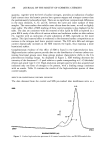
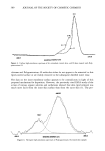
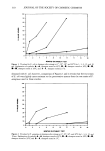
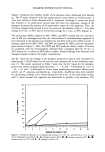
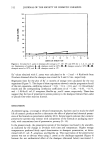
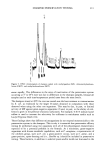
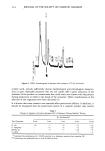
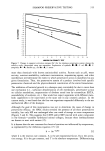
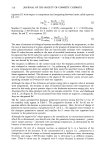
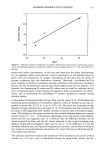
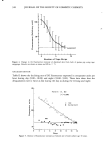
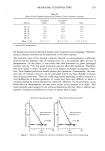
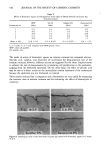
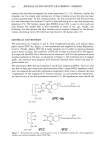
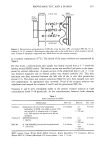
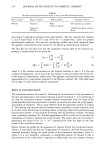
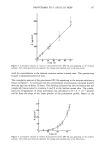
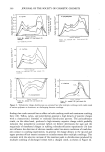
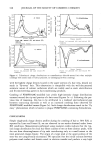
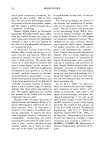
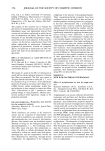
TRIBOELECTRIC CHARGE DISTRIBUTIONS ON HAIR 345 similar after each combing, independent of the comb potential. This effect of enhanced charging by the probe loaded to high potential of the opposite sign is difficult to explain within the framework of existing models of polymer-polymer or metal-polymer electrification. According to the band model of contact charging proposed by Davis (5,7) and Lewis (8), the charge would be transferred until either all the surface states are filled, or until a sufficient surface potential is created to prevent further charge transfer. Repeated contact usually leads to accumulation of transferred charges, which is explained by slow diffusion from surface states into bulk states, creating surface vacancies which can be subsequently refilled. This additional charge transfer is, thus, related to the concentra- tion gradient of charged species within the bulk and to the rate of transport of the surface states to the bulk states. For insulators such as comb materials used in this study, and keratin with low moisture content, the dielectric relaxation times are long, and consequently rapid filling of the surface states and slow filling of bulk states can be expected. This representation of contact charging justifies the enhanced electron transfer in the upper part of a tress but fails to explain why a charged comb contributes to the further intensification of this process. Another theory of triboelectric charging, the Duke and Fabish (9) sampling/non-communicating state model of polymer-polymer contact, does not account for the surface potentials developed after charge injection and does not predict how the state energies might be modified by the existence of electrical fields created by the excess charge. It cannot be thus used to analyze the effects reported in this paper. The middle peak in the charge distribution profiles shown in Figures 2a and 2b is sometimes undetectable in charge distributions, or it becomes merged with the entan- glement peak. Some data suggest that it might be an artifact which we believe may be related to the change in geometry of the tress as the hair clears the comb. However, the measurements of charge distribution without combing on previously charged tresses also demonstrate the existence of this peak. EFFECT OF COMB WORK FUNCTION AND MULTIPLE COMBINGS Teflon (4.26- 6.71 eV), polyethylene (4.9- 6.04 eV), nylon (4.08- 4.5 eV), polycar- bonate (3.85-4.8 eV), and aluminum (3.38-4.25 eV) combs were used to assess the effect of comb material on charge distribution profiles. The range of work function values (the work required to remove electrons from the Fermi level to the surface) given in brackets and reported in the literature serves only as a general indication of relative positions of these materials in the triboelectric series (3). As mentioned in our previous paper, there is a considerable discrepancy between various sources, mainly due to the use of different experimental procedures and materials with varying degrees of purity. Figures 3a-e shows charge density distributions on hair tresses combed with nylon, polyethylene, teflon, polycarbonate, and aluminum combs. The same figures illustrate the gradual buildup of static charge on hair as a result of consecutive combings. The numbers assigned to each distribution curve represent'the charge densities integrated over the length of the tresses (expressed in C/cm). Figure' 3a presents the charge distri- butions obtained with a nylon comb, including the combing force curve corresponding to the first combing cycle. The shape of the combing force curve as well as the values of the forces are representative for all comb materials studied. This is in accord with the

346 JOURNAL OF THE SOCIETY OF COSMETIC CHEMISTS 0.7' 0.6 0.5, 0.4, 0.2 0.1 0 a) nylon • Tress length First (0), seoond (D) andthird (o)-combing force 1.5 120 no % 100 • •, 90 80 ø• 1.( 70 } 6O 40 • 0.• 30 } 2O 10 0 b) •olyethylen• Tress length First (o) ,second (a) and third (V) combing c) teflon •ress length First (o),second (9) and third (V) combing 1.6 -5.0 Tress length First (O), second (•1) a•l third (V) e) alumin• . • Tress length First (O), s•3nd (f7) and third (•) Figure 3. Triboelectric charge distributions on untreated hair after multiple combings with combs made of various polymers or aluminum no discharging between combings. finding that comb material has no effect on both combing work and maximum combing force (10). Teflon, nylon, and polyethylene generate a high density of positive charges with a characteristic bimodal or trimodal distribution pattern. The polycarbonate comb, on the other hand, produced a high-intensity negative charge which probably indicates that piezoelectric potential (which we believe determines the sign and the magnitude of transferred charges in rubbing triboelectrification experiments (3)) does not influence the direction of electron transfer under low-stress conditions of comb-ker- atin contact in combing experiments. In general, the charge density in the tip-end and upper portions of hair tresses increases to a similar extent after multiple combings. This contrasts with the selective increase of the insertion peak in distributions produced by multiple combing of discharged tresses with a charged comb, as shown in Figure 2d.
Purchased for the exclusive use of nofirst nolast (unknown)
From: SCC Media Library & Resource Center (library.scconline.org)