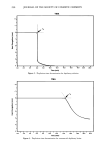
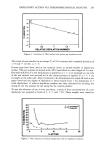
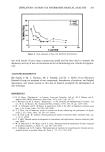
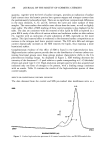
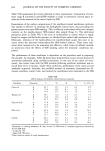
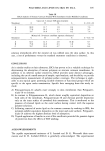
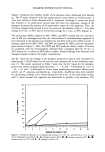
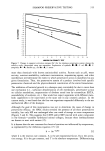
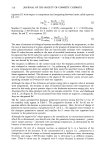
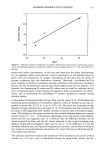
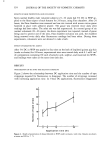
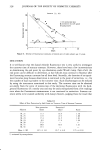
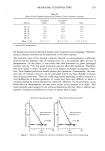
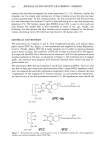
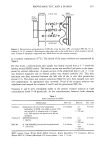
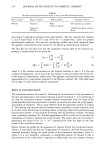
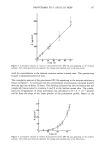
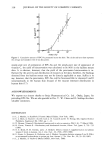
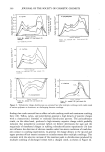
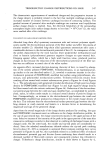
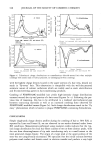
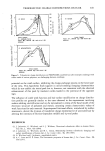
DEPILATORY ACTION VIA THERMOMECHANICAL ANALYSIS 293 I'-- 5L - .. / o 5 gel 2 get 1 cream % ACTIVE 20 Figure 6. Dose responses of three test depilatory formulations. late with results of tests using a guinea pig model and has been used to compare the depilatory activity of new actives and as an aid in formulating new vehicles for applica- tion. ACKNOWLEDGEMENTS My thanks to Dr. L. Hinman, Ms. J. Karolak, and Dr. L. Miller of our Discovery Research Group for synthesis of test compounds, formulation of products, and helpful discussions, and whose interest in this area of research prompted the development of this technique. REFERENCES (1) R. H. Barry, "Depilatories," in Cosmetics.' Science and Technology, 2nd ed., M. S. Balsam, and E. Sagarin, Eds. (Wiley-Interscience, New York, 1972), Vol. 2, pp. 39-72. (2) S. Brechner and M. E. Rieger, "Depilatories," in The Chemistry and Manufacturing of Cosmetics, 2nd ed., M. G. de Navarre, Ed. (Continental Press, Orlando, 1975), Vol. IV, pp. 1233-1246. (3) H. A. Yablonsky and R. Williams, A quantitative study of the effect of depilatory solutions upon hair, J. Soc. Cosmet. Chem., 19, 699-706 (1968). (4) T. J. Eliot, Use of laboratory model to evaluate the factors influencing the performance of depila- tories, J. Soc. Cosmet. Chem., 25, 367-377 (1974). (5) J. H. Hall and R. W. Godwin, Thermomechanical analysis of synthetic fibers, Instrument News, 21, 1, 10, 11 (1970). (6) P.S. Hill, Thermal analysis developments in instruments and applications, American Laboratory (Jan- uary 1984). (7) M. R. Martinelli, S. W. Mayer, and P. F. Jones, Thermomechanical examination of fabric composed of synthetic polymers,J. Forens. Sci., 24, 130-139 (1979). (8) L. Addyman and G. D. Ogilvie, Thermomechanical methods for researching the thermal and me- chanical history of synthetic fibers, Br. Polym. J., 11, 151-154 (1979).

Purchased for the exclusive use of nofirst nolast (unknown)
From: SCC Media Library & Resource Center (library.scconline.org)