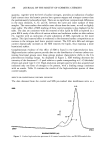
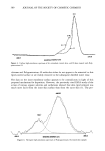
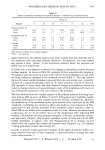
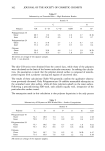
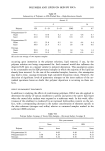
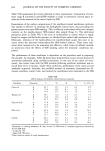
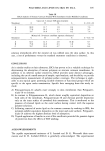
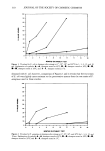
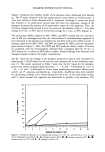
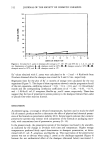
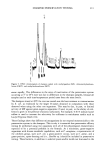
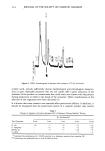
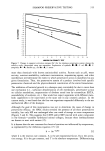
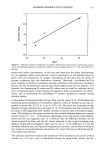
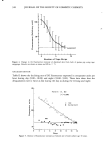
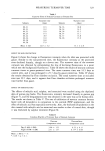
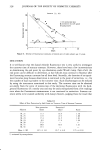
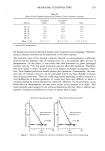
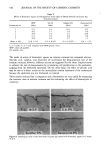
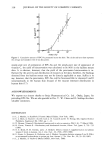
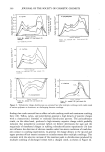
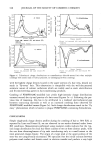
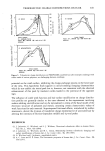
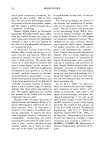
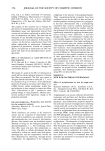
TRIBOELECTRIC CHARGE DISTRIBUTIONS ON HAIR 347 The characteristic apportionment of transferred charges and the progressive increase in the charge density is probably related to the fact that multiple combings produce an increased number of contacts between uncharged sections of contacting surfaces. The gradual increase of potential after multiple combings can continue until equilibrium surface charge density is reached. Also, the electrical breakdown of the surrounding atmosphere might limit surface charge density to less than 7 ø 10 9 C/cm 2 (2), the value never reached after a few combings. THE EFFECT OF HAIR SURFACE MODIFICATION Adsorbed long-chain alkyl quaternary ammonium salts and cationic polymers signifi- cantly modify the electrochemical potential of the fiber surface and affect the process of electron transfer (2). Adsorbed long-chain alkyl quaternary ammonium salts cause a considerable decrease in the electrochemical potential of hair (2). In consequence of this, the probes characterized by the work function lower (poly(methyl methacrylate)) and close to keratin (polycarbonate) generate negative charges on quat-treated hair. Charging against teflon, which has a high work function value, produced positive charges on hair because the reduction of the electrochemical potential of the fiber sur- face was not sufficient to match that of the teflon surface. An opposite effect, increased electron-donating character of hair, is caused by adsorp- tion of the cationic polymer PDMPDAMC. Triboelectrification, in an experimental set- up similar to the one described earlier (1,2), revealed a consistent increase in the elec- trochemical potential of PDMPDAMC-modified hair surface using polycarbonate, alu- minum, and poly(methyl methacrylate) probes. Triboelectrification results from combing of hair treated with cationic substances are given in Figures 4a-d and Figures 5a-c. The polycarbonate comb generated trimodal distributions of high positive-charge density for PDMPDAMC-modified hair (Figure 5c) and high negative-charge density for fibers treated with the cationic surfactant (Figure 4d). Reduction of the electrochem- ical potential gap between the comb and quat-modified hair, accomplished by polyeth- ylene, nylon, or teflon combs results in a reduced overall density of positive charge on hair. Correspondingly, an increase in the electrochemical gap between the comb and PDMPDAMC-modified hair produced an enhancement in the overall charge density of the hair. This indicates that the electrochemical surface-potential gap between the rub- bing element or comb material and keratin is a decisive factor in determining the magnitude and sign of the generated charge. Apart from the overall magnitude of the charge density produced by combing, the quat and PDMPDAMC treatments exert an influence on the charge distribution profiles. In the case of quat-treated hair, the charge concentrates mainly in the upper portion of the tress. Selective increase of the intensity of the peak in the upper portion of the tress after consecutive combings is similar to that observed in combing of discharged tresses with a charged comb. On the other hand, the middle and tip-end peaks are considerably re- duced. Since the adsorbed stearalkonium chloride reduces the tip-end peak combing force by about 10-30% as compared to untreated fibers (compare combing force curves presented in Figures 3a and 4a), this is probably related to a combined effect of reduced electrochemical potential gap and friction (lower combining force should result in a decreased number of fiber-comb contacts and consequently produce less triboelectric charge). Triboelectric charge distributions, similar to those shown in Figures 4a-d,

348 JOURNAL OF THE SOCIETY OF COSMETIC CHEMISTS 0.7 0.6' 0.5 , 0.2 Tress length First (0), seoond (•) and third (•) (o) -combing force 1.2 5.8 { •.5\ C) teflon .1..0 0.8 0.6 0.4 0.2 0 Tress length First (o),second (s) and third (V) combing , . -120 • 0.8- ß 100 v • •o 0.6 80 ø • • • 0.4 60 =• 40 •o 0.2 20 o• 0 • b) polyet Tress length First (o),second (D) and third combing mo 0 • -8.4 ! -2 • d) polyc -3 Tress length First (o),second (D) and third (V) combing Figure 4. Triboelectric charge distributions on stearalkonium chloride-treated hair after multiple combings with combs made of various polymers no discharging between combings. with the highest charge density located in the upper portion of a hair tress, should not result in "fly-away" hair. This observation is compatible with the well-documented antistatic nature of cationic surfactants which are widely used as static electrification and friction-lowering agents in hair-conditioning products. Combing of PDMPDAMC-modified hair yields high-intensity charge distributions centered around the tip-end portion of a hair tress (Figures 5a-c). Following the pre- vious line of reasoning, this has to be attributed to a widened electrochemical gap between contacting materials as well as an increased combing force observed for PDMPDAMC-modified tresses (Figure 5a). Such charge distributions result in the "fly away" phenomenon which is known to plague PDMPDAMC-containing formulations. CONCLUSIONS Simple single-peak charge density profiles during the combing of hair at 50% RH, as reported by Lunn and Evans (4), are not observed in our results obtained under lower RH conditions. Measurements performed using insulator combs indicate that the typ- ical charge distribution for clean hair fibers consists of two or three distinct peaks, with the one from disentanglement of tip ends contributing only to a small extent to the total generated charge density. The origin of a large peak at the upper portion of the tress was not unequivocally ascertained. We speculate that the initial contacts between polymer-comb surface and keratin result in electron transfer and produce a very high
Purchased for the exclusive use of nofirst nolast (unknown)
From: SCC Media Library & Resource Center (library.scconline.org)