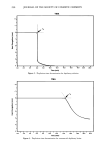
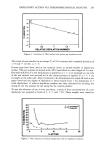
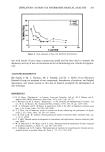
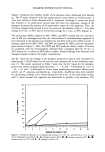
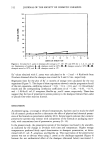
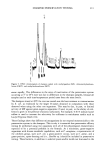
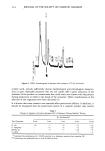
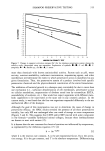
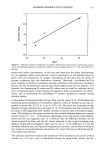
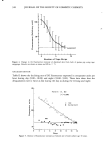
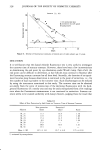
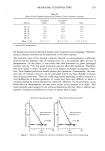
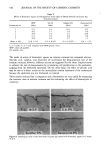
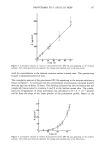
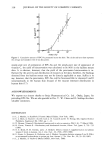
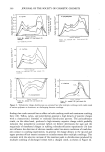
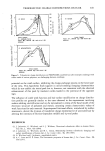
TRIBOELECTRIC CHARGE DISTRIBUTIONS ON HAIR 349 1. tress length O - oc•bing force First (0), second (0) and third (•7) c) poly•z• tress lergth First (O), second (•) and third 120 •:• 4' lOO •' B0 • 3 •2. 60 8 . o 0 0 b) t•flon • tress len• First (O), s•oond (1•) • third (•) •mbmg Figure 5. Triboelectric charge distributions on PDMPDAMC-modified hair after multiple combings with combs made of various polymers no discharging between combings. potential on the comb surface, inhibiting the charge-exchange process in the lower part of the tress. This hypothesis finds support in metal-combing charging characteristics which do not exhibit the initial peak but is, however, not consistent with the observed enhancement of this peak by insulator combs loaded to the potential of the opposite sign. The influence of comb work function and hair surface modification on charge distribu- tion profiles are generally similar to the ones observed in the experiments involving surface rubbing electrification and can be rationalized in terms of the band model of the electronic structure of polymers and metals, assuming certain characteristic values of work functions for each material. Superimposed frictional effects, introduced by surface treatments, distort the division of transferred charge representative of untreated hair by altering the intensity of friction-dependent middle and tip-end peaks. REFERENCES (1) J. Jachowicz, G. Wis-Surel, and L. J. Wolfram, Directional triboelectric effect in keratin fibers, Text. Res. J., 54(7), 492 (1984). (2) J. Jachowicz, G. Wis-Surel, and M. L. Garcia, Relationship between triboelectric charging and surface modifications of human hair, J. Soc. Cosmet. Chem., 36, 189 (1985). (3) G. Wis-Surel and J. Jachowicz, unpublished results. (4) A. C. Lunn and R. E. Evans, The electrostatic properties of human hair, J. Soc. Cosmet, Chem., 28, 549 (1977).

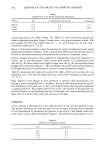
350 JOURNAL OF THE SOCIETY OF COSMETIC CHEMISTS (5) D. K. Davis, Charge generation on dielectric surfaces, Brit. J. Appl. Phys. (J. Phys. D.), 2, 1533 (1969). (6) D. A. Seanor, Triboelectrification of polymers--A chemist's viewpoint, Physicochem. Aspects Polym. Surf., Proc. Int. Symp., 1, 477 (1983). (7) D. K. Davis, The examination of the electrical properties of insulators by surface charge measure- ment,J. Sci. Instrum,, 44(7), 521 (1967). (8) T. J. Lewis, "The Movement of Electrical Charge Along Polymer Surfaces," in Polymer Surfaces, D. T. Clark and W. J. Feast, Eds. (John Wiley and Sons, Chichister, 1978). (9) C. B. Duke and T. J. Fabish, Contact electrification of polymer: A quantitative model, J, Appl. Phys., 49(1), 315 (1978). (10) A. Hambidge and L. Wolfram, unpublished results.
Purchased for the exclusive use of nofirst nolast (unknown)
From: SCC Media Library & Resource Center (library.scconline.org)