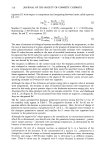
308 JOURNAL OF THE SOCIETY OF COSMETIC CHEMISTS formed by storage of products at various temperatures for up to 5 yr. to demonstrate satisfactory shelf life. Microbial spoilage may occur in aqueous products and in anhydrous products that are exposed to water consequently, cosmetic preservatives are included in formulations to inhibit the growth of bacteria, yeasts, and molds while products are in trade channels and in the hands of the consumer. The principles of preservative efficacy testing have been reviewed (2,3), including the need for demonstrating that products have adequate stability (2). Although several methods of preservative testing are available (4-6), our laboratory uses the "linear regression method" because it provides a rapid, quantitative expression of the rate of death of specific test organisms in a product when using defined test conditions (4). The rate of death determined by the linear regression method is ex- pressed as the decimal reduction time (D-value), which is the time required for inacti- vation of 90% of the population of test organisms. The rationale for using D-values is that every organism has a characteristic rate of death when subjected to a specific lethal treatment (4). This enables a laboratory to provide quantitative results on the rate of inactivation of specific test organisms in a product. Thus, the linear regression method can be used to determine the effect of formulation changes and component interaction on the stability of the preservative system. Since the linear regression method was adopted, we have observed changes in preserva- tive efficacy of some formulations during the course of stability studies. This report illustrates the value of performing preservative efficacy tests on stability samples by showing how a shampoo preservative system deteriorates with age. EXPERIMENTAL TEST ORGANISMS The test organisms used in these studies were taken from the Jergens culture collection and consisted of Staphylococcus aureus (FDA 209 strain), Pseudomonas aeruginosa (PRD 10 strain), Bacillus sp. (isolated from a contaminated cosmetic product), and Escherichia coli (ATCC 8739). These organisms were cultured and used for challenging the test samples, as described in a previous report (4). TEST SAMPLES The test samples consisted of a proprietary formulation of a shampoo in high-density polyethylene containers. The shampoo contained ammonium lauryl sulfate, cocamido- propyl betaine, propylene glycol, polysorbate 20, hydrolyzed animal collagen, tetra so- dium EDTA (and other ingredients), and was preserved with methylparaben IMP], chloromethylisothiazolinone [CMIT], and methylisothiazolinone [MIT]. STABILITY TEST One bottle of freshly prepared shampoo was used for the initial determinations (i.e., 0-mo.). Several bottles of the test samples were stored at refrigerator temperature, room

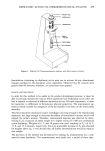
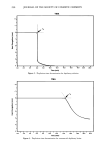
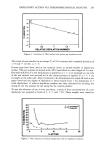
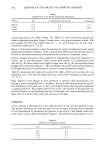
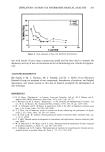
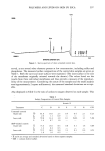
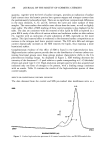
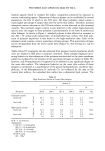
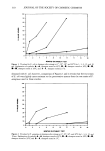
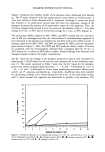
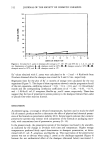
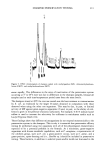
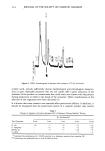
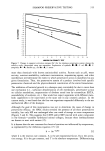
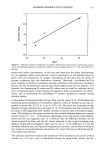
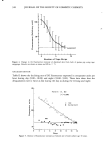
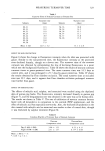
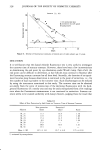
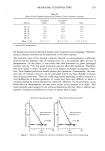
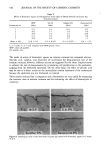
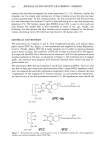
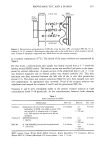
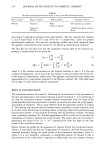
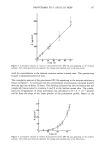
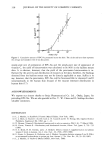
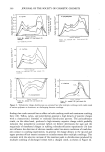
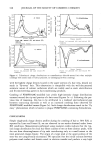
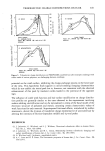
SHAMPOO PRESERVATIVE TESTING 309 temperature, 100øF, and 120øF (i.e., 3 ø, 20 ø, 38 ø, and 49øC, respectively)for the duration of the stability study. One bottle of product stored at each temperature was removed at specified times and subjected to preservative efficacy testing. After sam- pling, the bottles were placed in the sample storage archives. TEST PROCEDURE A 0.1-mL aliquot of test organism suspension, containing about 108 organisms/mL, was added to ca. 50=mL portions of each test sample in 100=mL screw-capped bottles. Aerobic plate counts were determined, and D-values were calculated as described in an earlier report (4). HIGH-PERFORMANCE LIQUID CHROMATOGRAPHY (HPLC) Test samples of shampoo were diluted to 1% (wt/vol) in mobile phase. After filtration, the samples were assayed by injecting 250-1zL aliquots onto a 250 x 4.6 mm i.d. LiChrosorb © RP-18 (5 Izm) column with a 40 X 4.6 mm i.d. guard column con- taining Perisorb © RP-18, 30-40 Izm. Chromatographic conditions were as follows: mobile phase = water:methanol (45:55) with 0.2% acetic acid, flow rate 0.5 mL/min, temperature 25øC, and detector range 0.05 AUFS. The column effluent was monitored at a UV wavelength of 275 nm. CALCULATION OF APPARENT ACTIVATION ENERGY The apparent activation energy (Ea') for the shampoo preservative system was deter= mined for each test organism at each time period of the stability study (i.e., 1, 3, 6, or 12 mo.). A plot of Log 2.303/D-value vs 1/T (where T is the absolute temperature in øK) was calculated for each test organism, and the slope of each line was determined by linear regression. The Ea' has a value of - 2.303R (slope), which is the same calcula- tion as for Ea (17). Preservative efficacy tests were not performed on samples stored beyond 6 mo. at 49øC or 12 mo. at 38øC. The D-values obtained on samples stored for 18 mo. at 3 ø and 20øC were not used in calculation of Ea' values because D-values at the higher temperatures were not available. RESULTS Figure ! shows the changes in preservative efficacy that occurred during storage of the shampoo at 3 ø, 20 ø, 38 ø, and 49øC for 18 mo. when using E. coli as the challenge organism. It is apparent that the preservative system was not stable and that the D- values increased with increasing storage time and temperature. Thus, the D-values for E. coli changed from •4 hr at the outset of the study to 35 hr after storage for 1 mo. at 49øC. The preservative efficacy decreased more slowly in samples stored at 38øC than at 49øC, and samples stored at 3 ø and 20øC were affected much less than those stored at 38øC, as indicated by smaller changes in D-values during the test. The preservative efficacy test results obtained when P. aeruginosa was inoculated into shampoo samples that had been stored up to 18 mo. at different temperatures are presented in Figure 2. The findings obtained with P. aeruginosa were similar to those
Purchased for the exclusive use of nofirst nolast (unknown)
From: SCC Media Library & Resource Center (library.scconline.org)