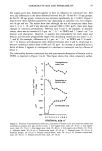
j. Soc. Cosmet. Chem., 39, 69-76 (January/February 1988) Determination of cocamidopropylamine oxide in commercial products RYSZARD JANIK and ROMAN K. PODGORSKI, Institute of Organic and Polymer Technology, Technical University of Wroclaw, Wybrzeze Wyspia•iskiego 27, 50-370 Wroclaw (R. J. ), and "Polifarb" Lacquer and Paint Plant, 50-964 Wroclaw (R. K. P. ), Poland. Received August 19, 1986. Synopsis Two methods of determining the content of amine oxide and free amine in commercial cocamidopropyla- mine oxide were examined, namely potentiometric titration and titanometric titration combined with a two-phase titration. Potentiometric titration was found to be the better method for analyzing commercial products. While the second method provided satisfactory results for the amine oxide content, the content of free amine from two-phase titration provided a large systematic error. To determine the amount of dry residue (solids), the conditions for evaporating water from commercial products were also investigated. Evaporation of samples at 80øC under atmospheric pressure is not recom- mended because of thermal instability of the amine oxide. Drying the samples at temperatures of 40øC and under reduced pressure yielded reliable results. INTRODUCTION Surface active amine oxides have a number of advantages making them useful in appli- cations such as manufacturing of emulsions and other cosmetic compositions. They are reported to be mild in skin and eye irritation tests (1), make the human skin softer while attenuating irritating action of anionic surfactants (2,3), and exhibit certain bac- tericidal effects (4). Cocamidopropylamine oxide is the amine oxide most frequently used in various cos- metic formulations. It is available under various trade names such as Ammonyx © CDO (Onyx Chemical Company) (5), Aminoxid WS 35 (Th. Goldschmidt AG) (2), or Stan- damox © CAW (Henkel Corporation) (3). The commercial products are in the form of aqueous solutions of 30% (3,5) or 35% (2) concentration. Apart from the amine oxide, constituting the main active component, commercial products may contain unreacted amine and various other products originating from different stages of synthesis. The content of amine oxide and unreacted amine are the most important parameters characterizing the quality of the product. These parameters are usually determined by titration or, less frequently, chromatographically. Of the methods described in the literature, the best results have been obtained by using potentiometric titration in nonaqueous media. By titration of the mixture of amine oxide and free amine with HCIO 4 solution in an appropriate solvent mixture, both components were determined (6,7). 69

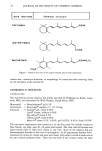
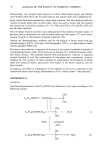
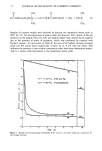
70 JOURNAL OF THE SOCIETY OF COSMETIC CHEMISTS Alternatively, two samples were analyzed in which either amino group was blocked with methyl iodide (8) or the N-oxide function was reacted with acetic anhydride (9). Good results have been obtained by using redox titration, but this method yields the content of amine oxide only. In most cases, TiCI 3 was used as titrant and the titration was carried out in an acidic medium (10-14). The use of SnCI 2 (15) and KI or HI (16) has also been reported. The two-phase titration has been used infrequently for the analysis of amine oxides. It has been used to determine the sum of amine oxide and free amine (17) or for deter- mining N-oxide in the presence of anionic surfactant (18). Among the chromatographic methods used for the analysis of amine oxides were gas chromatography (GLC), thin-layer chromatography (TLC), or high-pressure liquid chromatography (HPLC) (9). The aim of this work was to examine the accuracy of two selected methods of analysis of cocamidopropylamine oxide which serves as an example of a commercial amine oxide- free amine mixture. The methods selected were potentiometric titration in isopropyl alcohol (method I) and the combination of two-phase and titanometric titration (method II). The accuracy of these methods for simultaneous determination of amine oxide and unreacted amine, particularly with respect to the amine impurity, has not been studied. In addition, the effect of temperature on the stability of the active component in the commercial amine oxide during determination of the "solids content" was examined. EXPERIMENTAL MATERIALS Laurylamidopropylamine oxide (C•2NNO) was obtained in two steps according to the following scheme: C•.•H23COOH + H2N(CH2) 3 CH 3 I N I CH 3 C 11H23CONH(CH2)3 H202 C 11H23CONH(CH2)3 CH 3 N + I CH3 n-propanol 60øC CH 3 I N I CH 3 H20 O ß I-I20 (1) (2)
Purchased for the exclusive use of nofirst nolast (unknown)
From: SCC Media Library & Resource Center (library.scconline.org)