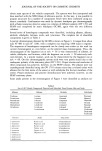
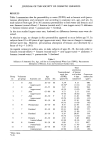
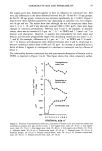
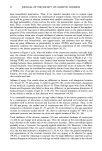
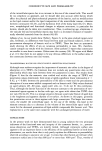
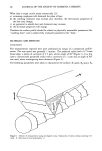
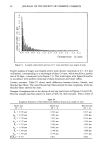
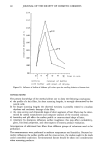
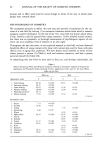
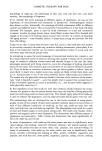
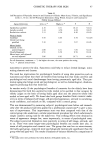
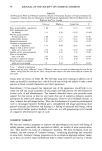
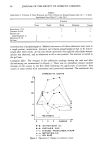
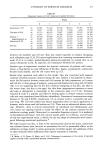
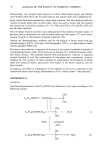
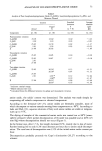
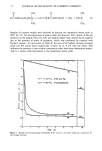
ANALYSIS OF COCAMIDOPROPYLAMINE OXIDE 73 Table I Analysis of Pure Laurylamidopropylamine Oxide (C•2NNO) , Laurylamidopropylamine (C•2NN), and Mixtures Thereof Content Standard Average deviation absolute Found S error Actual X (n = 8) AX Component wt. (%) wt. (%) wt. (%) wt. (%) Potentiometric titration C•2NNO 25.05 C22NN 2.02 %2NNO 25.05 C22NN 2.01 ]E 27.06 Titanometric titration %2NNO 25.05 C22NNO 25.05 C22NN 2.01 • 27.06 Two-phase titration %2NNO Ci2NNO C22NN 23.82 0.02 - 1.23 2.01 0.01 -0.01 23.78 0.02 - 1.27 2.24 0.03 +0.23 26.02 - 1.04 24.85 0.30 - 0.20 24.87 0.17 - 0.18 25.05 26.562 0.13 + 1.51 26.382 0.07 + 1.33 25.05 2.01 4.652* 0.12 +2.64 3.682* 0.19 + 1.67 27.06 29.522 0.09 +2.46 28.552 0.16 + 1.49 2 Indicator: methyl orange. 2 Mixed indicator (see text). * Calculated from the difference between two-phase and titanometric titration. amine oxide, the solids' content was determined. The analysis was made simply by evaporating off volatile components at elevated temperature. According to the literature (20-27), amine oxides are thermally unstable, most of which decompose to various extends starting from temperatures ca. 80øC. According to Lake and Hoh (13), aqueous solutions of fatty acid amine oxides are stable at tempera- tures up to 75øC. The drying of samples of the commercial amine oxide was carried out at 80øC (atmo- spheric pressure) where partial decomposition of N-oxide was possible and at 40øC (25 mm Hg) where decomposition should not occur (Figure 1). In the former case, after 1.5 h, the weight decreased 67%, mainly due to loss of water. Further heating led to only 0.2% mass decrease per hour due to amine oxide decompo- sition. The total rate of decomposition was 2.2% of the initial amine oxide content per hour. Decomposition probably proceeds via Cope's elimination (26,27) according to the scheme:

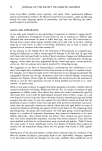
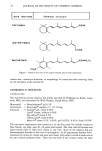
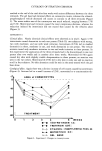
74 JOURNAL OF THE SOCIETY OF COSMETIC CHEMISTS 0 •H3 0 CH 3 II R-C-NHCH2CH2CH2• •O •R-C-NHCH2CH = CH 2 + HO-N CH 3 CH 3 (3) Samples of constant weight were obtained by heating the commercial amine oxide at 40øC for 4 h. No decomposition of amine oxide was detected. The content of the dry substance in the sample tested (33.8%) was slightly higher than claimed by the supplier due to the presence of water of hydration, which was confirmed by titration with Fischer's reagent. As can be seen in Table II, the sum of the highest amounts of amine oxide and free amine found analytically is lower by ca. 4.2% than the solids. This indicates the presence of non-volatile components other than those determined analyti- cally (i.e. amine oxide and amine) in the commercial amine oxide. 100 o• 7o -o--- t=40oc, p=25 men H•I • t=8ooc, p=otmospheric 30 Iv 20 I I I • o 1 2 3 Time Figure 1. Weight loss during heating of Gamidox K-40. Curves I, II: amine oxide loss. Curves III, IV: total weight decrease.
Purchased for the exclusive use of nofirst nolast (unknown)
From: SCC Media Library & Resource Center (library.scconline.org)