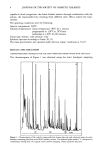
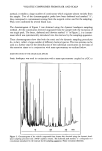
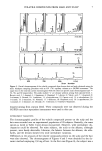
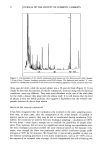
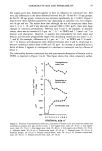
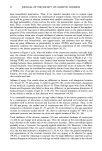
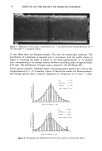
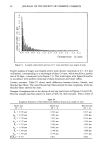
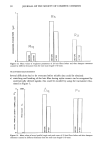
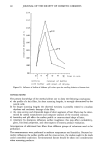
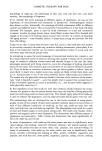
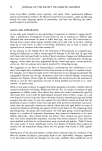
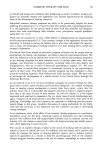
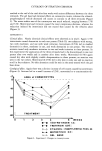
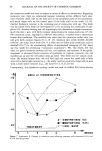
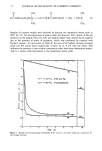
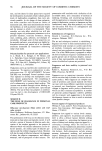
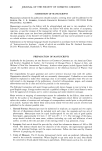
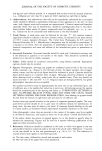
8 JOURNAL OF THE SOCIETY OF COSMETIC CHEMISTS 1,0 2p 3•0 min. Figure 4. Chromatogram of the volatile compounds from human hair of a three-year-old child. Sample: 130 mg of hair. Dynamic headspace procedure with FFAP column. The darkened peak marked "a" corre- sponds to a contaminant introduced in the mixture by the sampling apparatus. Flame ionization detection. three-year-old child, while the second subject was a 30-year-old male (Figure 5). It can clearly be seen that the amounts of volatile compounds, detected using strictly identical conditions, were very different. They were more abundant in the case of the adult than for the child, a feature they share with the sebum itself. It is well known that the level of sebum is very low before puberty this suggests a hypothesis that the volatile com- pounds detected do derive from sebum. ORIGIN OF THE VOLATILE COMPOUNDS It has been recognized that the incubation step involved in the static sampling proce- dure may, in some cases, alter the composition of the initial sample: if unstable or reactive species are present, they may be lost or transformed during incubation (5,6). Indeed, the conditions we used for the static headspace sampling--incubation at 120øC for two hours--seem drastic enough not to overlook the possibility of sample alter- ation. This, however, did not occur to a significant extent during our experiments since the static headspace procedure yielded the same chemical species as the dynamic tech- nique, even though the latter was performed under milder conditions (purge under nitrogen at 50øC for 30 minutes). We found that it was actually possible to carry out the dynamic sampling procedure at even lower temperatures, such as 25-30øC, but at the expense of an increased time of purge. At such temperatures the risk of altering the

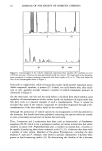
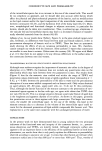
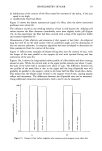
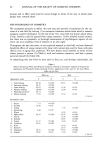
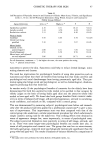
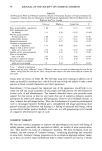
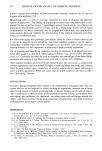
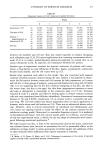
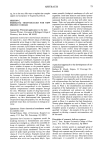
VOLATILE COMPOUNDS FROM HAIR AND SCALP 9 10 20 30 min. I I I Figure 5. Chromatogram of the volatile compounds from human hair of a 30-year-old male. Sample: 130 mg of hair. Dynamic headspace procedure with FFAP column. The darkened peak marked "a" corresponds to a contaminant introduced in the mixture by the sampling apparatus. Flame ionization detection. composition of the volatile compounds sampled can be mostly disregarded. Several experiments showed that there were no detectable discrepancies between the volatiles sampled at 25-30øC and those sampled at 50øC. The latter was preferred since the reduced time of purge resulted in a higher sample throughput. Thus, it is certain that the volatile compounds detected in this study were originally present on the hair and the scalp at the time the sample was collected. To our knowl- edge, these species have never been cited as endogeneous compounds synthetized by either the sebaceous glands or by the keratinizing epidermis. Due to the chemical nature of the compounds identified, it seems very unlikely that they are contaminants depos- ited on the hair and the scalp from the environment. The only plausible hypothesis we can give to the origin of these volatiles is through in situ transformations of the original skin surface lipids. This hypothesis is aided by the presence of odd and even carbon-atom-number chains. This rather uncommon feature is very characteristic of skin surface lipids. It is well known that lipids exposed to the ambiant environment are subject to auto-ox- idation, thermo-oxidation, photo-oxidation . . . etc., yielding various hydroperoxides. The latter are then involved in further transformations including the cleavage of ali- phatic chains. These phenomena have been studied extensively, and almost all of the compounds listed in Table I have been associated with the oxidation of lipid material by one author or another (18-26). The studies cited above were mainly concerned with
Purchased for the exclusive use of nofirst nolast (unknown)
From: SCC Media Library & Resource Center (library.scconline.org)