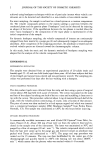
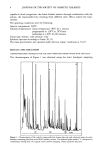
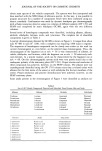
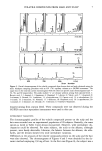
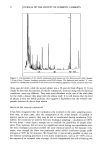
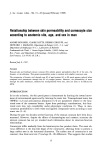
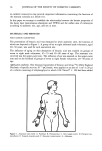
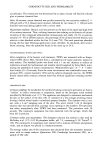
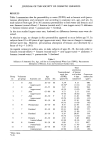
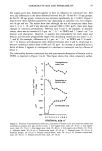
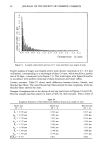
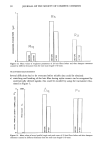
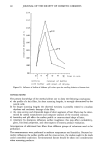
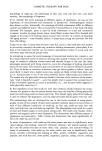
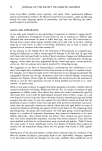
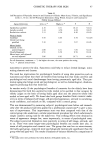
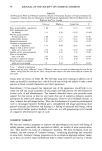
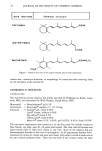
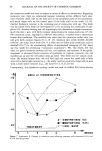
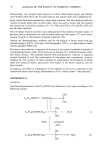
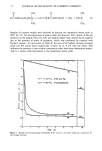
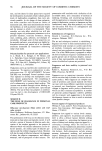
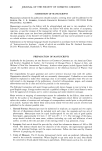
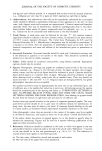
10 JOURNAL OF THE SOCIETY OF COSMETIC CHEMISTS 5 10 I • 15 20 min. Figure 6. Chromatogram of the volatile compounds originating from squalene after oxidation in air at 120øC for two hours. Detection by mass spectrometry (total ion current). The major peaks in the chromato- gram correspond to oxygen-containing compounds with chain lengths of C 2 to C 5. They elute before the start of the chromatogram shown in Figure 3. fatty acids or triglycerides, while in human skin surface lipids another important autox- idable compound, squalene, is present (27). Indeed, we could observe that, after oxida- tion in vitro, squalene actually released a number of volatile breakdown products as illustrated in Figure 6. On the other hand, the hair and the scalp harbor a microbial flora which exhibits some capability of biotransformation of skin surface lipids the hydrolysis of triglycerides into free fatty acids is a classical example of such a transformation. Thus, it cannot be excluded that some of the volatile compounds we identified originated through a bio- transformation of the skin surface lipids by the resident flora. Although the production of volatile species by microorganisms is well documented in the literature, few details have been published concerning the species which are usually or even occasionally encountered on human hair and scalp. Thus, 2-nonanone and 2-undecanone have been cited as characteristic of Pseudomonas aeruginosa (28,29) which is not a permanent resident on human normal skin but rather transient in nature (30). Propionibacterium acnes, a resident on normal skin, is known to be capable of producing short-chain carboxylic acids (31,32), a behavior they share with a number of other strains. Members of the genus Pityrosporum, including the skin residents P. ovale and P. orbiculare, were shown to produce characteristic •/-lactones when grown on lipid-containing media (33). By determining the chirality of the •/-lactones

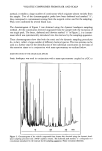
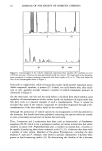
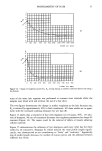
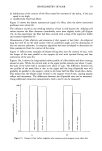
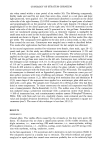
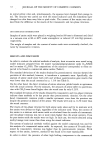
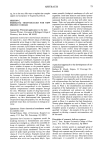
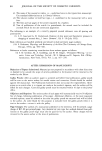
VOLATILE COMPOUNDS FROM HAIR AND SCALP 11 detected in the headspace, it is possible to gain valuable information on their origin, whether chemical or microbiological in nature, since only one of two enantiomers is expected from the activity of Pityrosporum. To assess whether pure enantiomeric lactones or racemic mixtures are present on the hair and the scalp, a chromatographic system capable of chiral recognition was devel- oped accoMing to Schurig (15-17). It was observed that each •/-lactone detected in the headspace samples was, indeed, a racemic mixture (see chromatogram, Figure 7). It appears highly unlikely, therefore, that these lactones arise through microbiological action on the skin surface lipids. CONCLUSION Headspace gas chromatographic investigations revealed that a number of volatile com- pounds are present on human hair and scalp together with the well-known skin surface lipids. The same molecular species were detected in all subjects over an experimental population, but large differences were observed in their distribution from one subject to another. The origin of these volatile compounds, belonging to various chemical classes (alkanes, alkenes, alcohols, aldehydes, ketones, acids and 'y-lactones), has not been • 3 • B 2 3 /" A i i 3 5 7 11 19 21 minu'tes Figure 7. Chromatogram using a column capable of chiral recognition. A: Mixture of synthetic standard compounds. B: Volatile compounds from human hair and scalp obtained using the static headspace sam- pling method. Detection was by mass fragmentometry at m/z = 85. 1: '•-butyrolactone 2: '•-valerolactone (pair of enantiomers) 3: '•-caprolactone (pair of enantiomers) 4: '•-heptalactone (pair of enantiomers) 5: '•-octalactone (pair of enantiomers).
Purchased for the exclusive use of nofirst nolast (unknown)
From: SCC Media Library & Resource Center (library.scconline.org)