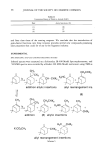
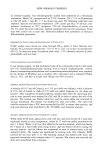
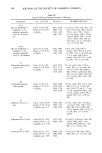
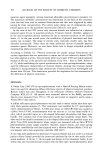
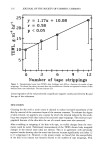
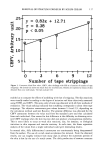
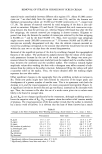
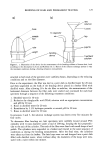
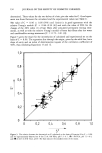
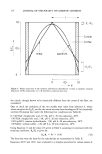
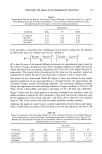
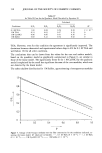
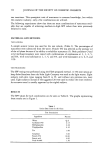
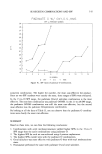
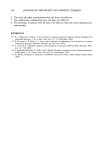
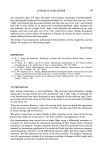
130 JOURNAL OF THE SOCIETY OF COSMETIC CHEMISTS determined. These values for the two halves of a hair give the value for C. Good agree- ment was found between the calculated and the experimental values (see Table I). The value of C = 0.96 --- 0.05 (95% conf. limits) is in good agreement with the relative Young's moduli [C = 0.86-0.94 (4)] and with the value of 90% for the change of the 20% index (1) of hair fibers after simulated permanent waving treat- ments, as well as with the relative Young's moduli of horse hair fibers after hot water and urea/bisulfite setting treatments [C = 0.72-1.01 (3)]. Figure 3 gives the result for the interrelation of calculated and experimental set on the basis of C = 0.96. The regression line through the origin, given by the solid line, has a slope of unity and an index of determination (square of the correlation coefficient) of 96%, thus validating Equations 13 and 12. 1,0 0,8 0,6 0,2 ß I [ 1 [ 0 0,2 0,6 0,8 1,0 Figure 3. The relation between the theoretical set S' calculated on the basis of Equation 9 for C = 0.96 and the experimentally observed set S e for (O) 0.3 M TGA, pH 7.5-9.7, 6}) ! M TGA, pH 7.5-8.4, and (O) 0.025-0.8 M TGA, pH 9. The bars indicate the standard errors of the means.

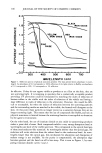
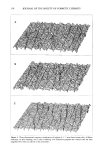
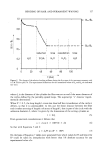
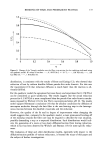
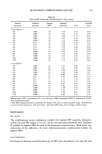
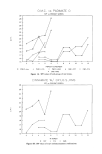
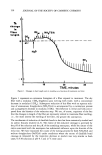
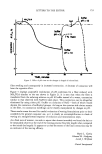
BENDING OF HAIR AND PERMANENT WAVING 131 YOUNG'S MODULUS AND BENDING STIFFNESS Figure 2 shows typical results for the time dependence of the bending stiffness observed during a treatment sequence. During the initial water treatment, about 15% of the initial stiffness is lost and mechanical equilibrium is approached after approximately 20 min. Throughout the subsequent reducing process, the bending stiffness decreases al- most linearly with time until the first rinse is applied. The rate of this decrease increases with the concentration of TGA as well as with pH. After application of the first rinse, the bending stiffness immediately ceases to fall and remains almost constant during the subsequent treatments, except for some cases in which a tendency for a slight increase was observed during the first rinsing process, especially for strongly reduced fibers. These results are in agreement with the observations made for the analogous extensional experiments (3,4). It is important to mention that the bending relaxation behavior observed during the reducing treatment is markedly different from the extensional behavior under the same conditions (4). First, in contrast to the linear decrease in the bending stiffness, the extensional stress relaxation shows a tendency to level off. Second, the extent of the decrease is significantly larger for the bending stiffness than for the extensional stress at all corresponding conditions. For example, for 0.3 M TGA at pH 9.0, a decrease of about 50-60% occurs for the bending stiffness (see Figure 2) but only about a 40% decrease is observed for the extensional stress (4). Assuming that in an untreated fiber the Young's modulus is homogeneous over the fiber cross-section and equal for extension and compression, the bending stiffness is related to the Young's modulus as B = I X E (14) where E is the Young's modulus of the fiber and I the moment of inertia, which for a circular fiber with radius r is given by I = ,r r4/4 (15) Scott and Robbins (6) verified the applicability of Equation 14 for human hair. In case the Young's modulus, though decreasing during reduction, remains uniform over the cross-section of the fiber, Equation 14 can be inserted into Equation 8 to yield (4): R c = Ere/Ero (16) where Ere and E•o are the Young's moduli under analogous experimental conditions such as Bre and Bro. Though the fiber diameter and hence the moment of inertia change during the treatment due to swelling and deswelling, Ere and Ero both finally act with the same moment of inertia, exhibited by the fiber at the time of release, so that the geometrical effects neutralize each other. It has been shown (4), however, that the calculation based on Young's moduli leads to significantly lower set values compared to the actually observed set. This deviation to lower values is readily explained by the principal difference of the role of the extensional stress and that of the bending stiffness for fiber bending set. As already mentioned, the normalized bending stiffness decreases faster during the re-
Purchased for the exclusive use of nofirst nolast (unknown)
From: SCC Media Library & Resource Center (library.scconline.org)