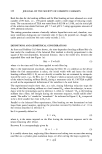
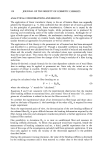
132 JOURNAL OF THE SOCIETY OF COSMETIC CHEMISTS ducing treatment than the normalized extensional stress, so that the residual of the normalized extensional stress after reduction Ere/E o is larger compared to that of normal- ized bending stiffness Bre/B o. Due to the validity of Equation 14 for the untreated fiber, this result implies the inequality: Bre I• x Ere (17) which on restricting the following considerations to the reduced state of a fiber is generalized as B I X E (18) The discrepancy between the normalized bending stiffness relaxation and the normal- ized extensional stress relaxation supports the hypothesis already put forward in refer- ence 4 that during hair reduction a non-uniform distribution of Young's moduli is generated. The existence of such a distribution becomes plausible from mathematical- mechanical considerations. Assuming that the cross-section of the fiber is circular with radius r and the distribution of the modulus is symmetrical about the center of the fiber, the general formula of the bending stiffness is given by B = E(p)dI = -rr E(p)p3dp (19) where p is a distance from the centre of the fiber and E(p) is the Young's modulus at the distance p. The Young's modulus determined by extensional experiments can be re- garded as the average value over the cross-section of the fiber, so that E = E(p) = E(p)dA/A = 2 E(p)pdp/r 2 (20) where A denotes the area of the cross-section, and a bar over E(p) stands for the aver- aging over the cross-section. Substituting Equations 15, 19, and 20 into Inequality 18 and rearrangement leads to • [E(p)p 3 - 0.5 r2E(p)p] dp 0 (21) Through integration by parts, it can be shown that Inequality 21 is fulfilled if :(r 2 - p2)p2E'(p)dp 0 (22) E'(p) is the first derivative of E(p). Since (r 2 - p2)p2 is always positive or zero (when p = 0 or p = r), the simplest sufficient condition for this relation is E'(p) 0 (23) This result supports the hypothesis that Young's modulus in a reduced fiber decreases continuously from the core towards the surface of the hair fiber. The generation of such a modulus distribution is quite reasonable since during diffusion into a hair fiber, the reductant decreases in concentration through reaction, resulting in a lower degree of reduction of the core parts of the fiber compared to the annular parts. The form of the

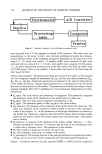
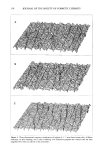
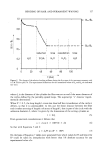
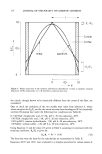
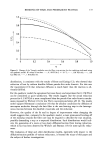
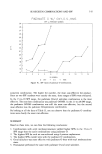
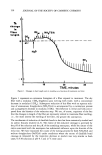
BENDING OF HAIR AND PERMANENT WAVING 133 distribution for a given reductant would be controlled by the specific interrelation of its diffusion and reaction rates. MODEL CONSIDERATIONS Equation 23 demands a decrease of the fiber modulus in the reduced state without any claims about the pathway of E(p) along the radius of the fiber. From the large number of possible model equations that intuitively might be considered as plausible empirical descriptions, a straight line relationship of some sort, to describe the change of the modulus over the cross-section, certainly is the simplest approach. Two models are considered and tested for applicability. The first one describes a linear decrease of the modulus from a value in the fiber core E c to that at the fiber surface E s as E(p) = E s + (E c - Es)(1 - p) (24) with E'(p) = -(E½- E) (25) Inserting Equation 24 into Equations 19 and 20 yields, when integrating over the radius of a hypothetical fiber with a radius of unity, the simple formulas: B = •r[Ec/4 - (E• - Es)/5] (26) and E = E½ - 2/3(Ec - E s) (27) With the hypothesis of a reducing agent that reacts with the substrate during diffusion and is hence decreased in concentration, the assumption of a linear change rather than a constant value of dE/dp along the radius of the fiber is considered as a reasonable ap- proach, so that E(p) = E s + (E• - Es)(1 - p2) (28) with E'(p) = -2(E½ - Es)P (29) Inserting Equation 28 into Equations 19 and 20 yields on integration over the hypo- thetical fiber radius of unity: B = •r[V4E½ - V6(E½ - E)] (30) and E = E c - V2(E c - E s) (31) Figure 4 illustrates for a specific set of experimental conditions (see below) the planar projections of the modulus distributions for the fiber with a radius of unity and a hypothetical cuticle thickness of 0.1 r. Ec/E o and Es/E o are the relative moduli that remain after reduction at the core and at the surface of the fiber, respectively, where the normalizing factor Eo is the initial fiber modulus that is assumed to be homogeneous over the fiber cross-section. As graphically indicated in Figure 4, no special effects of
Purchased for the exclusive use of nofirst nolast (unknown)
From: SCC Media Library & Resource Center (library.scconline.org)