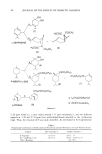
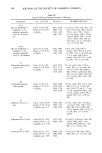
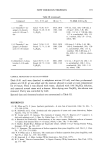
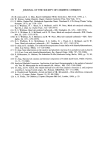
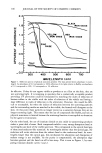
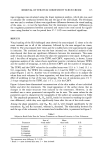
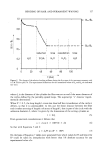
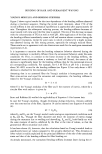
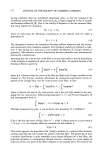
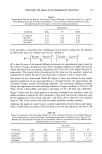
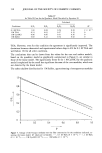
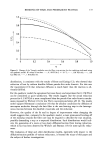
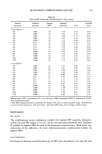
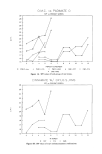
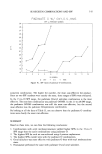
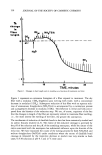
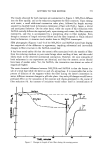
136 JOURNAL OF THE SOCIETY OF COSMETIC CHEMISTS Table IV As Table lll, but for the Quadratic Model Described by Equation 28 Calculated Conditions Ec/Eo Es/Eo E•/Eo B•/Bo A2 0.3 M TGA 1.00 0.08 0.54 0.39 2 X 10 -3 I M TGA 0.51 0.03 0.27 0.19 0 1 M Cys-HCl 0.96 0.06 0.51 0.36 0 I M Sulfite 0.82 0.22 0.52 0.42 0 TGA. However, even for this condition the agreement is significantly improved. The deviations between theoretical and experimental values drop to 4% for 0.3 M TGA and well below 1% for all other conditions. The conclusions that can be drawn from the values for the core and surface moduli, based on the quadratic model as graphically summarized in Figure 6, are similar to those of the linear model. The significantly better fit for 1 M Cys-HC1 by the quadratic model is explained by the small but significant decrease of the core modulus, which was not detected by the linear model. The rather shallow distribution for ! M Sulfite, approximating a homogeneous modulus o o,,, -I '"-.-.. ' 02 -- ,,,,,, 0 ......... 0 0,2 0,4. 0,6 0,8 1,0 Figure 5. Change of the Young's modulus over the fiber cross-section for the conditions indicated, as- suming the linear model. A 2 values are in brackets. '' ', 0.3 M TGA (8 X 10⁻³) -'-, 1 M TGA (2 X 10⁻⁵) ---, 1 M Cys-HCI (10-3) --, I M Sulfite (2 X 10⁻⁵).

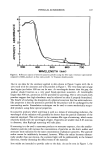
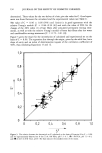
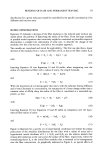
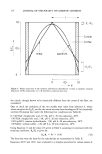
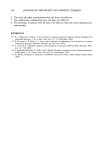
BENDING OF HAIR AND PERMANENT WAVING 137 1,0 0,8 0,2 ß • \' i i t i i i i i 0,2 0,• 0,6 0,8 1,0 Figure 6. Change of the Young's modulus over the fiber cross-section for the conditions indicated using the quadratic model. A 2 values in brackets. ß ß ', 0.3 M TGA (2 X 10⁻³) - ß --, 1 M TGA (0) ---, 1 M Cys-HCI (0) --, 1 M Sulfite (0). distribution, is consistent with the results of Reese and Eyring (12), who showed that reduction of hair by sodium bisulfite follows pseudo-first order kinetics. For this case the requirement (13) that reductant diffusion is much faster than the reaction is ob- viously fulfilled. For the quadratic model the agreement between theory and experiment for 0.3 M TGA can be considered as quite satisfactory. The results suggest that the actual reduction process for 0.3 M TGA is more complicated than the pseudo-first order kinetics mecha- nism proposed by Wickett (13) for low TGA concentrations below pH 10. The results rather support Herrmann's conclusion (14) that for alkaline conditions the diffusion of mercaptan molecules through the hair fiber is the rate-limiting step in the heteroge- neous reaction between the disulfide cross-links and the reductant. However, the quality of the fit and its degree of improvement when changing the model suggests that, compared to the quadratic model, a more pronounced leveling off of the modulus towards the fiber core may be required to describe the true situation, possibly demanding a step or a trapezoid distribution. Such distributions would indi- cate the generation of a more or less sharp diffusion/reaction front during reduction, which in fact has been observed by Wickett and Barman (15) for some specific reduc- tants. The evaluation of these and other distribution models, especially with respect to the diffusion/reaction profiles of various reductants, is beyond the scope of this paper and the subject of further investigations.
Purchased for the exclusive use of nofirst nolast (unknown)
From: SCC Media Library & Resource Center (library.scconline.org)