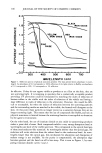
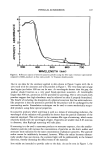
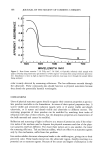
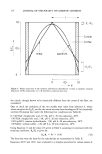
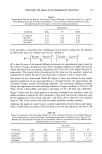
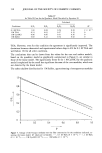
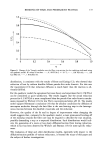
138 JOURNAL OF THE SOCIETY OF COSMETIC CHEMISTS CONCLUDING REMARKS The present study clarified that the bending stiffnesses of reduced/reoxidized fibers control their permanent waving efficiencies according to the implications of Denby's equation and hence the rules of generalized linear viscoelasticity. The evaluation of the differences between the changes of the fiber Young's modulus and the bending stiffness verifies the theory that during reduction a distribution of local toodull is generated in a fiber. The model calculations show that the assumption of a linear change of the rate of the modulus decrease from the fiber core to the fiber surface (quadratic model) leads to excellent fits for those conditions where high concentrations of reducing agents are applied. The results indicate that the performance of the reductants is located some- where between the extremes of a pseudo-first order reaction over the whole fiber cross- section on the one hand and a moving boundary diffusion/reaction on the other. On the basis of data on the bending and extensional properties of a fiber during reduc- tion, modulus distribution models can serve as probes to evaluate the diffusion/reaction profiles of a reductant under a given set of processing conditions. ACKNOWLEDGMENTS The authors wish to thank Professor H. H6cker and Professor G. Blankenburg of the Deutsches Wollforschungsinstitut, Dr. H. Fukusaki and M. K. Fujii (KAO Corpora- tion, Berlin Laboratory), and Dr. F. Masuda, Mr. I. Honma, and Mr. T. Okumura (KAO Corporation, Tokyo Laboratories) for their efforts to establish and to actively support the cooperative research project. (5) (6) (7) (8) (9) (10) REFERENCES (1) S. D. Gershon, M. A. Goldberg, and M. M. Rieger, "Permanent Waving," in Cosmetic Science and Technology, M. S. Balsam and E. Sagarin, Eds. (Wiley Interscience, New York, 1972), Vol. II, pp. 167-250. (2) C. R. Robbins, Chemical and Physical Behaviour of Human Hair, 2nd ed. (Springer Verlag, New York, Berlin, 1988). (3) S. DeJong, Linear viscoelasticity applied to wool setting treatments, Text. Res. J., 55, 647-653 (1985). (4) F.-J. Wortmann and I. Souren, Extensional properties of human hair and permanent waving, J. Soc. Cosmet. Chem, 38, 125-140 (1987). G. V. Scott, C. R. Robbins, A convenient method for measuring fiber stiffness, Text. Res. J., 39, 975-976 (1969). G. V. Scott and C. R. Robbins, Stiffness of human hair fibers, J. Soc. Cosmet. Chem., 29, 469-485 (1978). B. M. Chapman, Linear superposition of time-variant viscoelastic responses, J. Phys. D. Appl. Phys., 7, L185-L188 (1974). E. F. Denby, A note on the interconversion of creep, relaxation, and recovery, Rheol. Acta, 14, 591-593 (1975). M. Feughelman, F. Irani, and M. Gan, Stress-relaxation of wool fibers in different media at 96øC, Text. Res. J., 38, 1039-1044 (1968). H. Munakata, The stress relaxation and set of wool fibers with particular reference to their structure and mechanical properties, Text. Res. J., 34, 97-109 (1964).

BENDING OF HAIR AND PERMANENT WAVING 139 (11) H. D. Weigmann, L. Rebenfeld, and C. Dansizer, Kinetics and temperature dependence of the chemical stress relaxation of wool fibers, Text. Res. J., 36, 535-542 (1966). (12) C. E. Reese and H. Eyring, Mechanical properties and structure of hair, Text. Res. J., 20, 743-750 (1950). (13) R. R. Wickett, Kinetic studies of hair reduction using a single fiber technique,J. Soc. Cosmet. Chem., 34, 301-316 (1983). (14) K. W. Herman, Hair keratin reaction, penetration and swelling in mercaptan solution, Trans. Farad. Soc., 59, 1663-1671 (1963). (15) R. R. Wickett and B. G. Barman, Factors affecting the kinetics of disulfide bond reduction, J. Soc. Cosmet. Chem., 36, 75-86 (1985).
Purchased for the exclusive use of nofirst nolast (unknown)
From: SCC Media Library & Resource Center (library.scconline.org)