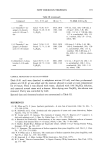
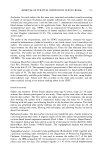
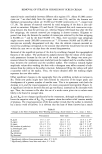
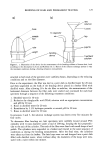
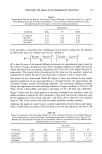
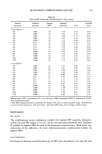
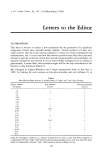
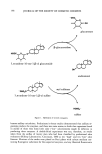
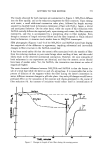
.]. Soc. Cosmet. Chem., 41, 147-154 (March/April 1990) Letters to the Editor TO THE EDITOR: This letter is written to outline a new mechanism for the generation of a significant component of body odor, steroidal axillary malodor. Various workers (1,2) have pro- vided evidence that the actual odorous substances in sweat are certain androstenols and androstenones, but it is not clear how skin bacteria produce them from their precursor steroids in apocrine secretions. Given that steroids, being generally water-insoluble, are typically transported and excreted in vivo as water-soluble conjugates such as sulfates or glucuronides, it seems likely that hydrolysis might well be the only contribution of the bacteria to odor formation (Figure 1). My colleagues at Coglate-Palmolive and I began experimental work on this idea in 1985, by looking for such enzymes as beta-glucuronidase and aryl sulfatase (3) in Table I Beta-Glucuronidase Activity in Axillary Sweat of "High" and "Low" Odor Formers Subject number Aryl sulfatase Beta-glucuronidase and group activity activity 2L + 3L - 4H - 5H + 6H - 7L - 8H + 9 H Lost 10 H + IlL - 12 H + 13 L - 14 H Lost 15 L - 16 H + 17 L + 18 H + 19 L - 20 L - Using the contingency coefficient as a measure of association (5), there is more than 99% probability of correspondence between "high" order formation and beta-glucuronidase activity, and more than 95 % prob- ability of correspondence between "high" order formation and aryl sulfatase activity. 147

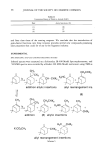
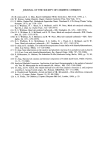
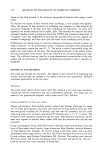
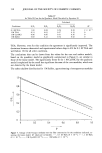
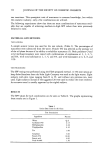
148 JOURNAL OF THE SOCIETY OF COSMETIC CHEMISTS glucuronate HOO0• 0 . 5,ot-androst- 16-ene-3, [3-ol glucuronide androstenol 5, ot-androst- 16-ene-3, [3-ol sulfate % HOSO=- Figure 1. Hydrolysis of steroid conjugates. sulfate human axillary microbiota. Preliminary in-house studies demonstrated that axillary or- ganisms produce the enzymes, and there was some reason to think that organisms found in axillae of those who form little odor ("low" odor-formers) might be deficient in producing these enzymes. A double-blind experiment was run, therefore, on swabs taken from the axillae of twenty men who had been classified by professional odor evaluators (Hilltop Laboratories, Cincinnati, OH) as ten "high" and ten "low" odor formers. Elutions of the swabs were plated on Petri plates with culture medium con- taining fiuorogenic substrates for the suspected enzymes, and any liberated fluorescence
Purchased for the exclusive use of nofirst nolast (unknown)
From: SCC Media Library & Resource Center (library.scconline.org)