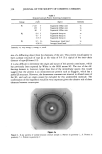
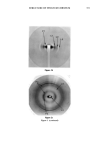
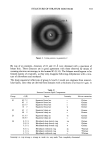
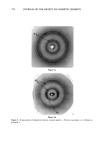
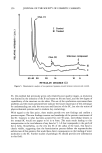
STRUCTURE OF STRATUM CORNEUM 357 The second finding concerns the existence within the SC of a protein, the structure of which would also be close to a [3 structure. This unidentified protein might correspond to what microscopists call "desmosome remnants," which play, in addition to lipids, a fundamental role in intercorneocyte cohesion. The isolation and biochemical character- ization of this protein would be an important step toward understanding the desquama- tion process in the SC. With regard to SC lipids, numerous diffraction patterns were obtained and their inter- pretation is still underway. It is alreadoY clear, however, that the two rings situated, respectively, in the zones (63 -+ 3) A and (45 -+ 3) •, according to the samples studied, correspond to wide and narrow lipid bilayers in the intercellular spaces and are therefore of great interest in understanding the barrier function of the SC and its modi- fications under the influence of physical (UV, heat) and chemical treatment. Finally, we have shown the interest of this technique in characterizing vesicular systems and their various interactions with the SC. The stratum corneum is the anatomic struc- ture in the skin to which cosmetic agents are applied and also where they are designed to act. Detailed information on this extremely thin layer and its complex organization is necessary for a clear understanding of the relationship beween its structure and func- tion. In the same way, it is only through a precise knowledge of present-day physico- chemical systems, which are becoming more and more complex, that their interaction with the SC and their influence on its properties can be predicted. In both cases, studies based on X-ray diffraction using the synchrotron will take an increasingly important place. REFERENCES (1) G. Swanbeck, Macromolecular organization of epidermal keratin, Acta Dermato. Venereol. 39 (Suppl. 43), 5-37 (1959). (2) H. P. Baden and L. Bonar, The (x-fibrous proteins of epidermis, J. Invest. Dermatol., 51, 478-483 (1968). (3) H. P. Baden and A.M. Gifford, Isometric contraction of epidermis and stratum corneum with heating, J. Invest. Dermatol., 54, 298-303 (1970). (4) G. L. Wilkes, A-L Nguyen, and R. Wildnauer, Thermal stability of the cristalline lipid structure as studied by X-ray diffraction and differential thermal analysis, Blochim. Biophys, Acta, 304, 267-275 (1973). (5) S. E. Friberg and D. W. Osborne, X-ray diffraction study of human stratum corneum,J. Soc. Cosmet. Chem., 36, 349-354 (1985). (6) S. H. White, D. Mirejovsky, and G.I. King, Structure of lamellar lipid domains and corneocyte envelopes of murine stratum corneum. An X-ray diffraction study, Biochemistry, 27, 3725-3732 (1988). (7) P.M. Elias, Epidermal lipids, barrier function, and desquamation, J, Invest. Dermatol., 80, 44-49 (1983). (8) D.C. Swartzendruber, P. W. Wertz, D. J. Kitko, C. Kathi, M.D. Madison, and D. T. Downing, Molecular models of the intercellular lipid lamellae in mammalian stratum comeurn, J. Invest. Der- matol., 92, 251-257 (1989). (9) R. O. Potts, "Physical Characterization of the Stratum Corneum: The Relationship of Mechanical and Barrier Properties to Lipid and Protein Structure," in Transdermal Drug Delivery, Vol. 35 (Marcel Dekker, 1989). (10) W. P. Smith, M. S. Christensen, S. Nacht, and E. H. Gance, Effect oflipids on the aggregation and permeability of human stratum corneum, J. Invest. Dermatol., 78, 7-11 (1982). (11) J. L. L•v&que, M. Escoubez, and L. Rasseneur, Water keratin interaction in human stratum corneum, Bioeng. Skin, 3, 227-242 (1987).

358 JOURNAL OF THE SOCIETY OF COSMETIC CHEMISTS (12) R. D. B. Fraser et al., Keratins (C. Thomas, 1972). (13) G. Plewig, E. Scheuber, B. Reuter, and W. Waidelid, "Thickness of Corneocytes," in Stratum Cor- neum (Springer Verlag, 1983), pp 171-174. (14) K. C. Madison, D.C. Swartzendruber, P. W. Wertz, and D. T. Downing, Presence of intact inter- cellular lipid lamellae in the upper layers of the stratum corneum, J. Invest. Dermatol., 88, 714-718 (1987). (15) G. Vanlerberghe, R. M. Handjani-Vila, and A. Ribier, Les "Niosomes" une nouvelles families de vdsicules it base d'amphiphiles non ioniques, Colloques nationaux du CNRS, No. 938, Physicochimie des composgs amphiphiles.
Purchased for the exclusive use of nofirst nolast (unknown)
From: SCC Media Library & Resource Center (library.scconline.org)